
The best writing prompts for kids offer a clear starting point without deciding the whole story. They match the child’s current ability, allow drawing or dictation when needed, and make room for surprising ideas. Use the 50 prompts below or create a fresh printable page with our Writing Prompt Generator for Kids. If forming letters is slowing down the ideas, pair the activity with the Custom Handwriting Worksheet Generator.
How to Choose a Writing Prompt
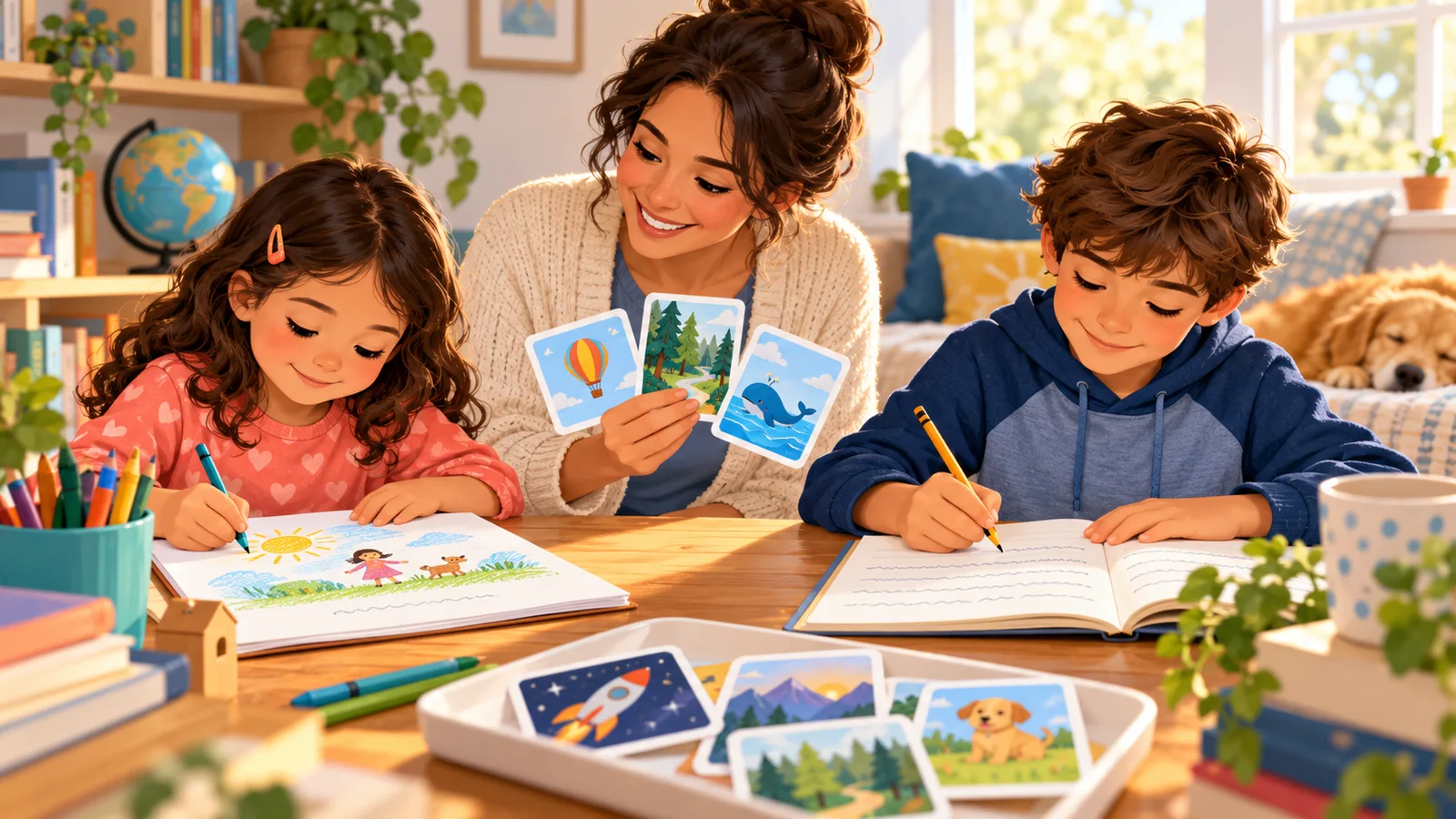
Choose by ability and confidence, not age alone. A beginning writer may draw and label a picture. Another child of the same age may be ready for three connected sentences. An older reluctant writer may need a simple, concrete prompt before attempting a longer story.
- Offer a choice: show two or three prompts instead of assigning one.
- Define a small finish line: one picture and one sentence can be a complete response.
- Support ideas first: talk, sketch, or act out the response before writing.
- Separate drafting from correcting: do not interrupt every sentence to fix spelling.
- Stop while energy remains: short, positive sessions encourage children to return.
Prompts for Ages 5–7: Draw, Label, and Write
Invite young writers to draw first, dictate a sentence to an adult, copy a shared sentence, or write independently. Any of these can be a valid response.
- Draw your favorite place and write one thing you do there.
- If your backpack could talk, what would it say?
- Invent a new ice-cream flavor and describe it.
- Write a note to a friendly animal.
- What would you build with a giant box?
- Draw a tiny house. Who lives inside?
- What is the best sound in your home?
- Imagine that your shoes can jump over anything. Where do you go?
- Write three things that make a rainy day fun.
- Draw a new playground and label its best feature.
- What would happen if your breakfast came alive?
- Write about a time you helped someone.
- Choose a color and list five things that match it.
- Invent a pet that fits in your pocket.
- Finish the sentence: “Behind the little door, I found…”
Prompts for Ages 8–10: Build a Paragraph or Short Story
- You discover a map inside an old library book. Where does it lead?
- Describe the perfect treehouse using all five senses.
- Write about a day when everyone had to communicate without speaking.
- Invent a machine that solves a small everyday problem.
- A mysterious package arrives with no name on it. What happens next?
- Write a letter convincing your family to try a new tradition.
- Imagine that gravity stops for ten minutes.
- Describe a character who is brave in an unexpected way.
- Turn a family recipe into an adventure story.
- What would your neighborhood look like one hundred years from now?
- Write instructions for caring for an imaginary creature.
- Two rivals must work together to solve a problem.
- Explain whether recess should be longer and give three reasons.
- A door appears in a place where no door existed yesterday.
- Write about a mistake that leads to a useful discovery.
- Describe a storm from the point of view of a bird.
- Invent a holiday and explain how people celebrate it.
- Write a news report about something unusual at your home.
- Your favorite toy has one day to explore the world.
- Choose an ordinary object and give it a secret power.
Prompts for Ages 10–12: Develop Voice and Structure
- Write the same event from two characters’ different points of view.
- Should students choose some of the subjects they study? Defend your position.
- Describe a city designed for children and explain how it works.
- Write a mystery in which the first clue is a misplaced key.
- A character receives a message from their future self.
- Explain a family rule you would keep, change, or create.
- Write a survival guide for a fictional place.
- Tell a story that begins with a celebration and ends with a surprise.
- Describe a familiar room as if you are seeing it for the first time.
- Invent an environmentally friendly product and pitch it to a customer.
- Write about a character who must choose between being popular and being fair.
- Turn a scientific fact you know into the beginning of a story.
- Write a scene in which nobody may use the word “no.”
- Compare two ways to spend a free afternoon and recommend one.
- End a story with this line: “That was when we finally understood the map.”
A Simple Plan–Write–Review Routine
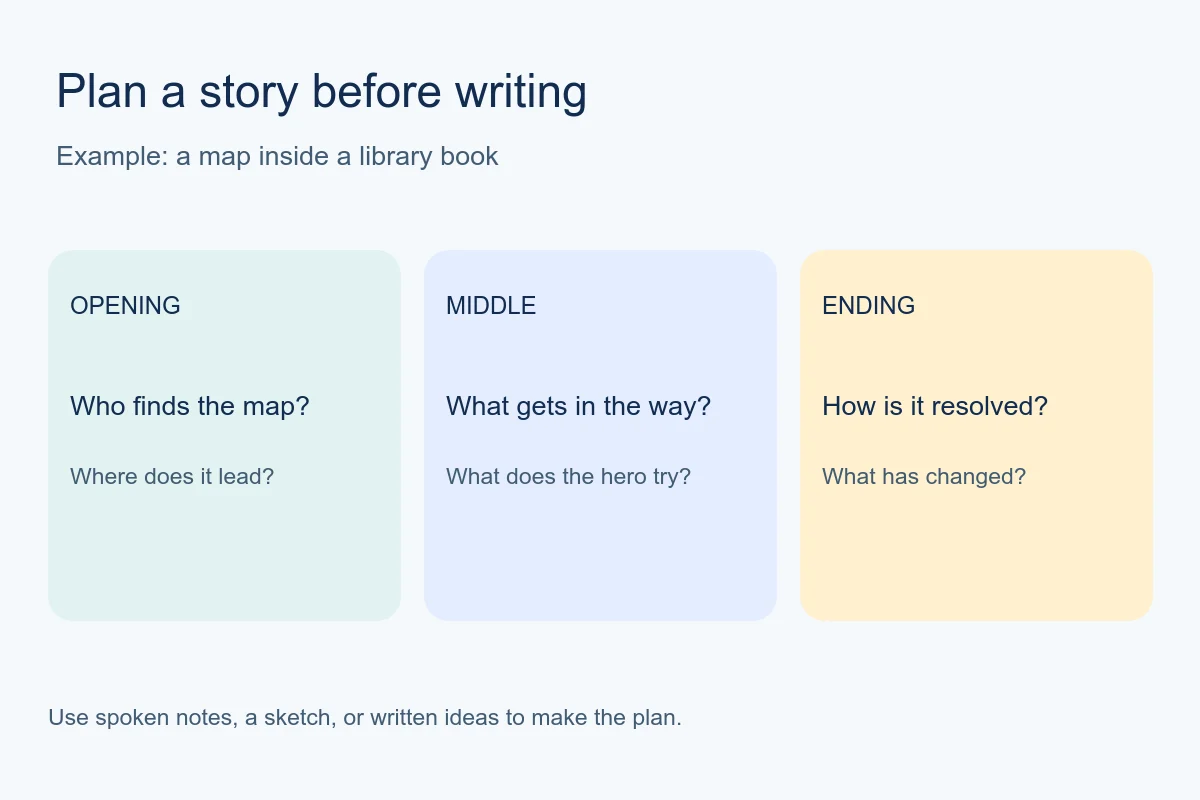
Plan for Three Minutes
Ask four questions: Who is involved? Where does it happen? What is the problem or main idea? How might it end? The child can answer with words, a sketch, or a quick oral explanation.
Write for Ten Minutes
Set a small target that fits the writer: one labeled picture, three sentences, one paragraph, or one complete scene. During drafting, help with a requested spelling word but avoid rewriting the child’s voice.
Review One Thing
Choose one revision goal: add a detail, make the order clearer, replace one vague word, or check sentence endings. Editing every possible error at once can hide the progress that matters.
Support for Reluctant Writers
- Adult scribe: let the child dictate while an adult writes, then ask the child to add one sentence.
- Draw plus caption: build the idea visually before expecting a paragraph.
- Sentence starters: offer a beginning such as “The strangest thing about…”
- Shared writing: alternate sentences with the child.
- Choice of format: try a comic, letter, list, interview, field note, or news report.
- Interest bridge: connect prompts to animals, sports, science, games, or a favorite book.
Reading strong examples can also unlock ideas. Browse the free educational book library or use a short passage from our reading comprehension resources as a model for description, dialogue, or sequence.
How to Respond to a Child’s Writing
Respond first as a reader. Mention something you understood, enjoyed, or wanted to know more about. Then ask one genuine question: “What did the character notice when the door opened?” Specific curiosity encourages revision more effectively than a page covered in corrections.
When editing is appropriate, select one or two conventions the child has already been taught. A beginning writer might check capital letters and periods. A more experienced writer might review paragraph breaks, dialogue punctuation, or repeated words.
Turn One Writing Prompt Into Three Different Tasks
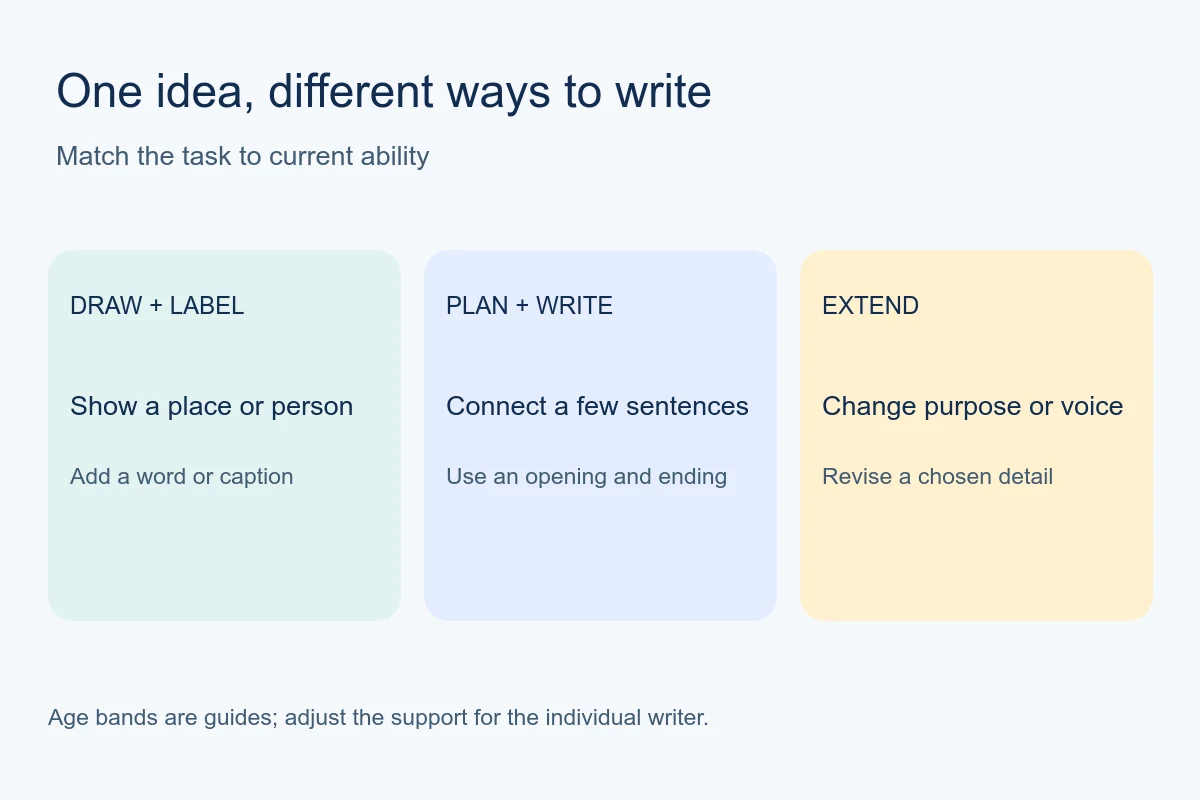
Consider the prompt about finding a map inside a library book. It can support several kinds of writing without requiring every child to produce the same result. Keeping the starting idea constant lets siblings work together while adjusting the amount and structure of the writing.
Beginning Writer: Draw and Caption
Ask the child to draw the map and circle the most interesting place. Invite one sentence explaining where it leads. If needed, use a starter such as “My map leads to…” and let the child complete it orally before writing. An adult can record a longer spoken story while the child writes the short caption. The finished work still belongs to the child.
Developing Writer: Plan a Short Adventure
Make four quick notes: character, destination, obstacle, and solution. Ask for an opening that introduces the map, a middle that presents the problem, and an ending that shows what the character does. Three connected paragraphs may be appropriate for one child; another may need just three linked sentences. Set the goal before writing so the child knows when the task is complete.
Experienced Writer: Change the Purpose
Instead of writing the adventure, create a letter warning the next reader about the map, an instruction manual for using it, or a news report about its discovery. Ask who will read the piece and what that reader needs to understand. The same imaginative idea now requires a different voice, organization, and choice of details.
Show Revision With a Small Worked Example
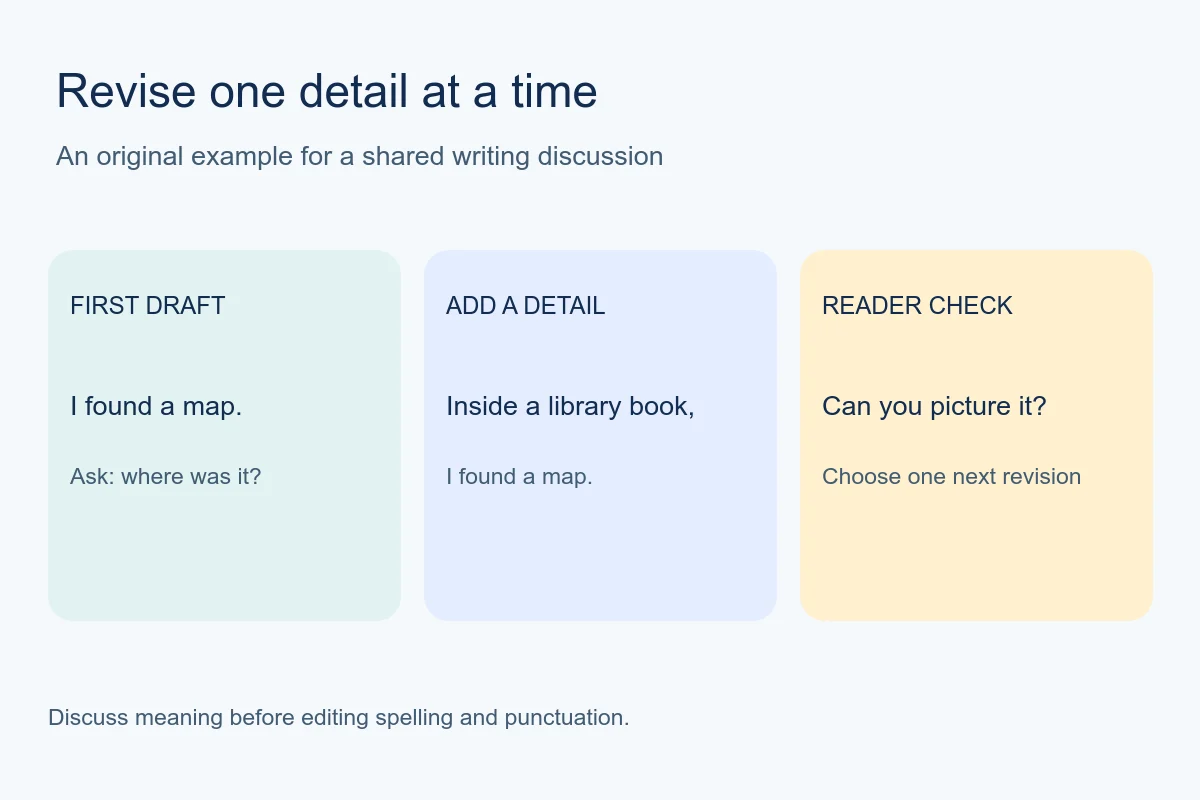
Begin with this short draft: “I found a map. We went to a tree. It was good.” Ask the child which part leaves the reader with a question. Choose one question to answer, such as why the tree mattered. A revised version might read: “Inside the library book, I found a map marked with a silver tree. We followed the path until a tiny door opened in its trunk.”
Discuss the change in meaning before checking punctuation. The revision gives the discovery a location and creates a reason to keep reading. It also replaces a vague opinion with something the reader can imagine. This is a demonstration written for this article, not a standard that every young writer must imitate.
For another session, focus only on the ending. Ask what the character wants and whether the final sentence answers that question. Changing one part of a draft can teach a useful revision move without demanding a complete rewrite. When the child is ready, invite them to read the draft aloud and notice a sentence that sounds unfinished.
Keep a Small Writing Portfolio
Save one dated piece each week. Include different formats, such as a caption, explanation, story, and opinion paragraph. Once a month, invite the child to choose a piece they are proud of and explain why. Look for a specific development: clearer sequence, more precise vocabulary, a complete sentence, or a useful revision. Comparing a child’s own work gives a more informative picture than comparing siblings.
If you want a regular routine, place a short writing block after shared reading or another familiar activity. Our visual homeschool schedule maker can help families make the sequence visible. Leave room for the child to continue a favorite project rather than always choosing another prompt.
The Institute of Education Sciences’ elementary writing practice guide emphasizes the writing process, opportunities to write, and instruction in the skills needed to put ideas on a page. The prompt adaptations above are original home activities that put those broad principles into a practical format. A child working on word reading may also use our first grade word-practice guide separately from composition.
Frequently Asked Questions
How often should children use writing prompts?
Two or three short sessions each week can build a steady habit. Children also need opportunities to continue their own projects instead of starting a new prompt every time.
Should parents correct spelling during creative writing?
During a first draft, protect the flow of ideas. Help when asked, record words for later study, and choose only a small editing focus after the draft is complete.
What if a child says, “I don’t know what to write”?
Offer two prompts, discuss each for one minute, and let the child draw the opening scene. A sentence starter or adult-scribed first sentence can reduce the blank-page barrier.
Can a child dictate instead of writing?
Yes. Dictation lets a child practice storytelling and sentence formation when handwriting is not yet fluent. Add a small independent-writing part so both composition and transcription develop.
What to Do Next
Let your child choose one prompt, set a ten-minute writing window, and respond first to the idea rather than the errors. For a different prompt or a printable Draw + Write, Plan + Write, or Full Writing Page format, open the free writing prompt generator.
Helpful reference: Institute of Education Sciences, Teaching Elementary School Students to Be Effective Writers.
2 Responses