
Blends and digraphs can look similar on a phonics page because both involve neighboring consonants. But they do different jobs. In stop, the letters s and t represent separate sounds. In ship, the letters s and h work together to represent one sound. That difference matters when a child reads, spells, or tries to work out why a word has more letters than sounds.
This parent-friendly guide explains the distinction, shows accurate sound-box examples, and gives original practice tasks with answers. It is a practical next step for a learner who can already read some simple words—not a reason to introduce every consonant pattern at once. Keep the examples aligned with your child’s teaching sequence.
Blends and Digraphs: What Is the Difference?
A consonant blend is a sequence of consonants in which the individual consonant sounds remain represented. Examples include sl in slip, st in stop, and mp in lamp. Reading smoothly does not mean inserting a pause between those sounds, but both still need to be included.
A consonant digraph uses two letters to represent one consonant sound, such as sh in shop, ch in chin, or ck in duck. The letters are two written symbols, but the sound unit they represent belongs together when mapping the word.
The University of Florida Literacy Institute glossary distinguishes consonant blends from digraphs and explains sound–spelling terminology. You do not need to quiz a child on those labels before helping them read; use the terms mainly to keep your own explanations consistent.
In everyday speech, “blending” also means joining sounds to read a word. That process is different from the label “consonant blend.” A child blends the sounds in ship even though its opening spelling is a digraph. Our guide to joining letter sounds explains that broader decoding process.
Choose Patterns That Fit the Learner’s Starting Point
Begin with the patterns already introduced in the child’s reading instruction. You might work on sh with known short vowels, or on one initial blend such as sl. Do not combine a new consonant pattern with unfamiliar vowel teams, a long word, and a new worksheet format in the same first task.
A small consonant-blend menu
- Initial sl: slip, slap, sled.
- Initial st: stop, stem, step.
- Initial fl: flag, flat, flip.
- Final mp: lamp, damp, jump.
- Final nd: hand, sand, pond.
These are examples to select from, not a required lesson order. Check every vowel and consonant spelling in the chosen word. A child may know sl in slip but still need help with the short-e spelling in sled.
A small consonant-digraph menu
- sh: ship, shop, shut, fish.
- ch: chin, chat, chop, much.
- th: thin, thick, moth, bath.
- ck: back, neck, sock, duck.
Explain a specific spelling in its current word rather than saying it always behaves the same way. For example, th has a different sound in this than in thin. The word thick also includes ck, so choose a simpler example if that second digraph has not been taught.
If the middle vowel is causing most errors, narrow the words and use our short vowel activities to work on that contrast. A correct consonant-group explanation will not automatically settle an unfamiliar vowel.
Use Sound Boxes Without Confusing Sounds and Letters
Draw one box for each spoken sound in the selected word, not automatically one box for each written letter. Say the word, help the child identify its sounds, and place the matching spelling in each box. Keep digraph letters together in the box representing their one sound.
For stop, use four boxes: s | t | o | p. For ship, use three: sh | i | p. Both words contain four letters, but their sound-box maps are different. Make that contrast visible rather than merely telling the child to remember a definition.
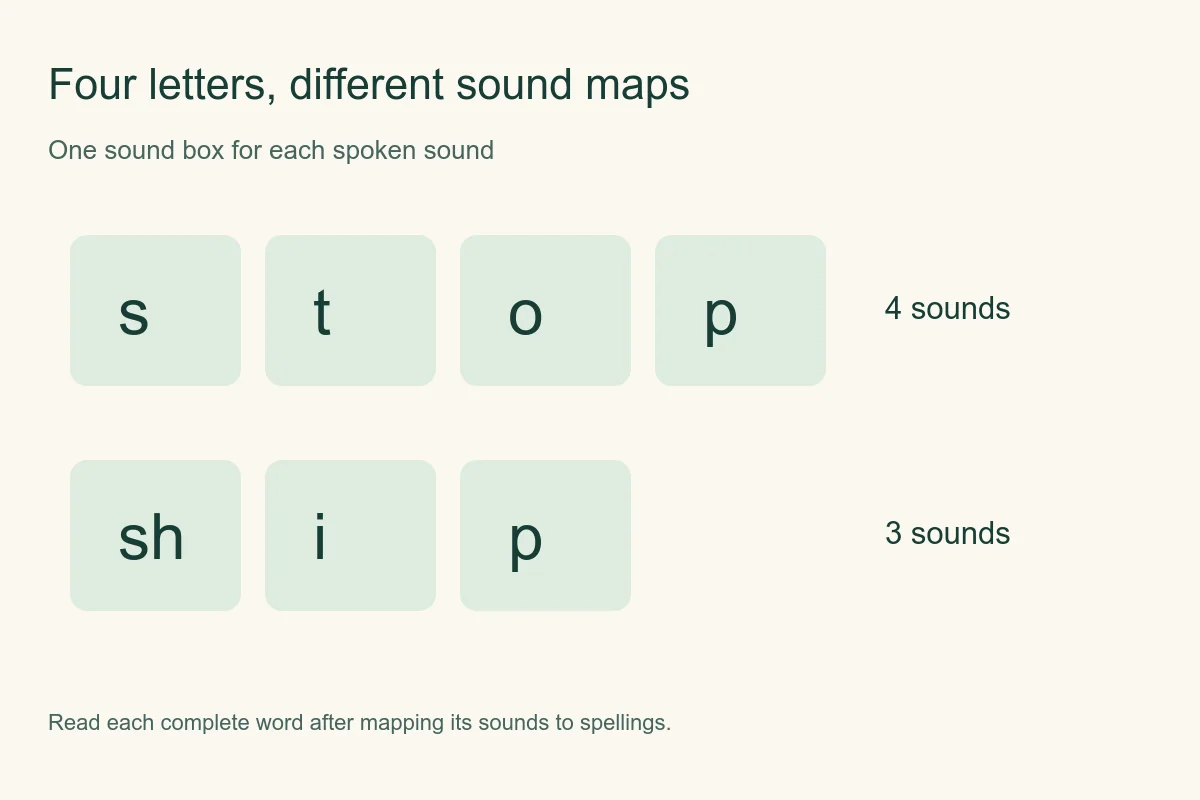
For lamp, the ending m and p go in separate sound boxes. For duck, the ending ck goes together. Read the whole word after building it so that mapping remains connected to reading and meaning.
If counting sounds orally is difficult, demonstrate the map and work together. Do not turn every word into an extended test of phonemic awareness before allowing the child to see the spelling. A clear model can show how the spoken word and printed pattern connect.
Use paper cards or a drawn grid around younger siblings who might mouth small pieces. Large enough writing and uncluttered spacing make the comparison easier to see. The color of a box may help highlight the target, but the child should not need color to identify the letters later.
Four Practical Activities for Consonant Patterns
1. Build, add, and reread
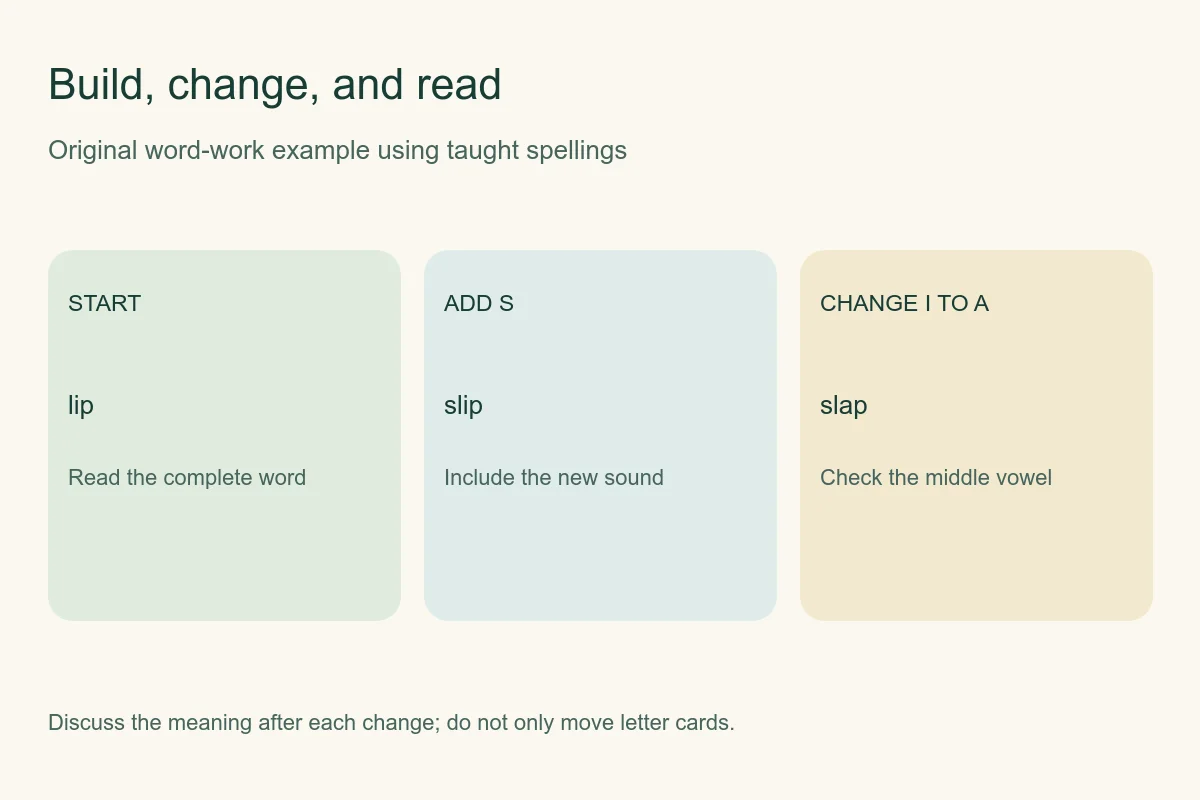
Start with lip, then add s to make slip. Point out that one written letter and one spoken sound have been added. Read both words and discuss their meanings. Next, change i to a to make slap, if that vowel is familiar.
The UFLI decoding and spelling activity collection offers more word-work formats. Our examples are original selections; follow the child’s actual sequence rather than assuming every pattern on a resource page belongs in today’s lesson.
2. Compare a blend and a digraph
Build stop and shop. Read each complete word, then compare their openings. In stop, both /s/ and /t/ are represented separately. In shop, sh represents one sound. Use the sound boxes to explain why changing one letter changes the sound map.
3. Catch the missing consonant
Write lamp and deliberately read “lap.” Ask the child to help you check the print. Point to the overlooked m, model the complete word, and read it again. Keep the tone playful and specific; the purpose is careful reading, not catching the child out.
4. Make a pattern sentence
Choose a word such as fish and help the child make a short spoken sentence. Write it, supply spellings not yet taught, and invite the child to read the target word within the message. Then draw or discuss the sentence so the activity has a purpose beyond locating two letters.
For additional meaningful writing, adapt one of our writing prompts by ability. A beginning writer can dictate while you write; a child does not need to spell every sentence independently to use a new reading pattern in context.
Original Blends and Digraphs Practice With Answers
Use only the questions that match taught patterns. Answer aloud, write in a notebook, or copy a few examples onto cards. This is an on-page practice set, not a formal assessment or a separate downloadable worksheet.
- Does the opening of stop represent a consonant blend or a consonant digraph?
- Does the opening of ship represent a consonant blend or a consonant digraph?
- Map the sounds in fish. How many sound boxes do you need?
- Map lamp. Do m and p share one sound box?
- Map duck. Do c and k share one sound box?
- What sound is lost if a child reads slip as sip?
- Build lip, add one letter to make slip, then change one letter to make slap.
- Find the digraphs in shop, chin, and back.
Answer key and useful feedback
- Consonant blend. The opening includes separate /s/ and /t/ sounds.
- Consonant digraph. The letters sh represent one sound in ship.
- Three boxes: f | i | sh. The final digraph belongs together.
- Four boxes: l | a | m | p. The final consonants remain separate sounds.
- Three boxes: d | u | ck. The final digraph spells one /k/ sound.
- The /l/ sound. Point to l, model the complete word, and reread.
- Add s, then replace i with a. Read each new whole word and check its meaning.
- sh, ch, and ck. The two letters in each example represent one consonant sound.
A correct label is not the same as accurate reading. After sorting a card under “digraph,” ask the child to read an accessible example. Likewise, a child may read a word correctly without knowing the technical label. Keep the practical reading and spelling goals visible.
Check Reading and Spelling Separately
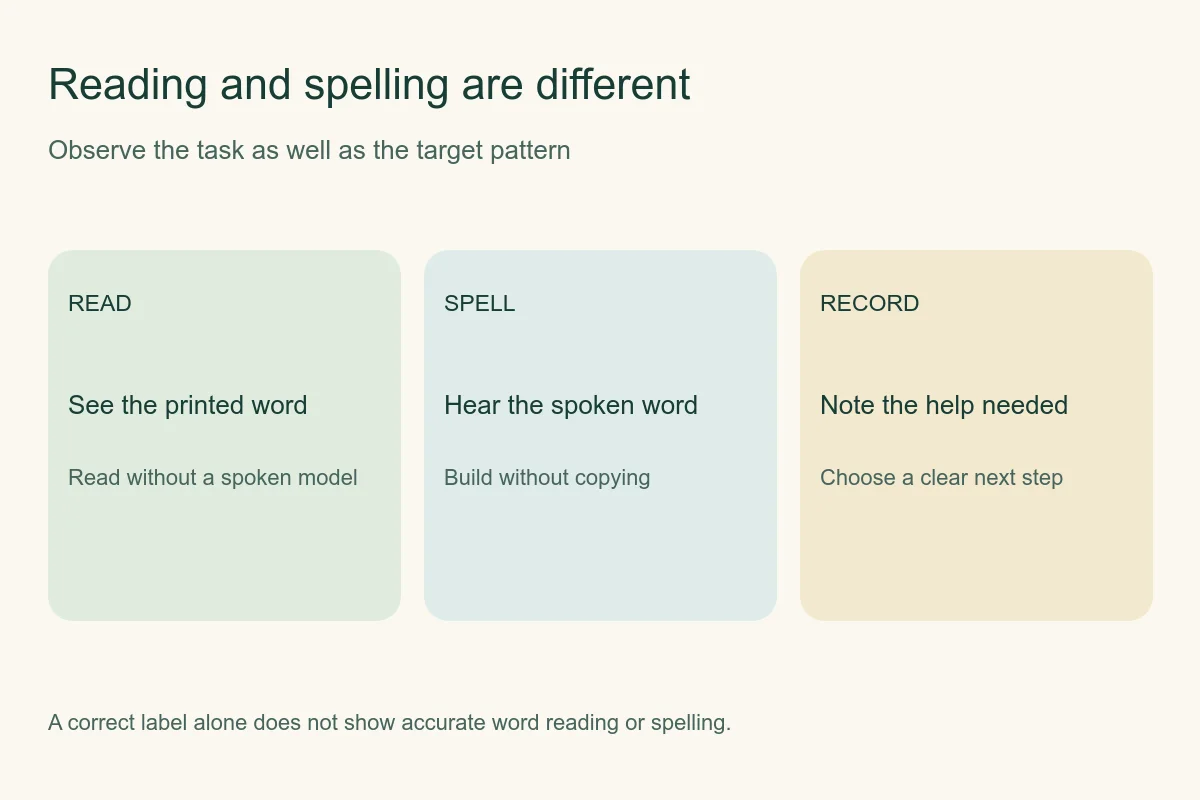
To observe reading, show a printed word and ask the child to read it. To observe spelling, say a familiar word and ask them to build or write its spelling without copying. These are different tasks, and success in one does not guarantee that the other is equally secure.
For example, a child might recognize ship accurately but write sip from dictation. Return to the spoken word and the sh mapping rather than making them copy the same word twenty times. Another child might spell lamp correctly but omit /m/ during a hurried reading attempt.
Keep a small record with the pattern, the task, and the support given. “Read shop independently; built ship after a shared model” is more informative than “knows sh.” Include a new accessible word later to see whether the learning transfers beyond a familiar card.
Use our phonics workbook selectively for additional practice. Then connect accurate word reading to the supported fluency activities rather than staying with isolated word cards indefinitely.
A Review Plan and Common Problems to Notice
Choose one pattern, review a few familiar examples, model one useful comparison, and finish with a meaningful phrase or sentence. Revisit the pattern in a different order on another day. Add a new consonant group when the current examples can be handled with an appropriate amount of support.
If a child drops the second sound in an initial blend, point through both letters and model the whole opening without adding extra vowel sounds. If they split a digraph into separate letter sounds, show the letters together in one sound box and provide the correct model.
If final consonants disappear, shorten the word set and draw attention to the end of each word. A line tracker or finger under the print may help the child keep their place, but it does not replace teaching the spelling–sound connection.
Keep pronunciation and accent in mind. Choose clear examples and do not use this activity to correct a child’s speech. If reading or spelling difficulties persist despite consistent instruction, discuss the specific observations with the child’s teacher or a qualified reading specialist. This practice set is not a diagnostic test.
Frequently Asked Questions
Is blending the same thing as a consonant blend?
No. Blending is the process of joining sounds to read a word. A consonant blend is a particular sequence of consonants whose individual sounds remain represented. Children also blend words containing digraphs.
How many sound boxes does ship need?
Ship needs three sound boxes: sh, i, and p. Its four written letters represent three sounds, and the digraph sh belongs together in the box for its sound.
Should we teach every blend as a separate item to memorize?
Children need practice reading the component sounds in connected words, not only memorizing a long list of two-letter labels. Follow a clear sequence, use manageable examples, and revisit patterns in reading and spelling.
What if my child reads a pattern correctly but cannot spell it?
Practice spelling as a separate task. Say a familiar word, map its sounds, and build the matching spellings with support. Record what the child can do without copying instead of assuming that accurate reading guarantees independent spelling.
Keep the distinction useful: Separate sounds stay represented in a blend; two letters share one sound in a consonant digraph. Show the difference in a few familiar words, map them accurately, and return to meaningful reading. Clear examples are more helpful than a large list learned without context.
One Response