
A homeschool schedule for multiple ages has to solve a problem that a beautiful timetable cannot: only one adult may be available when two children need teaching and a toddler needs care. Planning separate full school days for everyone can leave the parent switching constantly while the children wait. A workable alternative is to organize the day around shared anchors, short teaching turns, and genuinely familiar independent tasks.
This guide includes a sample morning, practical rotation ideas, a toddler-aware plan, a weekly planning method, and a lighter-day fallback. The examples are for families with preschool and elementary-age children. They are planning options, not a complete curriculum, a claim that every child needs the same hours, or advice about local homeschool requirements.

Build Your Homeschool Schedule for Multiple Ages Around Anchors
Begin with the parts of family life that already have a place: breakfast, a caregiver’s work shift, an appointment, lunch, or a regular outing. These are anchors. Place learning blocks around them before adding precise clock times. If breakfast runs late, “reading after breakfast” can still happen even when “reading at 8:45” no longer fits.
Next, identify the lessons that genuinely need you. New decoding instruction, explaining a new math idea, and discussing a piece of writing usually need adult attention. Copying a familiar word, rereading a known passage, or finishing an already understood drawing task may need less. Make this distinction for the individual child, not by assuming that a certain age guarantees independence.
Write a short list for each learner: one adult-supported priority, one familiar task, and one shared experience. This is a planning starting point, not the total education they should receive. Compare it with your curriculum, commitments, and any relevant requirements before deciding how much belongs in the complete day.
A visual sequence can help children see the broad order. Our visual homeschool schedule maker can help you create a daily plan. Keep its labels brief and show only the parts your child needs to follow; a detailed parent checklist does not need to become a crowded child-facing chart.
For background on visual cues, the National Center for Pyramid Model Innovations visual schedules handout (PDF) explains how pictures can show an activity sequence and what happens next. The sample schedule below is an original family-planning example, not a timetable tested by the center or a promise of behavior changes.
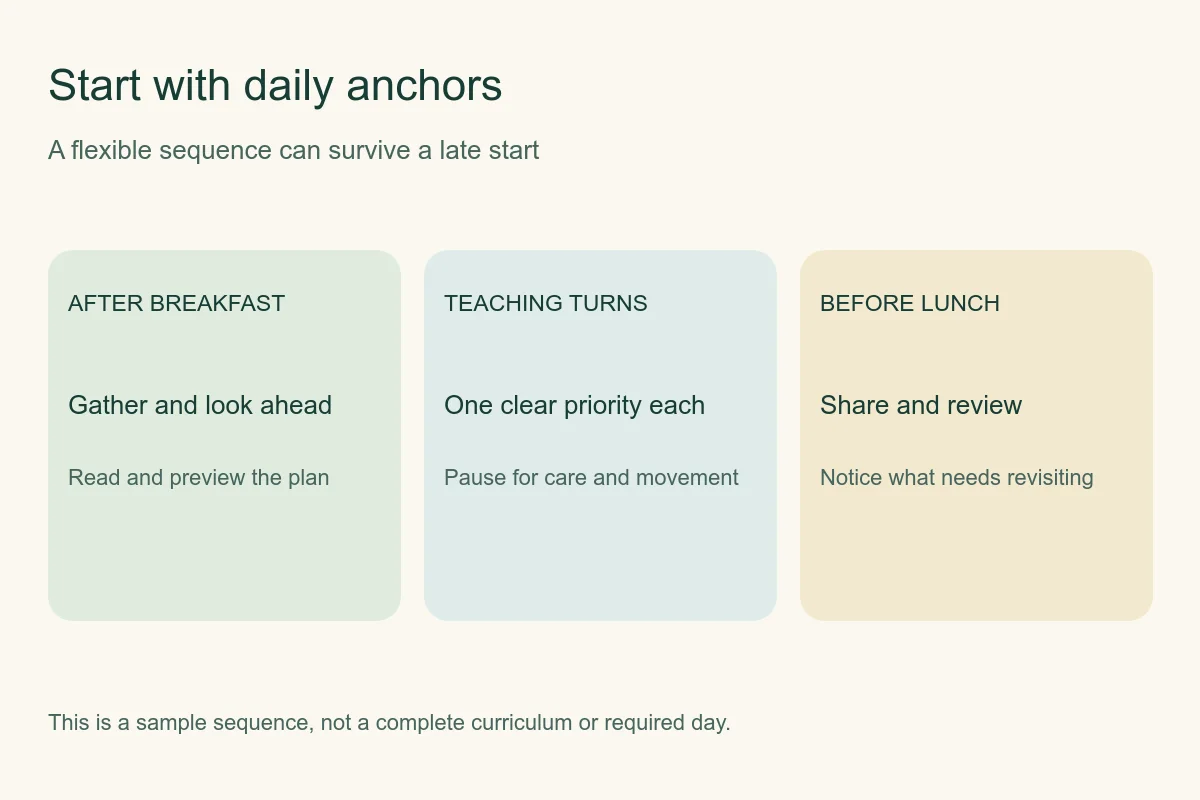
A Sample Morning for Two Learners and a Younger Sibling
Imagine an early reader, an older elementary learner, and a toddler, with one adult available. The blocks below illustrate a sequence, not a requirement to finish formal learning before lunch. Add further lessons, outdoor time, appointments, and other needs according to the family and curriculum.
- After breakfast: gather and look ahead. Read aloud briefly, review today’s plan, and identify any appointment or change.
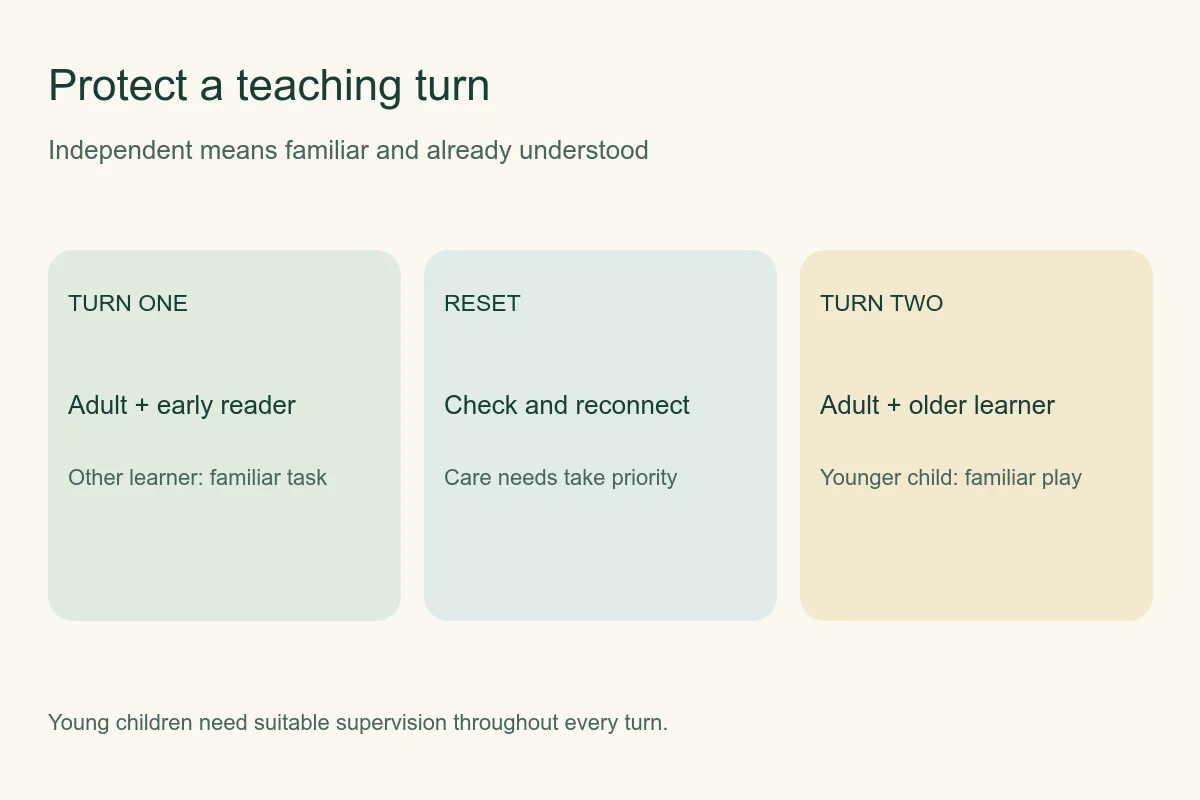
- First teaching turn: early reading. The adult teaches the younger learner while the older child completes a familiar task. The toddler remains in a safe, supervised nearby space.
- Short reset: move and reconnect. Put materials away, stretch, check the toddler, and explain the next turn.
- Second teaching turn: older learner’s math. The adult introduces or reviews a specific skill while the younger learner draws, rereads, or plays with familiar materials nearby.
- Shared break: snack and movement. Care and conversation come before trying to squeeze in more work.
- Shared learning block: science, art, or a read-aloud discussion. Everyone joins the same topic but responds at a suitable level.
- Before lunch: check and close. Look at completed work, note what needs another teaching turn, and preview the next part of the day.
If an older child needs a longer explanation, give it space rather than forcing the lesson into an arbitrary ten-minute slot. Conversely, an early reader may do better with a short focused turn and another brief revisit later. The purpose of the rotation is protected attention, not identical lesson lengths.
For the reading turn, choose a clear goal such as joining the sounds in three familiar words. Our CVC blending guide provides a practical example. “Do reading” is less helpful on a busy morning than knowing which process you will model.
Make Teaching Turns Work Without Leaving Children Stuck
Choose independent work that is already understood
A task is not independent just because it is printed on a worksheet. Before relying on it, ask the child to explain the directions and complete one example while you watch. If they need you to read every question or teach a new concept, move the task to an adult-supported block.
Useful options might include illustrating a familiar story, completing a few previously taught calculations, organizing a collection, or rereading an accessible book. Match the task to what the child can manage today. Leave a clear stopping point so they do not have to interrupt to ask whether they are finished.
Teach a simple “when I need help” routine
Show the child how to mark a difficult item, move to an agreed familiar activity, and bring the question to the next check-in. This is not a rule against asking for help. Safety, distress, and urgent care needs always take priority over a teaching turn.
Use a visible cue such as a small card beside you to show whose teaching turn it is. Explain the cue while everyone is calm, then practice with a very short turn. A new waiting routine needs teaching just like an academic skill; it is unlikely to work perfectly because a parent announced it once.
Check the work before switching too far ahead
A quick review prevents an entire page of misunderstood practice. Ask what went smoothly and look at one example together. For an older learner practicing multiplication, the equal-groups and fact-strategy guide can help you decide whether the next turn needs a model, a strategy explanation, or recall practice.
If a child finishes early, offer one or two predictable choices rather than a new assignment with unfamiliar directions. You might say, “After these four questions, draw your array or read from your book basket.” The plan should reduce waiting without filling every spare moment with more schoolwork.
Plan for Toddlers and Preschoolers as People, Not Interruptions
Young children need attention, movement, care, and supervision. A basket of activities may help you organize a brief teaching turn, but it cannot guarantee quiet or replace an available adult. Keep the younger child within appropriate supervision and be ready to pause the academic task.
Choose a few familiar, age-appropriate options: sturdy picture books, large blocks, a large-piece puzzle, or drawing with suitable materials. Check the manufacturer’s age guidance and remove small parts that could be swallowed. Do not transfer responsibility for a toddler to an older sibling so that the schedule can continue unchanged.
Rotate a small number of materials rather than introducing five new activities every morning. A preschooler might sort large objects by color or retell a story with toys while you remain nearby. Our preschool activity guide offers ideas to adapt, and the activity finder can help you choose a manageable option for the time available.
Nap time can provide one useful window, but avoid making every important lesson depend on a nap that may change. If the older learner is exhausted by afternoon, try moving one short priority to the morning and use the nap window for something less demanding. Observe the result rather than assuming that one routine suits every child.
Plan a reconnecting moment after the teaching turn: a short book, a song, or helping with a simple household routine. The younger child’s place in the day should be visible, not limited to being told to wait. If another adult can reliably cover a block, reserve that time for a lesson that needs uninterrupted attention.
Combine Topics, Then Differentiate the Response
Some subjects lend themselves to shared experiences: listening to a story, observing a plant, looking at a map, or exploring an art material. You can introduce one topic and vary the response. Combining does not mean giving every child the same worksheet or expecting an older learner’s entire curriculum to fit a younger sibling’s level.
Example: one leaf observation, three responses
Collect a few safe fallen leaves during a walk, then look at them together. A preschooler can describe colors and sort large leaves with adult support. An early writer can draw one leaf and label a feature. An older learner can compare two leaves, record observations, and explain how they are alike or different.
Everyone shares the conversation, but the written demand changes. If the older learner needs additional subject-specific reading or a more advanced explanation, plan that separately. Shared family learning is an organizing tool, not a reason to hold one child back or rush another forward.
Example: a read-aloud followed by different writing tasks
After a chapter or picture book, ask everyone what changed for the main character. One child draws a scene and dictates a sentence. Another writes a short summary. A more experienced writer argues which decision mattered most and supports the opinion with details. Our writing prompts by ability can supply other starting points.
Keep foundational teaching separate where the learning paths differ. Two children can share a story while still needing different decoding instruction and math lessons. This balance often makes the plan more realistic than choosing between “everything together” and “everything separate.”
Build a Weekly Rhythm With Room for Real Life
Once a week, look at appointments and commitments before assigning lessons. Mark fixed events, then protect the individual teaching priorities. Place shared projects and outings where they actually fit. Avoid putting a delicate paint project immediately before the family must leave for an appointment.
A simple three-column plan can be enough: adult teaching, familiar practice, and shared learning. Write each child’s name or initials in the parent copy if useful, but do not publish identifying family details in a public schedule. Add a small space for materials so that you can gather them before the block starts.
Use a rotating list for subjects that do not need an identical slot every day. For example, the next shared block might be art, followed by nature study, then a map activity. If Tuesday changes, continue with the next item rather than treating the entire week as lost. Keep required or curriculum-specific frequencies in your separate planning record.
The Harvard Center on the Developing Child activity guide describes age-adapted opportunities to practice executive-function skills through interaction and play. It is a useful reminder to match expectations and support to the child, rather than expecting a planning chart to create instant independence.
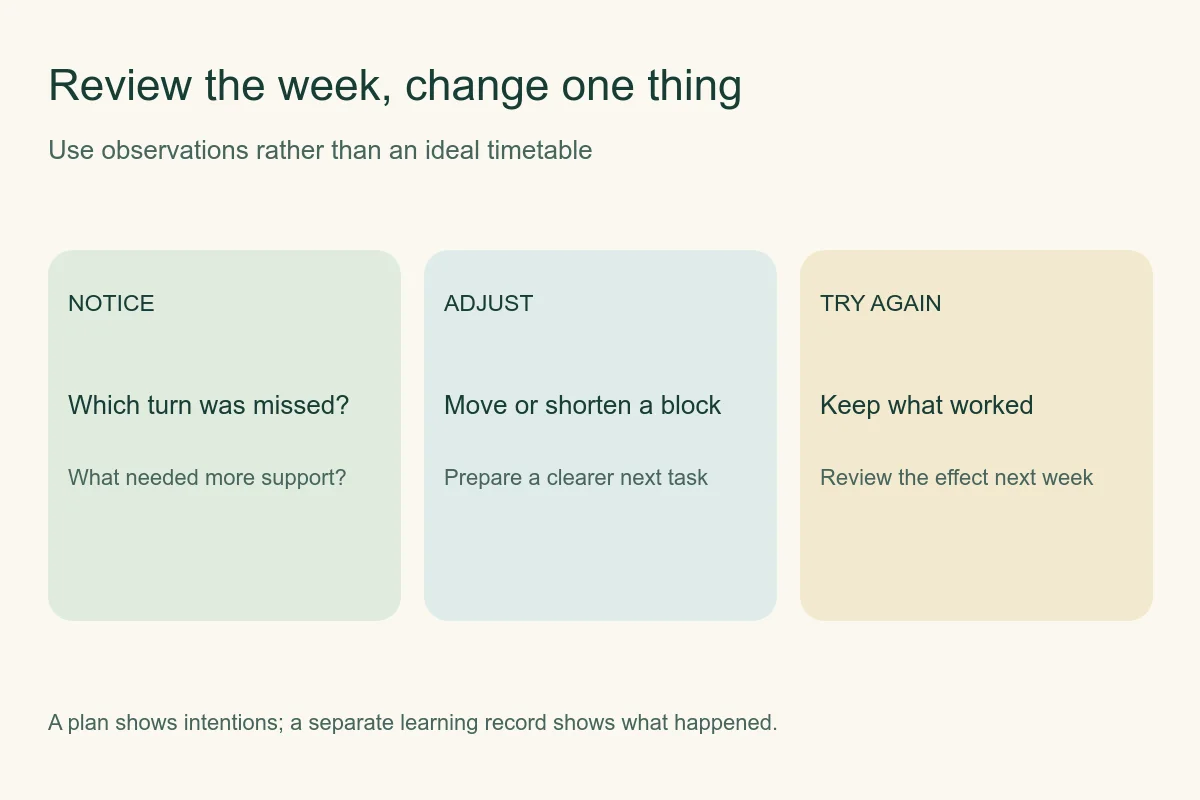
End the week with three questions: Which teaching turn was repeatedly missed? Which task needed more help than expected? Where was there unnecessary waiting? Change one feature for the next week. Moving the reading turn earlier is easier to evaluate than replacing the curriculum, schedule, and activity system all at once.
What to Change When the Day Stops Working
If children keep interrupting one another
Check whether the independent task is truly familiar and whether the teaching turn is too long for the situation. Prepare materials first, offer a clear finish point, and shorten the first rotation. More reminders will not fix directions the child cannot yet follow.
If the plan feels crowded
Remove unnecessary switches. Two related tasks in one block may be easier to manage than repeated transitions between rooms and materials. Leave space for cleanup and care instead of treating them as delays outside the “real” day. Use the visual plan to show what happens next, not to display every unfinished item.
If the whole morning falls apart
Use a preplanned lighter-day list: one essential teaching priority, a manageable shared reading experience, and a note about what needs rescheduling. This is a temporary response to a difficult day, not a complete long-term program. Resume or revise the wider plan when the immediate situation allows.
Keep a brief factual learning record, separate from your ideal timetable. A schedule shows what you intended; a record shows what happened. If you regularly cannot meet a child’s learning needs within the available time, ask for practical support and review the commitments rather than interpreting the problem as a personal failure.
Frequently Asked Questions
Should all my children study the same subject at the same time?
Not necessarily. Shared topics can work well for read-alouds, art, and some science experiences, while reading and math instruction may need individual turns. Base the decision on the learning goal and the support each child needs.
How long should a multi-age homeschool day last?
There is no single duration that fits every family. Age, curriculum, individual support needs, local requirements, and the meaning of “school time” all matter. Plan the necessary teaching and learning rather than copying another family’s total hours.
What can a younger child do during an older child’s lesson?
Offer familiar, age-appropriate activities nearby with suitable supervision. Examples include large blocks, sturdy books, or a simple puzzle. Keep teaching turns realistic and pause when the younger child needs care; an activity basket is not a substitute for supervision.
What if we cannot follow exact clock times?
Use an ordered sequence anchored to events such as breakfast, lunch, or an appointment. Add exact times only where they help. Review what was actually completed and adjust the plan instead of treating every late start as a failed day.
Try one change tomorrow: Protect a single teaching turn, prepare one genuinely familiar task for the other learner, and show everyone the next shared anchor. A useful schedule gives the family a clear next step while leaving room for care, conversation, and real learning.
One Response