
Teaching multiplication can feel surprisingly difficult when a child understands equal groups but cannot recall the facts. One day, 6 × 4 seems secure. The next day, the same question brings a long pause, finger counting, or tears. The useful response is not to choose between understanding and memory. Help your child connect a clear model, an efficient strategy, and a small amount of repeated practice.
This guide separates those goals and gives you worked examples, a flexible ten-minute routine, original practice questions with answers, and ways to notice progress without making every lesson a speed test. It is designed for children beginning multiplication and older learners revisiting the foundations; adjust the materials and tone to the individual child.
Start With the Multiplication Skill Your Child Actually Needs
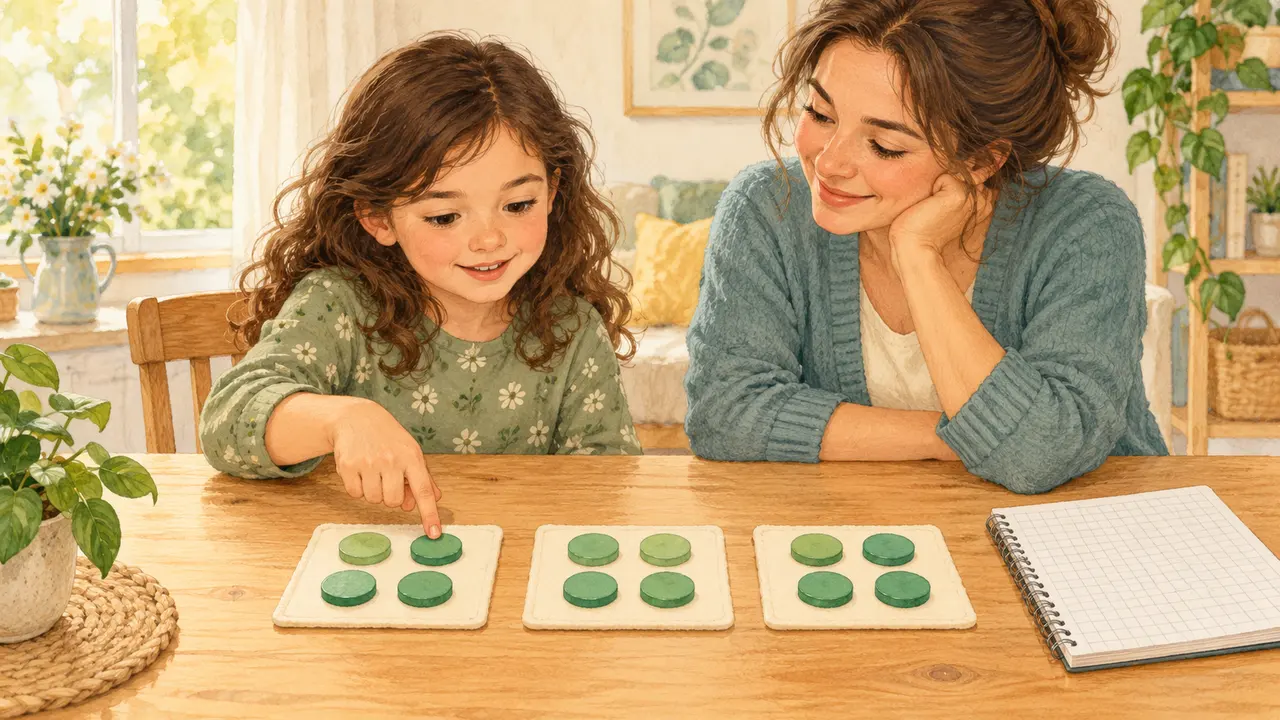
Before choosing another worksheet, ask your child to show three groups of four using large counters or a drawing. Can they explain what each number represents? Can they find the total? Then ask a familiar multiplication question without the objects. These tasks tell you different things: understanding the situation, choosing a strategy, and recalling a fact are related but distinct.
A learner who builds equal groups accurately but counts every object has a starting concept. A learner who answers quickly but cannot match an equation to a situation may need more explanation and modeling. Neither observation is a reason to label the child lazy or incapable.
Write down the specific obstacle. For example: “Builds 4 × 3 correctly; counts all twelve; does not yet use 2 × 3 to help.” That description points toward doubling a known fact. “Cannot do multiplication” does not suggest such a clear next lesson.
If equal groups and repeated addition are still confusing, revisit our addition and subtraction practice guide alongside the concrete group work. You do not need to withdraw every multiplication task while strengthening addition; just choose totals and representations the child can manage.
The What Works Clearinghouse elementary mathematics intervention guide recommends systematic instruction, clear mathematical language, representations, number lines, and word-problem teaching. The home examples here apply those broad ideas; the suggested session lengths and games are editorial practice formats, not guaranteed interventions.
Teach Multiplication With Equal Groups and Arrays
Connect the story, the model, and the equation
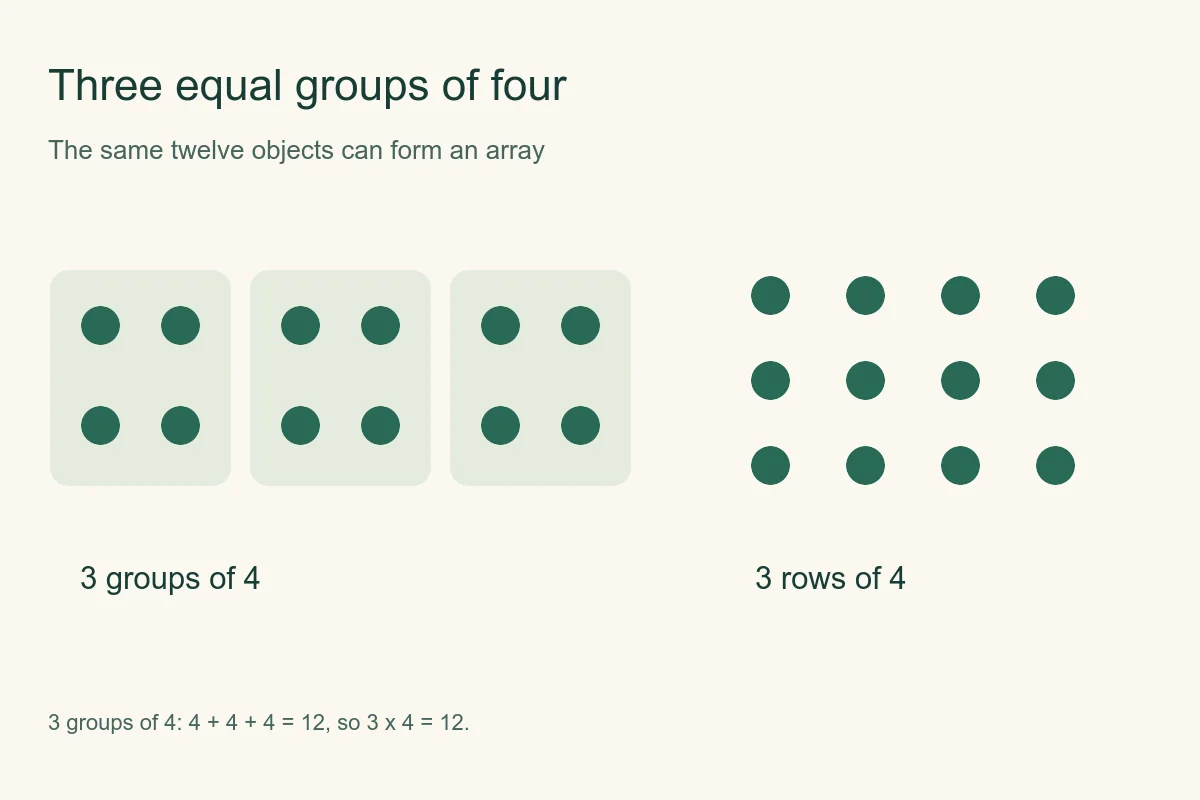
Say, “There are three trays. Each tray holds four cups. How many cups are there altogether?” Draw three trays with four circles in each. Point to the three groups, then the four items in one group, and finally the total. Record 4 + 4 + 4 = 12 and 3 × 4 = 12 beside the picture.
In this guide, the first factor names the number of groups and the second names the number in each group. Teaching conventions can differ, so explain the convention used in your child’s materials. What matters is that the equation and explanation describe the same situation.
Now change the story: four trays with three cups on each. The total remains twelve, but the groups have changed. This distinction helps a child see why 3 × 4 and 4 × 3 have the same product without pretending that every story detail is identical.
Arrange the same objects into rows
Make an array with three rows of four dots. Count across a row, count the rows, and discuss the total. Rotate the paper to see four rows of three. Then draw a line between one row and the other two to show that twelve can also be viewed as four plus eight.
Large counters are useful when children can handle them safely; use drawings or large blocks when younger siblings are nearby. Keep a physical model available while your child works toward mental strategies. Removing every support too early can hide the reasoning you want them to explain.
You can also mark equal jumps on a number line: starting at zero, three jumps of four land on twelve. Ask what one jump represents. This keeps the picture connected to the story instead of becoming another procedure to imitate.
Build New Multiplication Facts From Known Ones
Practice facts in connected sets rather than introducing every times table at once. The following sequence is one workable option, not a compulsory order. Keep using a strategy until your child can explain it and apply it to a new example.
Use twos, fives, and tens as anchors
For twos, connect multiplication with doubles: 2 × 7 is seven plus seven. For fives, count equal groups and notice the alternating final digits of products. For tens, build ten groups or use place-value materials before relying on a written shortcut. Saying “add a zero” alone does not explain why the value changes.
Double a known fact for fours and eights
If 2 × 6 = 12 is familiar, double twelve to find 4 × 6 = 24. Double again to find 8 × 6 = 48. Draw the arrays in two matching sections so the child can see why the doubling works. If doubling the larger total is difficult, use a different known fact rather than forcing this strategy.
Split a harder fact into manageable parts
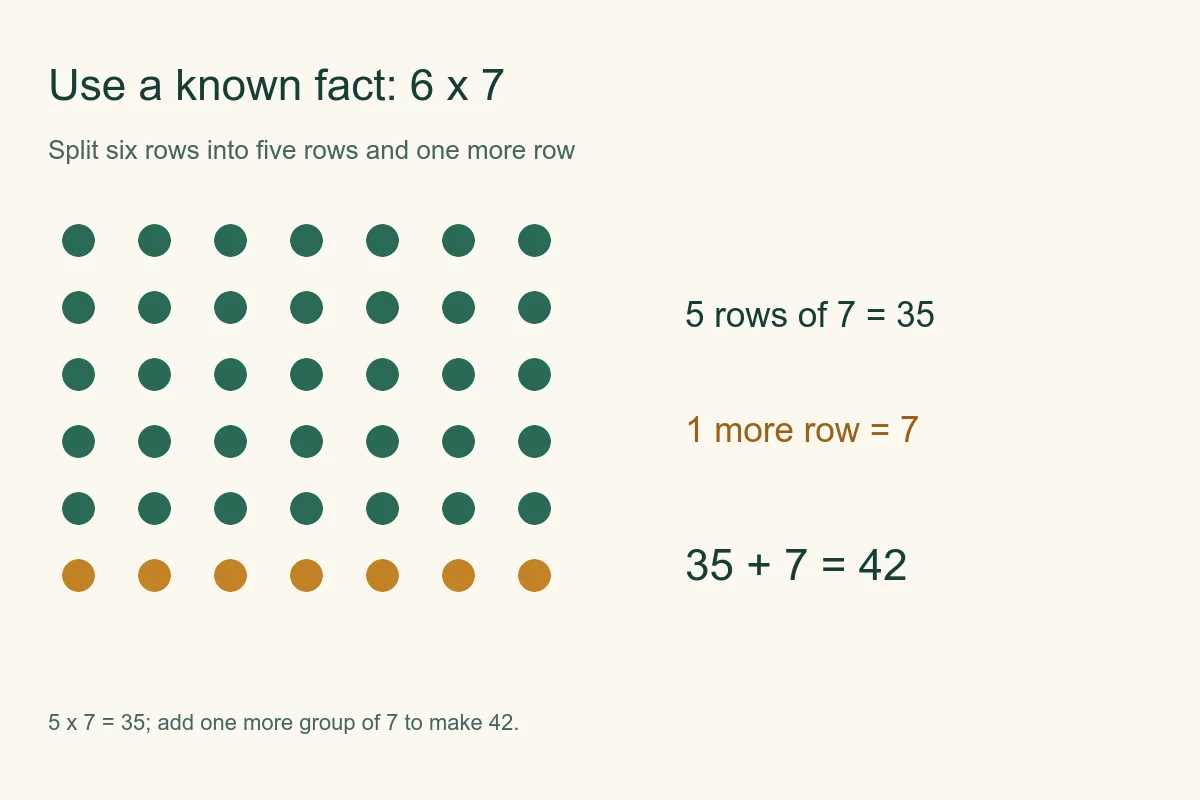
To find 6 × 7, think of six groups of seven as five groups of seven plus one more group: 35 + 7 = 42. For 9 × 6, begin with ten groups of six and remove one group: 60 − 6 = 54. Ask the child to identify the group added or removed, not just recite the answer.
Another useful connection is the turn-around fact. Once 3 × 8 = 24 is known, 8 × 3 has the same product. This reduces the number of unrelated items a child feels they must learn, while arrays keep the relationship visible. Continue including word problems so that the symbols retain meaning.
For broader practice choices, our math worksheets and resource guide can help you select an appropriate task. Choose a small set focused on the current strategy rather than printing the largest available page.
A Ten-Minute Multiplication Practice Routine
Shorten or extend this example according to the child’s attention, comfort, and teaching plan. Ten minutes is an organizational suggestion, not a rule. Aim for a little meaningful work that you can revisit, not an exhausting attempt to settle every fact in one sitting.
- Two minutes: retrieve something familiar. Ask a few known facts in a mixed order. Let the child explain one answer.
- Three minutes: model one connection. Build or draw a new fact using an anchor fact, such as 5 × 7 helping with 6 × 7.
- Three minutes: try a small set. Mix the new example with familiar facts. Offer a model when needed, then invite another attempt.
- Two minutes: apply and record. Solve one short story problem and note the strategy or support used.
Revisit the new fact on another day and in a different order. If your child only answers correctly while moving down a familiar list, they may be using the sequence rather than retrieving an individual fact. Mix enough to check that distinction without making the session unpredictable or overwhelming.
A multiplication chart can remain available during a more complex task while separate brief sessions focus on recall. Be clear about the goal: using a chart in a word problem is different from checking which facts are recalled independently. Neither task needs to be disguised as the other.
When several children need you, schedule the new explanation during an adult-supported turn. Our multi-age homeschool schedule guide shows how to separate teaching time from familiar independent practice.
Original Multiplication Practice With Answers and Explanations
Use these questions orally, on scrap paper, or copied into a notebook. This is an on-page practice set, not a separate downloadable worksheet. Begin with only the questions that fit the child’s current learning. Ask for one explanation rather than a written paragraph after every calculation.
- Draw three groups with four dots in each. Write the multiplication equation.
- Complete: 2 × 8 = __. Explain how doubles can help.
- Use 5 × 6 = 30 to find 6 × 6.
- Use 10 × 7 = 70 to find 9 × 7.
- Find 4 × 9 by doubling 2 × 9.
- Complete: 7 × 3 = 21, so 3 × 7 = __.
- A box holds five crayons. There are four full boxes. How many crayons are there?
- There are 24 apples shared equally among four baskets. How many apples go in each basket?
- Find the missing factor: __ × 6 = 30.
- A child says 3 × 5 = 8. What might they have done, and how could a drawing help?
Answer key
- 3 × 4 = 12. The drawing should contain three equal groups, with four dots in each group.
- 16. Eight plus eight makes sixteen.
- 36. Add one more group of six to thirty.
- 63. Remove one group of seven from seventy.
- 36. Two groups of nine make eighteen; double eighteen.
- 21. Reversing the factors preserves the product.
- 20 crayons. Four equal groups of five make twenty.
- 6 apples. Four groups of six make twenty-four. This connects multiplication and division.
- 5. Five groups of six make thirty.
- They may have added the factors. Three groups of five show fifteen objects, not eight.
When an answer is wrong, rebuild the situation and identify the step that changed. A child who draws the right groups but miscounts needs different feedback from one who draws unequal groups. Use the model as information, not as evidence that the child “should know this by now.”
Three Low-Pressure Multiplication Games
Array detective
Draw two arrays and ask your child to match each one to an equation. Include one deliberate mismatch, such as a two-by-six array beside 2 × 5. Let the child explain the problem and fix the label. Taking the role of checker creates a reason to look carefully at both factors.
Build a fact pair
Make small paper cards containing an anchor fact and a related harder fact. Pair 5 × 8 with 6 × 8, for example. After making a pair, your child explains the connection. Award no speed points; the purpose is noticing how one known answer can support another.
Design a tiny shop
Choose a few pretend items sold in equal packs, such as four pencils per pack. Ask how many pencils are in three packs, then change the number of packs. Let your child become the shopkeeper and write a question for you. Keep the quantities within their learning range.
If you want another playful session, explore our educational games collection. Check what a particular game actually practices; not every number game teaches multiplication. For a younger sibling, choose a separate task with the screen-free activity finder rather than expecting them to follow the same facts.
Check Progress Without Making Speed the Whole Goal
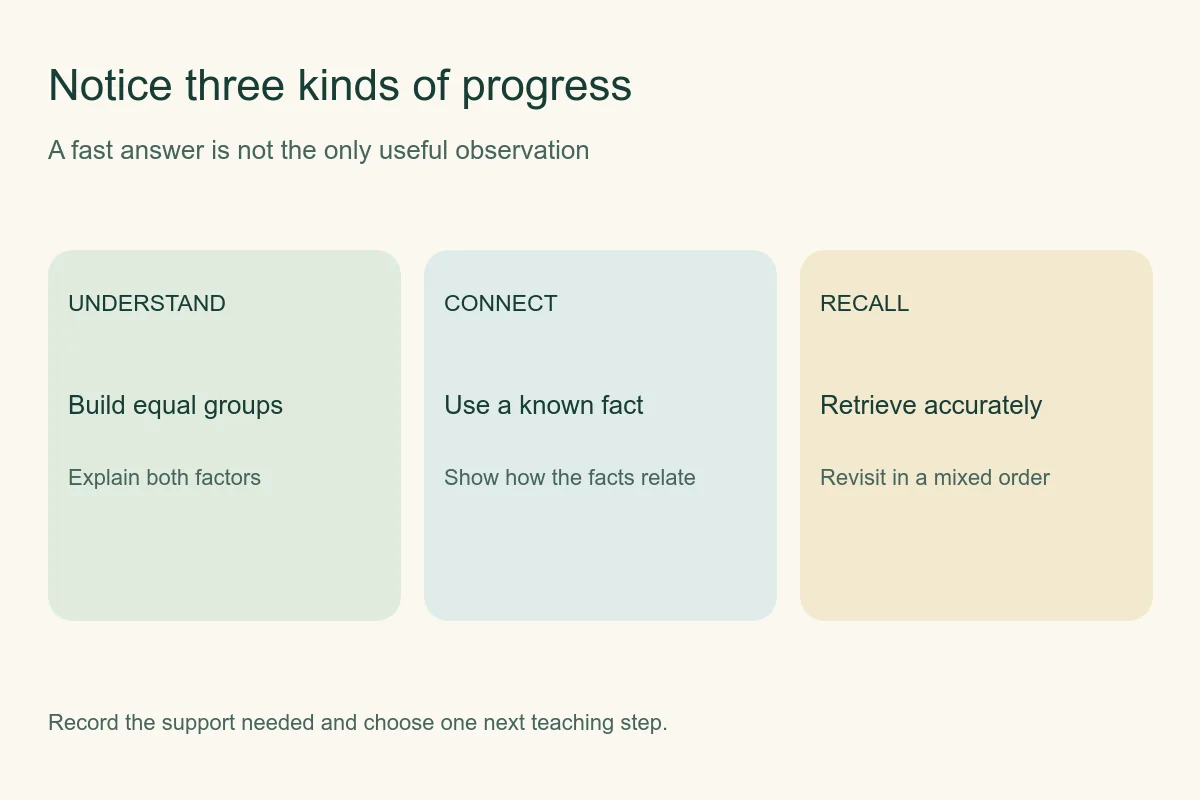
Track three things separately: accurate models, useful strategies, and independent recall. A note such as “6 × 7: used five groups plus one without prompting” records genuine progress even before the answer becomes immediate. Recheck later so that a fact remembered during one lesson is not automatically marked secure forever.
Timed activities are one recommendation in the What Works Clearinghouse guide, but they are not the only part of mathematics instruction. This home routine starts untimed. If you use a brief timing activity, keep the task familiar and manageable, and do not let a score replace explanations, instruction, or a calm learning environment.
For curriculum context, the Common Core third-grade operations standards connect multiplication with equal groups, arrays, properties, and fluency. These are United States curriculum expectations, not a diagnosis or a deadline that describes every learner. Follow the relevant curriculum and support plan for your child.
If difficulty persists or the work regularly causes distress, discuss specific examples with the child’s teacher or a qualified learning specialist. Avoid diagnosing a condition from a fact score or an online checklist. Bringing a few work samples and notes about successful supports makes the conversation more productive.
Frequently Asked Questions
Should my child memorize multiplication facts?
Accurate, increasingly efficient recall is useful, but it should connect to an understanding of multiplication. Combine clear models, strategies for deriving facts, and manageable repeated practice rather than relying only on memorization drills.
Is finger counting always a problem?
No. Notice what the child is doing with their fingers and whether the strategy is accurate. Then teach a more efficient connection when appropriate. Removing a support without offering another method can make the task harder without improving understanding.
Which multiplication tables should we teach first?
Twos, fives, and tens often provide useful anchors, followed by related facts. This is one practical sequence, not the only valid order. Coordinate with your child’s curriculum and revisit the facts that need support.
What if a child understands multiplication but forgets the answers?
Keep the conceptual model available, teach connections between known and less familiar facts, and revisit a small mixed set across days. Record the support needed. If difficulties remain substantial, seek individualized teaching advice rather than simply increasing the worksheet length.
Start today: Build one equal-group story, connect it to an equation, and choose one related fact. A clear explanation and a successful short session give you a better next step than another page completed under pressure.