
First grade sight words become easier when children meet a small group of useful words in real sentences, read them often, and still use phonics whenever a word can be sounded out. This guide gives families a practical sequence, a ten-minute routine, and playful review ideas. You can also build a personalized practice page with our Sight Word & Phonics Practice Generator and connect word recognition to meaning with these reading comprehension activities.
What Are First Grade Sight Words?
Sight words are words a child can recognize quickly and accurately without stopping for a long decoding attempt. Some are fully decodable once a child knows the relevant sound-spelling patterns. Others contain an unusual part that needs extra attention. Fast recognition matters because it frees attention for understanding the sentence, but memorizing long lists should never replace systematic phonics instruction.
Schools use different lists and teach patterns in different orders, so treat any grade-level list as a flexible reference rather than a test. Start with the words your child encounters in current books and lessons. If the school provides a list, use that as the primary sequence.
A Practical First Grade Sight Word List
The following commonly used first-grade Dolch words are a helpful starting point:
| after | again | an | any | as | ask |
| by | could | every | fly | from | give |
| giving | had | has | her | him | his |
| how | just | know | let | live | may |
| of | old | once | open | over | put |
| round | some | stop | take | thank | them |
| then | think | walk | were | when |
Do not introduce all 41 words at once. Choose three to five words that appear frequently in a book, poem, or lesson your child is already using. A smaller set makes it easier to notice progress and prevents guessing.
The Ten-Minute Practice Routine
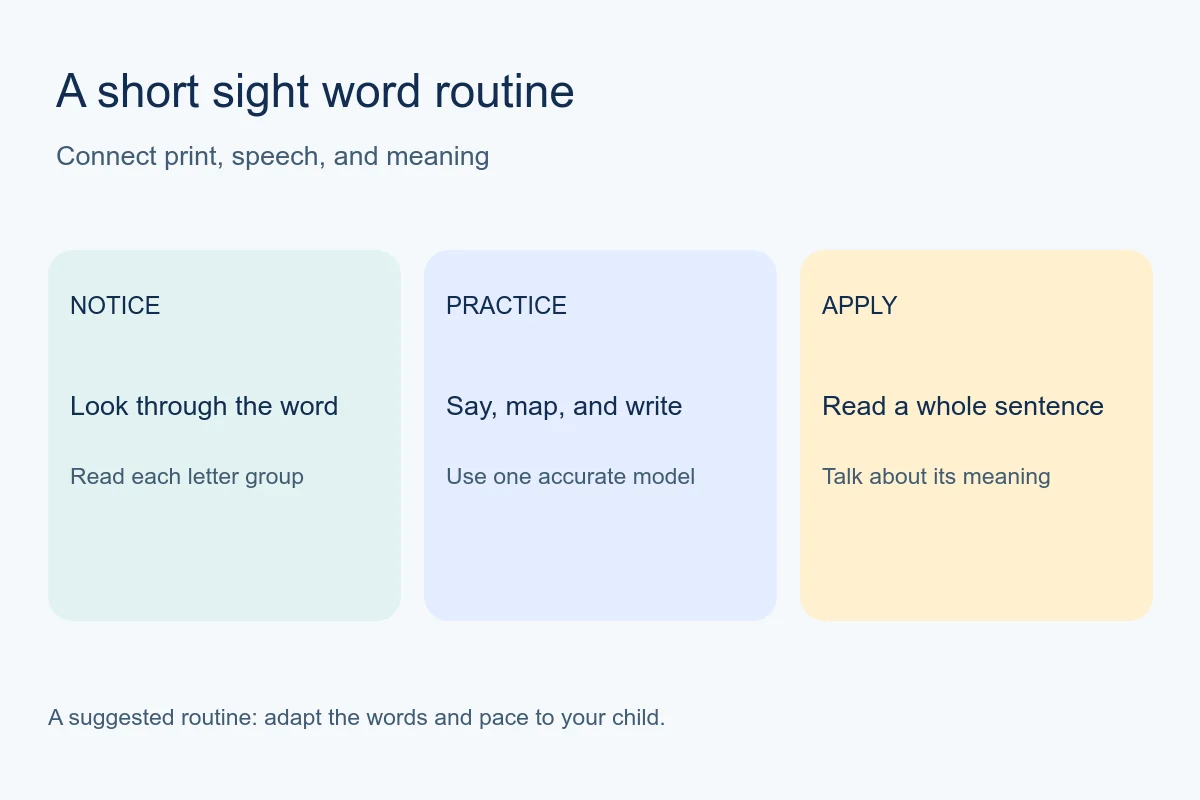
1. Read and Notice — Two Minutes
Show one word at a time. Ask the child to read it, then look closely at the letters. Point out the part that follows a familiar pattern and the part that may be surprising. For example, a child may recognize the beginning sound in when while learning that the opening letters work together.
2. Say, Map, and Write — Three Minutes
Say the word naturally, stretch the sounds that can be heard, and connect those sounds to the printed letters. Then have the child write the word once or twice while saying it. The goal is accurate attention, not filling an entire page.
3. Read It in a Sentence — Three Minutes
Use each target word in a short, meaningful sentence: “When can we go?” or “Put the book over there.” Ask one simple question about the sentence so the child connects fast word recognition with comprehension.
4. Quick Review — Two Minutes
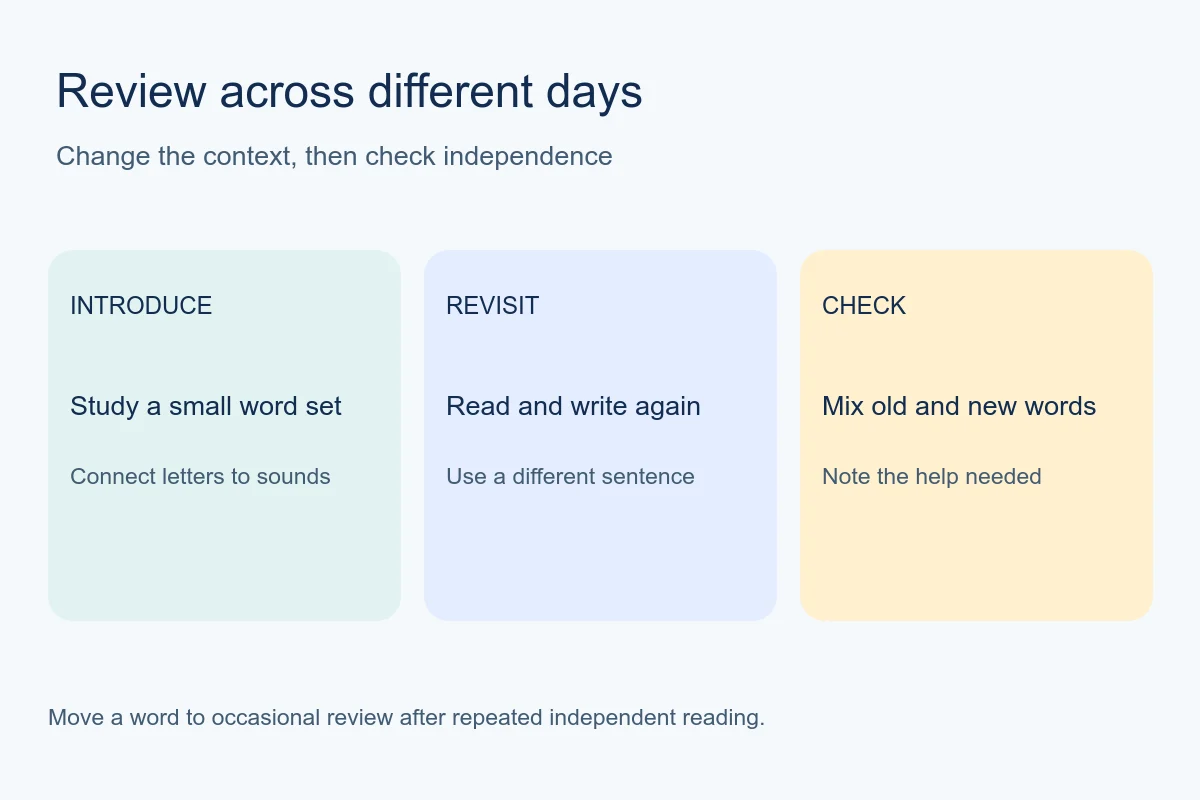
Mix two new words with three already-known words. If the child reads a word accurately within a few seconds on several different days, move it into a weekly review pile. If not, return it to the practice group without calling it a failure.
Seven Sight Word Games That Still Support Reading
- Sentence builder: Combine a target word with simple decodable words to build a sentence.
- Word detective: Find the word on one page of a familiar book, then read the whole sentence.
- Memory pairs: Make two cards for each of five words and read every card when it is turned over.
- Sort by pattern: Group words by a shared beginning, ending, vowel pattern, or unusual spelling.
- Missing word: Remove one word from a familiar sentence and choose the card that completes the meaning.
- Read, cover, write, check: Study one word, cover it, write it, and compare it with the model.
- Word trail: Place cards around the room and read a short sentence at each stop.
How to Choose the Right Difficulty
A useful practice set feels successful but not automatic. If a child misses most words, reduce the set to two or three and add more oral practice. If every word is immediate, use the same words in new sentences or short passages rather than adding a large new list.
- Emerging reader: two or three words, strong picture support, and adult read-aloud help.
- Developing reader: three to five words plus sentence reading and one writing attempt.
- Confident reader: five to eight words used in a short paragraph, question, or mini-story.
For additional connected practice, use the activities in our free phonics workbook. Children who still need support with letter formation can use the custom handwriting worksheet generator for short, personalized practice.
How to Track Progress Without Pressure
Use three simple columns: learning, almost automatic, and review later. Move a word only after the child reads it correctly in isolation and in a sentence on more than one day. A weekly check is enough. Daily scores can turn a useful routine into a performance test.
Watch for the strategy the child uses. Good progress is not only faster reading. It also includes looking through the whole word, connecting letters to sounds, noticing mistakes, and correcting them independently.
Common Mistakes to Avoid
- Practicing too many words: a focused set of three to five is more useful than a stack of twenty.
- Using flash cards only: children also need sentences, books, and conversation.
- Encouraging picture guessing: ask the child to look at every part of the printed word.
- Dropping phonics: high-frequency words should strengthen, not replace, sound-spelling knowledge.
- Repeating errors: provide the correct word, study it briefly, and try again later.
- Timing too early: accuracy and confidence come before speed.
A Five-Day First Grade Sight Words Practice Plan
This sample week shows how to revisit a small word set without repeating an identical activity. Use ask, stop, and when only if their spelling patterns match your child’s current instruction. Otherwise, replace them with three useful words from the teacher’s list. The schedule is an example you can adapt, rather than a required teaching program.
Monday: Look Closely at Each Word
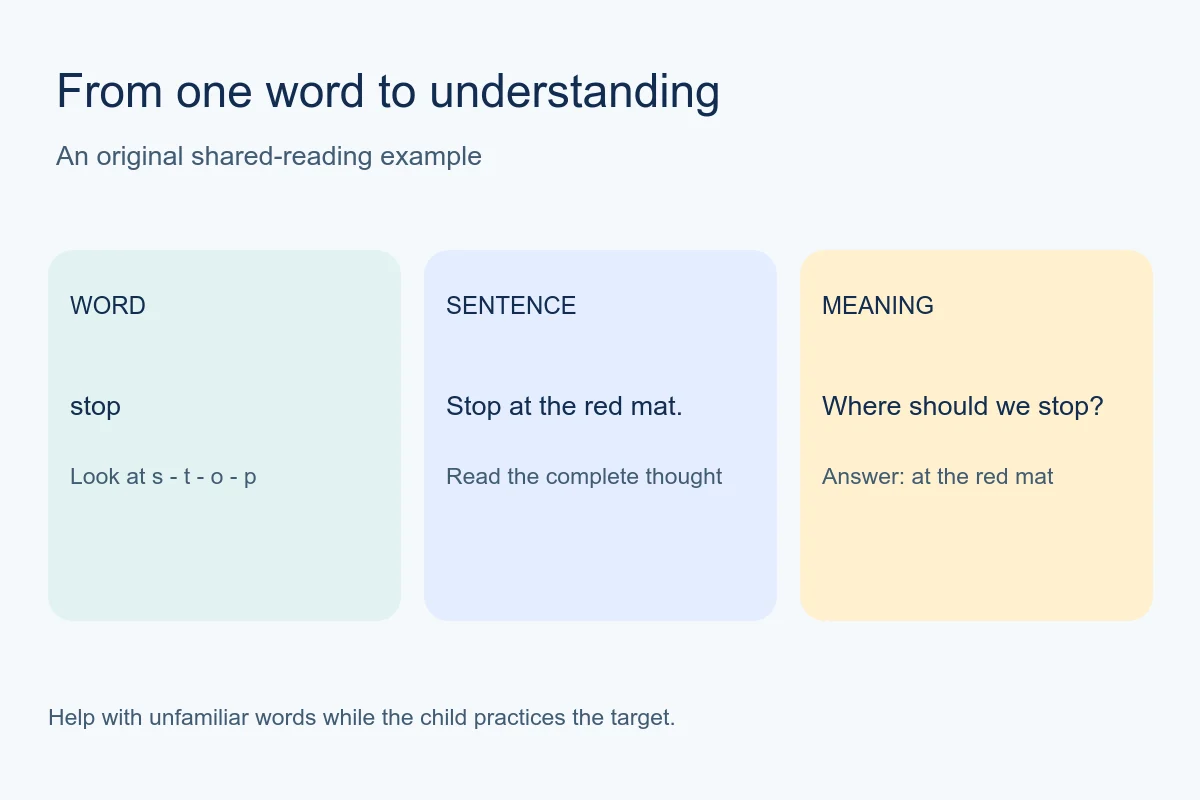
Write the three words in clear lowercase print on separate cards. Read each word aloud and invite the child to repeat it. For stop, say the four sounds /s/ /t/ /o/ /p/ and match each sound to its letter. Blend the sounds back together. End by reading, “Stop at the red mat.” Supply any unfamiliar words in the sentence so the target word remains the main task.
Tuesday: Build and Change a Sentence
Revisit yesterday’s cards, then place one in a short sentence. Say, “Ask Dad for a cup,” and invite the child to replace Dad with another name. Read both versions. This variation keeps attention on the word while showing that sentences carry different meanings. Let the child say a new sentence before you write it together.
Wednesday: Write From Memory
Show one card, read it, then cover it. Ask the child to write the word and compare it with the model. If a letter is missing, uncover the card and discuss what changed. One careful correction is enough. Avoid asking the child to copy a mistake ten times; the useful part is noticing the spelling and making an accurate new attempt.
Thursday: Read in a New Context
Hide the cards in different places or change the order of the review pile. Use a new sentence for each word. A word that is remembered only in one fixed sequence may need more practice. Ask the child to find the target in a short passage, then read the sentence and explain what happened.
Friday: Review and Choose Next Week’s Set
Mix the week’s words with familiar ones. Record whether each word was read independently, read after a prompt, or needed a model. Keep a word in practice if it still requires support. Add new words gradually, and leave room for reading a favorite book together. A weekly review should help plan instruction rather than label a child as ahead or behind.
An Original Read-and-Discuss Mini Passage
Use the following passage for shared reading after introducing its target words. It is an original practice example, not a fully decodable text for every phonics sequence. Read unfamiliar words aloud and let the child take responsibility for the words already taught.
“When can we stop?” asks Ben. “We can stop by the old tree,” says Dad. Ben has a cup. Dad has some water. They sit, sip, and look up. A bird can fly over them. “Thank you for the walk,” says Ben.
Ask three questions: Where did Ben and Dad stop? What did they drink? Which words help you picture the place? Return to the passage to check each answer. Then invite the child to change one detail, such as the place they stop. This links word recognition to comprehension and simple composition. Our writing prompts arranged by age and ability offer more ways to turn reading into a short response.
Keep the Practice Accessible and Useful
Use large, high-contrast print for a child who loses their place. Cover extra lines with a blank card when a page feels crowded. If handwriting takes most of the effort, let the child build a word with letter tiles or say the letters while an adult records them. You can work on handwriting separately with our short handwriting practice routine.
For multilingual families, briefly explain a word’s meaning in the language the child knows best before reading the English sentence. Pronunciation varies by accent, so focus on how the spoken word connects to its written form in your teaching context. Keep notes about what support helped. Those notes are often more useful for a teacher conversation than a single score.
The Institute of Education Sciences recommends linking speech sounds with letters, teaching word reading, and practicing connected text in its foundational reading practice guide. The routines here are practical examples for home use; the exact word set and pace should follow the child’s instruction and observed needs.
Frequently Asked Questions
How many sight words should a first grader know?
Expectations differ by school and curriculum. Use the list provided by the child’s teacher when available, and focus on steady mastery rather than one universal number.
How often should we practice?
Five to ten focused minutes on four or five days each week is usually more manageable than one long session. Stop earlier if accuracy or attention drops.
Should children memorize sight words by shape?
Children should attend to the letters and sounds inside the word, not memorize an outline as a picture. Even an irregular word usually has parts that follow familiar spelling patterns.
What if my child forgets the same word?
Reduce the number of target words, examine the spelling more closely, use the word in several meaningful sentences, and review it across several days. Persistent difficulty across many reading skills is worth discussing with the child’s teacher.
What to Do Next
Choose three words from a current book, practice them for ten minutes, and finish by rereading the sentence where each word appeared. When you need a fresh page, create one with the free sight word worksheet generator.
Helpful reference: Institute of Education Sciences, Foundational Skills to Support Reading for Understanding in Kindergarten Through 3rd Grade.
One Response