
Reading mistakes can feel unusually threatening to a perfectionist child, even when the text is well matched. For some children, one uncertain sound does not feel like a small problem to solve. It feels like proof that the whole lesson has gone wrong. The child freezes, cries, argues, erases repeatedly, calls themselves “stupid,” or refuses to stop until the page is perfect.
The adult’s job is not to win a debate about whether the mistake matters. It is to make help predictable, reduce the size of the task, and keep correction factual. A reading error needs information—not a verdict about the child.
This guide is about the emotional routine around practice. For instruction on joining sounds, see CVC words blending practice. For broader coping and independence ideas, visit our life skills for kids guide.

Understand the loop before changing it
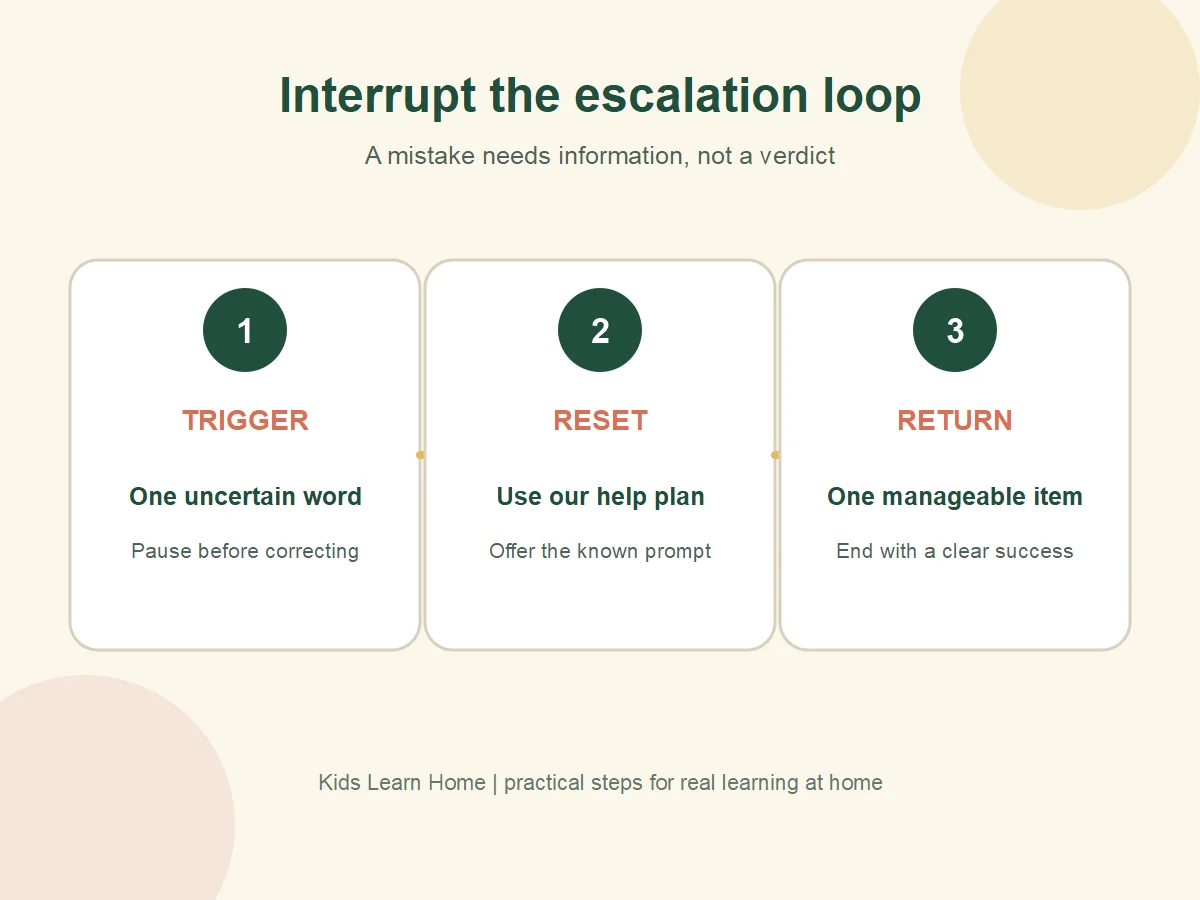
A common loop looks like this:
- The child meets one uncertain word.
- The adult corrects quickly or says, “You know this.”
- The child hears the correction as evidence of failure.
- Emotion rises; useful thinking falls.
- The adult explains more, bargains, or removes the entire task.
- The next uncertain word arrives with even more pressure.
No one is choosing the loop on purpose. Interrupt it early, before the adult’s explanation grows and the child’s sense of threat hardens.
This article is educational, not mental-health treatment. Persistent severe distress, negative self-talk, or difficulty across daily life deserves discussion with an appropriate qualified professional.
Before the lesson: make help visible
Define a small finish line
Say, “We will read this row and one sentence,” not “We are doing reading.” Show the exact stopping point. A visible boundary prevents the child from imagining an endless stream of tests.
Preview the help plan
Agree on a sequence:
- child tries;
- adult points to the relevant part;
- they blend together;
- adult supplies the word if needed;
- they reread the sentence.
Help is not a prize earned after distress. It is part of instruction.
Choose a matched task
Use words and text containing mostly taught patterns. A task far beyond the child’s current decoding knowledge can manufacture repeated failure. The IES foundational reading guide supports explicit decoding instruction and scaffolded connected-text reading; it does not support leaving a child alone with inaccessible text.
During the lesson: correct the action, not the identity
Replace global language with specific prompts.
- Instead of “You know this,” say, “Check the vowel.”
- Instead of “That was easy yesterday,” say, “Start the first sound.”
- Instead of “Stop guessing,” say, “Point to each spelling.”
- Instead of “Calm down,” say, “We can pause. Your help plan is still here.”
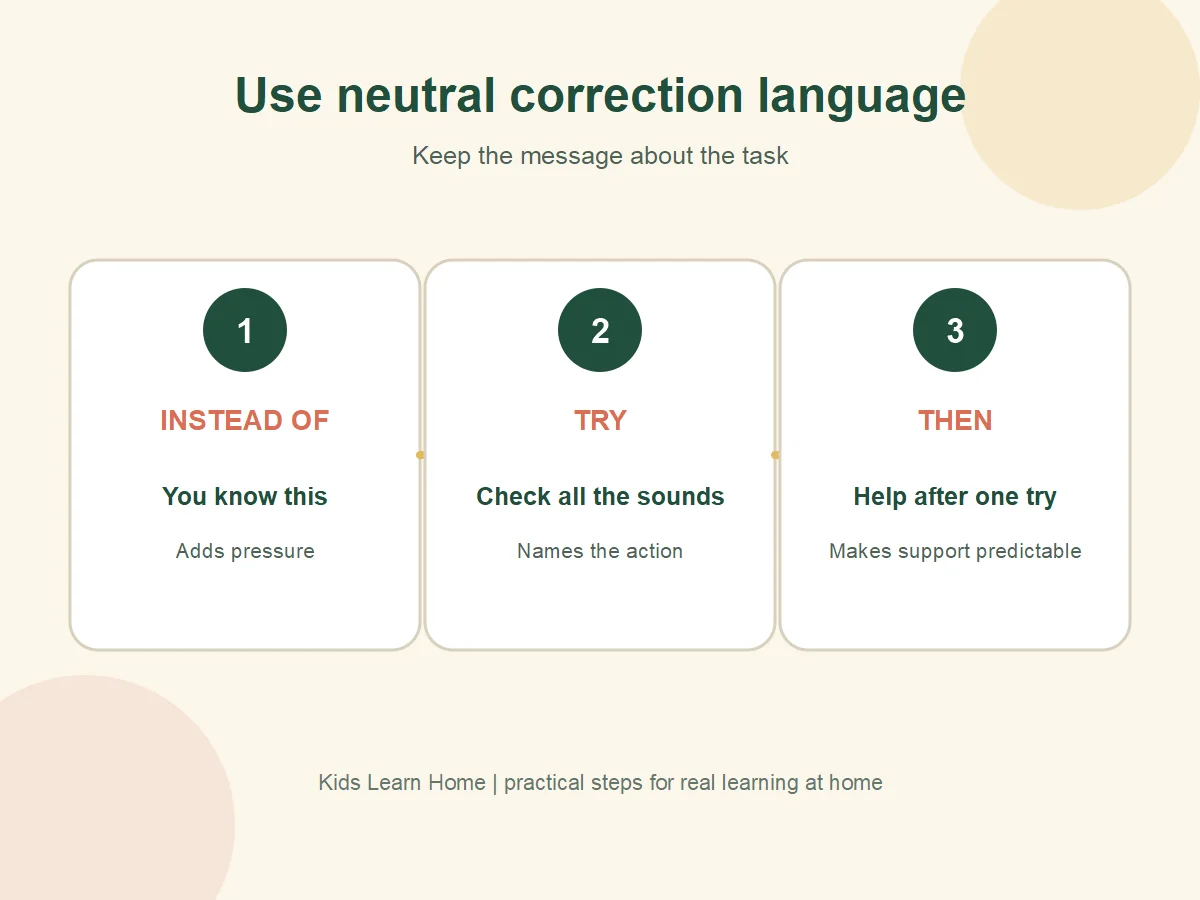
Neutral does not mean cold. Keep your voice warm and your message precise. “That word is map, not mat. The last letter spells /p/. Let’s blend it once” gives usable information.
A five-step reset when emotion rises
1. Stop adding language
Long explanations are difficult to process when the child is overwhelmed. Use one sentence: “This feels hard. We will pause.”
2. Regulate the environment
Move the page aside, lower your voice, offer water or a brief movement, and reduce extra people or noise. Do not demand eye contact or immediate discussion.
3. Offer two bounded choices
“We can finish one familiar word now, or mark the place and return after lunch.” Both choices preserve the plan without forcing a power struggle.
4. Return below the failure point
Choose an item the child can complete with available support. The goal is not to prove the original item was easy; it is to re-enter a useful learning state.
5. Close the lesson clearly
Name specific evidence: “You used the first sound after the pause,” or “You told me when you needed help.” Then put the materials away. Do not attach an extra worksheet because the ending went well.
One page, one win
A repeatable closing ritual helps a child learn that practice has an endpoint:
- Preview: show the row, page, or three cards.
- Practise: use the agreed prompt ladder.
- Close: identify one action that worked and stop.
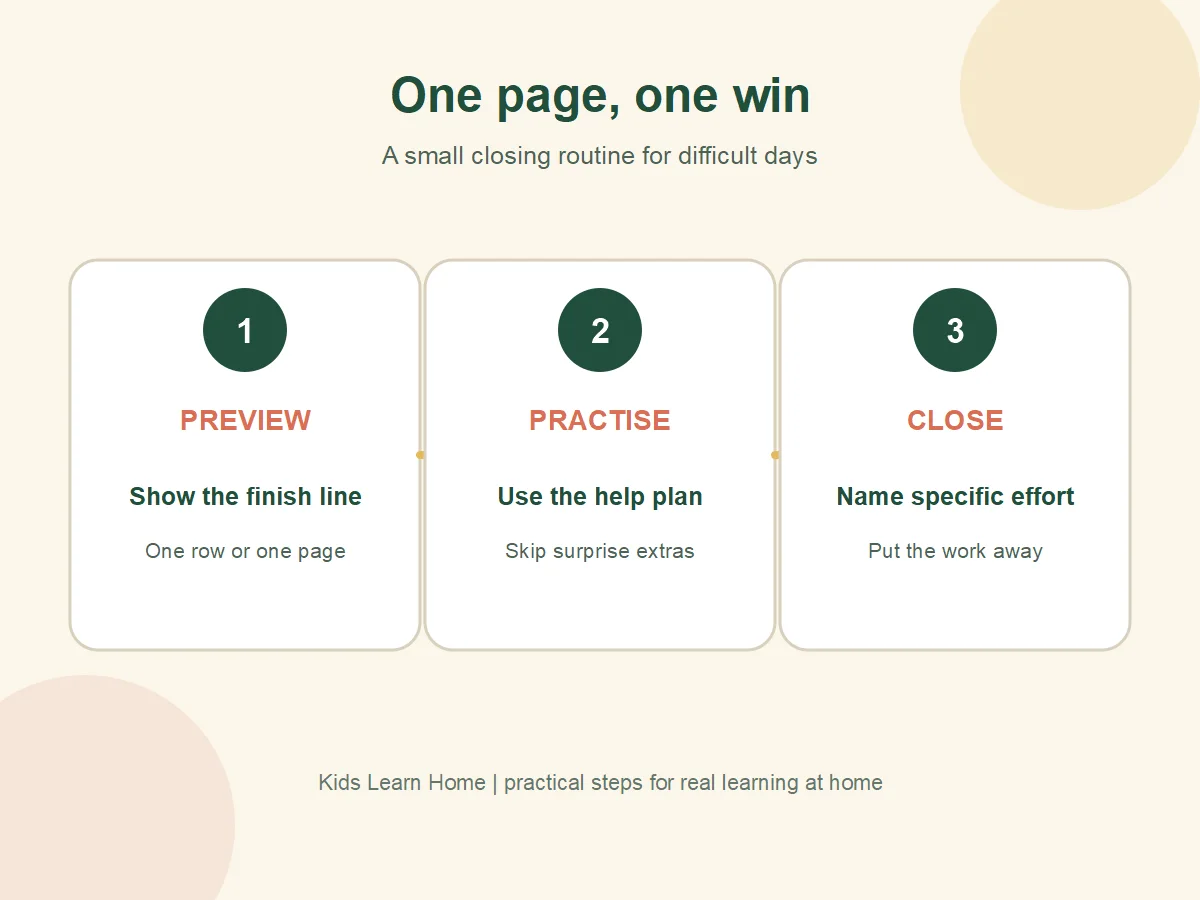
“Win” does not mean zero errors. It means the child completed a bounded practice experience using a helpful strategy.
What to praise
Praise information-rich actions:
- noticing a mismatch;
- trying the sound again;
- asking for the planned help;
- tolerating a correction;
- rereading after a fix;
- stopping when the agreed work is complete.
Avoid making “smart” or “perfect” the central identity. Also avoid exaggerated praise the child does not believe. A calm observation is often stronger: “You checked the ending and changed your answer.”
Keep a short observation log
For one or two weeks, record:
- task length and time of day;
- skill being practised;
- first sign of distress;
- exact adult prompt;
- what helped the child return;
- whether the text matched taught patterns;
- sleep, hunger, noise, or transition factors that were obvious.
The pattern may show that distress is tied to surprise, fatigue, handwriting load, a specific reading skill, or corrections delivered in front of siblings. Use the evidence to change the environment and instruction.
Our flexible multi-age homeschool schedule may help create protected one-to-one teaching turns, but a schedule alone does not resolve emotional distress.
Where a structured workbook can fit—and where it cannot
A predictable printable may reduce surprise because the format repeats and the finish line is visible. If a child age 5–7 is currently learning short vowels and CVC blending, Blend & Read: CVC Phonics Workbook offers 44 pages, six short stories, A4 and US Letter versions, and a printing/use guide.
Use one row or page segment, not a completion marathon. The workbook does not treat perfectionism, anxiety, dyslexia, or another condition. Its role is simply to provide a sequenced practice option when the skill fit is right. Continue rich read-alouds and seek professional support when concerns persist.
Practise coping away from the hardest page
Do not introduce every emotional strategy at the moment of maximum frustration. Rehearse when calm. Make a small card with three options: try one prompt, ask to blend together, or mark and return. Role-play an adult making a harmless mistake and using the card without self-criticism.
Use games where mistakes are expected and quickly recoverable. The Center on the Developing Child at Harvard offers an activities guide for executive function and self-regulation organized by age. The guide presents broad play ideas, not a treatment for perfectionism and not proof that one game will change reading behavior.
Build challenge gradually. If one row is manageable for three sessions, add a second short row—not a full packet. If the child uses the help card independently, acknowledge that action even when the word remains wrong.
Coordinate language among adults. A shared phrase such as “Mistakes give us the next teaching step” is more stable than one adult insisting on independence while another immediately answers. Keep correction private when siblings are present, and avoid comparisons.
Protect the rest of the reading life
Keep bedtime stories, audiobooks, library visits, and conversations separate from correction-heavy practice. A child can listen to complex language and enjoy stories while learning to decode simpler print. Do not stop every read-aloud to quiz letter sounds.
Offer genuine choices outside the instructional target: which story to hear, where to sit, or which character voice the adult should use. Choice does not mean the child chooses whether foundational skills ever receive instruction; it means reading is not experienced only as a sequence of errors.
On hard days, preserve one successful contact with print and one joyful contact with language. They serve different purposes, and both belong in a sustainable reading life.
Questions parents often ask
Should I let the child keep going when they refuse to stop?
Hold the agreed boundary calmly. Continuing while distressed can turn practice into endurance. Offer a clear return time or one familiar closing item, then end.
Am I reinforcing avoidance if I shorten the task?
Shortening a mismatched or escalating task can protect productive practice. Keep a predictable routine and return at an appropriate level; do not make the entire subject disappear indefinitely.
Should I correct mistakes immediately?
Correct errors relevant to the current skill, but use the least intrusive prompt and avoid public or emotional correction. Some slips can be addressed after a sentence if immediate interruption would destroy meaning.
When should I ask for help?
Seek guidance when distress is frequent, severe, worsening, or spreading beyond reading; when the child uses persistent negative self-talk; or when well-matched explicit instruction is not producing expected progress. Bring your observation log.