
Counting games for preschoolers help children connect number words, written numerals, and real quantities through movement and play. Reciting “one, two, three” is only one part of early number sense. Children also learn to touch one object for each number word, understand that the last word tells how many, recognize small groups without counting, and compare which group has more. The games below use everyday objects and can be adjusted from numbers one to three up to ten or beyond as a child becomes ready.
In this guide
Getting ready safely
Gather large counters such as blocks, toy animals, jar lids, paper circles, a die with dots, numeral cards, tape, and two bowls. Avoid small loose parts when children still put objects in their mouths, and supervise throughout play. Begin with a quantity the child can handle confidently. Model slow, accurate counting by moving or touching each item once. The National Association for the Education of Young Children highlights number-path, dot-card, and finger games as playful ways to support numeral recognition, one-to-one correspondence, subitizing, magnitude, and counting on.
For related learning ideas, explore preschool activities and games. For additional background, see NAEYC number-path game guidance.
Counting Games for Preschoolers: 15 Play Ideas
1. Dot-card flash
Show a card with one to five dots for two seconds. Ask how many the child saw and how they saw it—for example, three and one make four.
2. Toy parking lot
Draw numbered parking spaces and place the matching number of toy cars in each. Start with spaces one to three and add more as counting becomes accurate.
3. Number-path hop
Tape large numbered squares on the floor. Roll a die, move one square per dot, and say the landing number. Walk rather than jump if the floor is slippery.
4. Feed the puppet
Label a toy container with a numeral and feed it that many large blocks or pretend snacks. Count each item aloud as it enters the container.
5. Muffin-tin sets
Put a numeral card in each muffin-tin section and add the matching quantity of large counters. Check by moving each counter to a second row.
6. Clap and copy
Clap one to five times and ask the child to copy the same number. Switch roles so the child creates a sequence and the adult counts.
7. Sock-pair count
Match clean socks into pairs, then count pairs and individual socks. Ask whether adding one more pair changes the total by one or by two.
8. Nature collection
Collect a small number of safe leaves or stones, sort them, and count each group. Leave living plants and unfamiliar natural objects untouched.
9. Build the numeral
Choose a numeral card, build that numeral with craft sticks, then place the matching number of blocks beside it. This connects symbol, shape, and quantity.
10. More or less bowls
Place different small sets in two bowls and ask which has more. Let the child pair objects one-to-one to check instead of relying only on visual size.
Need another direction? Browse early literacy activities and adapt one idea to the child’s age, interests, and available space.
11. Finger combinations
Show a number in different ways with two hands, such as two fingers and three fingers making five. Invite the child to find another combination.
12. Count and move
Draw a movement card and a number card, then perform that many stomps, reaches, or gentle jumps. Choose movements appropriate for the space and child.
13. Hidden quantity
Count a set together, cover it, and ask how many are hidden. Add or remove one secretly, uncover, and discuss how the quantity changed.
14. Roll and build
Roll a die and build a block tower with the matching number. Compare two towers using taller, shorter, more, less, and equal.
15. Story counting
Tell a tiny story while moving toy animals into a scene. Ask how many arrived, how many left, and how many remain, using very small quantities first.
A simple learning routine
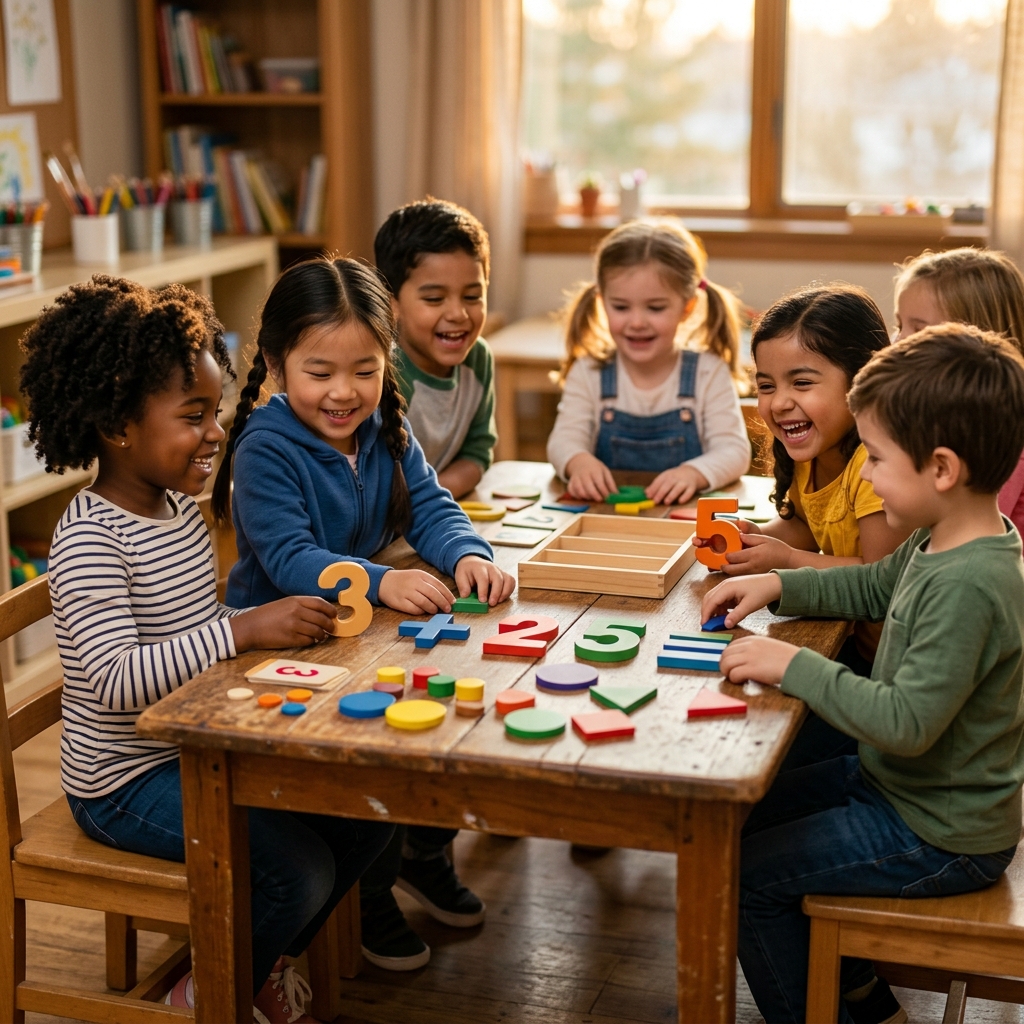
Keep a game going while the child is interested, often five to ten minutes. Repeat favorites because repetition lets children notice deeper ideas after the rules become familiar. Use mathematical language naturally: “You have four, I have three, so you have one more.” Ask the child to show a quantity in another way or predict the next number. If counting becomes inaccurate, reduce the set, arrange objects in a line, and slow the pointing movement so one word matches one object.
Keep a small note of what the child attempted, what felt easy, and what deserves another try. For printable or hands-on follow-up, visit math worksheets and resources. Progress is easier to see when adults compare a child with their earlier work rather than with siblings or classmates.
Common mistakes to avoid
Do not rush to larger numbers because a child can recite a long sequence. Check whether they can make a requested set, recognize small quantities, and answer “how many?” without starting over. Avoid correcting with embarrassment or turning every daily moment into a quiz. Uneven spacing can make one group look larger, so pair objects or count to compare. Worksheets can reinforce numerals, but preschool mathematics also needs objects, movement, talk, and playful problems.
How to adapt the activity
For a younger learner, reduce the number of steps, model one action at a time, and offer two choices instead of an open-ended decision. For an older or more experienced child, ask them to plan materials, predict an outcome, explain a strategy, or teach the activity to someone else. Adapt tools, movement, noise, timing, and communication so the child can participate meaningfully. Breaks and alternative roles are valid supports, not rewards that must be earned.
How to know the activity worked
Success is not limited to a perfect finished product or score. Look for attention, safe tool use, clearer explanation, willingness to revise, independent choices, and enjoyment. Ask three closing questions: “What did you notice?”, “What was difficult?”, and “What would you do differently next time?” Record one sentence or photo if the child agrees. This reflection turns a pleasant activity into reusable learning without making it feel like a test.
Frequently asked questions
What counting skills should preschoolers practice?
Useful foundations include stable number order, one-to-one correspondence, cardinality, numeral recognition, subitizing small groups, comparing quantities, and noticing one more or one less. Development varies by child.
How high should a preschooler count?
There is no single required number for every preschooler. Work within the child’s accurate range and deepen quantity understanding before emphasizing a longer memorized sequence.
What is one-to-one correspondence?
It means matching one number word to one object while counting. Moving each object into a new group can help a child avoid skipping an item or counting it twice.
What is subitizing?
Subitizing is recognizing a small quantity without counting each object individually, like seeing three dots on a die. Dot-card and finger games provide natural practice.
How often should we play counting games?
Short games several times a week are plenty, especially when counting also appears naturally during cleanup, cooking, stairs, books, and outdoor play. Follow the child’s interest.
Observe number sense during play
Listen for more than a correct spoken sequence. When a child counts six blocks, notice whether each block is touched once, whether the last number is used to answer “how many,” and whether the child can make another set of six without copying the arrangement. Show the same quantity in a line, a circle, and a scattered group. If the child thinks a spread-out group must contain more, pair the objects one-to-one and describe what stayed the same. These observations reveal which idea to practice next without turning the game into a formal test.
Extend a familiar game by changing one feature. Add one more space to a number path, ask what comes before the landing number, or let the child invent a rule. When working with several children, give each a separate collection so fast counters do not take over. Encourage explanations such as “I knew it was five because I saw two and three.” Accept fingers and objects as useful thinking tools. If a child loses track, arrange items, slow the count, and model again. Accurate small quantities create a stronger foundation than hurried work with large numbers.
A simple week of counting play
On Monday, use dot cards for quantities one to five. Tuesday, build matching sets with blocks. Wednesday, walk a number path and name the number before and after each landing space. Thursday, compare two small collections and explain which has more or whether they are equal. Friday, let the child choose a favorite game and change one rule. Repeat the same number range all week if needed. Familiar materials reduce the effort of learning rules, leaving more attention for quantity, order, and comparison. Keep notes brief: record one skill that appeared independently and one idea to model again next week.
Final thoughts
Start small, prepare the environment, and let the child’s response guide the next step. A short activity that ends with curiosity is more valuable than a complicated plan completed under pressure. Save the ideas that fit your family or classroom, repeat the favorites, and change only one challenge at a time so children can notice their own progress.