
Math word problems can overwhelm a child who calculates accurately but struggles to organize the language and story. A child can add 8 + 5 correctly and still feel lost when the same numbers appear inside a story. That does not automatically mean the child has forgotten addition. A word problem asks the learner to coordinate reading, vocabulary, situation knowledge, mathematical relationships, representations, and calculation.
The first useful step is to separate those jobs. Do not begin with “Which operation?” Begin with “What is happening?”
If calculation itself needs practice, use our addition and subtraction guide. The routine below focuses on understanding the problem before calculating.
Why a correct calculator can struggle with a story
Consider: “Mina has 5 shells. Omar gives her 3 more. How many shells does Mina have now?” The child must identify the starting quantity, understand the action, know that “gives her” increases Mina’s set, locate the unknown, represent the change, and then calculate.
If decoding is slow, the child may forget the beginning before reaching the question. If vocabulary is unfamiliar, the action may be unclear. If instruction has focused on keywords, the child may select an operation without understanding the relationship.
The IES elementary mathematics practice guide recommends deliberate instruction on word problems, mathematical language, and representations. It also advises exposing learners to varied problem structures rather than relying on one surface form. Our home routine translates those broad recommendations into a repeatable conversation.
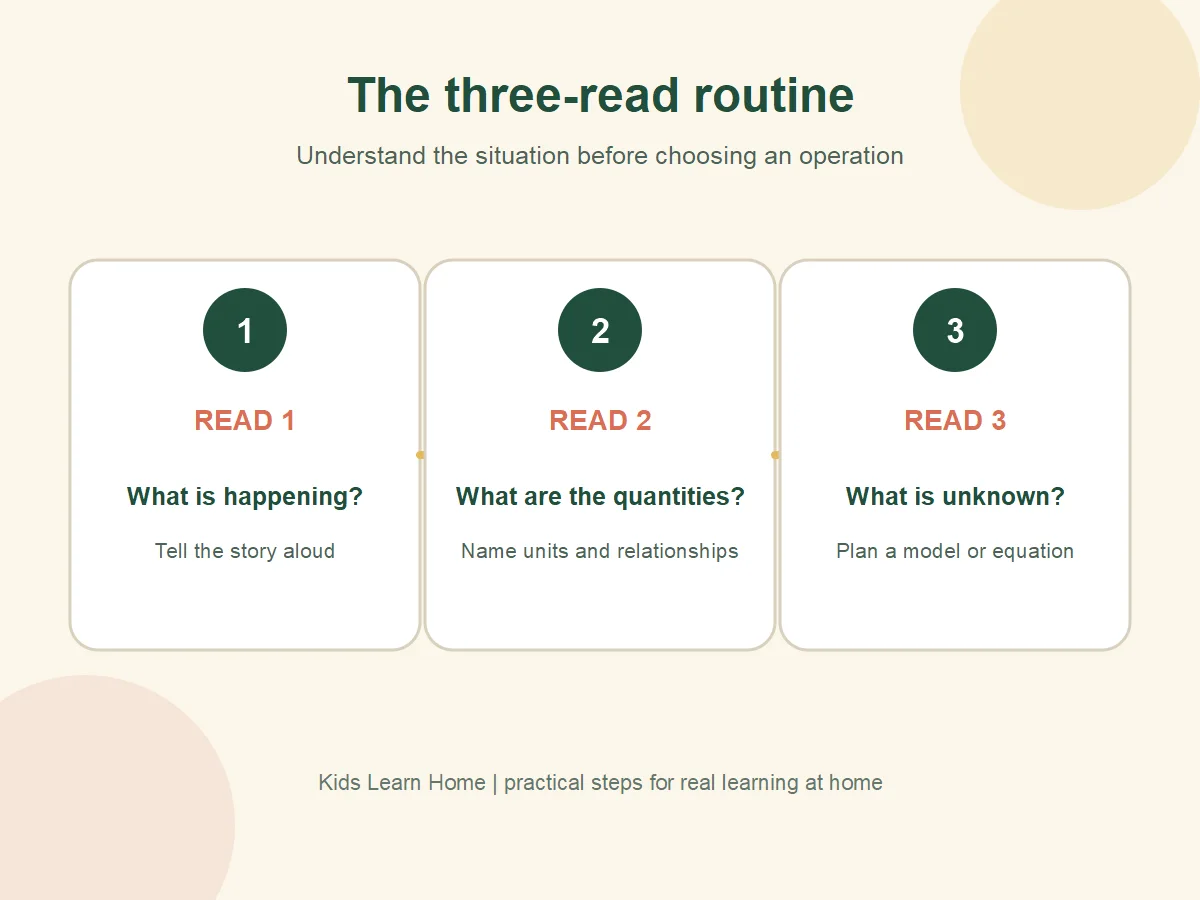
The three-read routine
Read 1: What is happening?
Read the problem without asking for numbers or an operation. The child retells the situation in ordinary language. If independent reading is the bottleneck, the adult reads aloud while the child follows.
Ask:
- Who or what is in the story?
- What happens first?
- What changes?
Read 2: What are the quantities and relationships?
Read again. Name the quantities with their units: five shells, three shells—not just 5 and 3. Ask how the quantities are connected. One is the starting amount; one is added; the total is unknown.
Read 3: What are we trying to find?
Read the question and state the unknown precisely. “How many shells Mina has now” is clearer than “the answer.” Then choose a drawing, objects, bar model, or equation.
Do not require three dramatic oral readings forever. The routine is scaffolding. As the child internalizes the questions, it becomes a quick mental check.
Move from story to model to equation
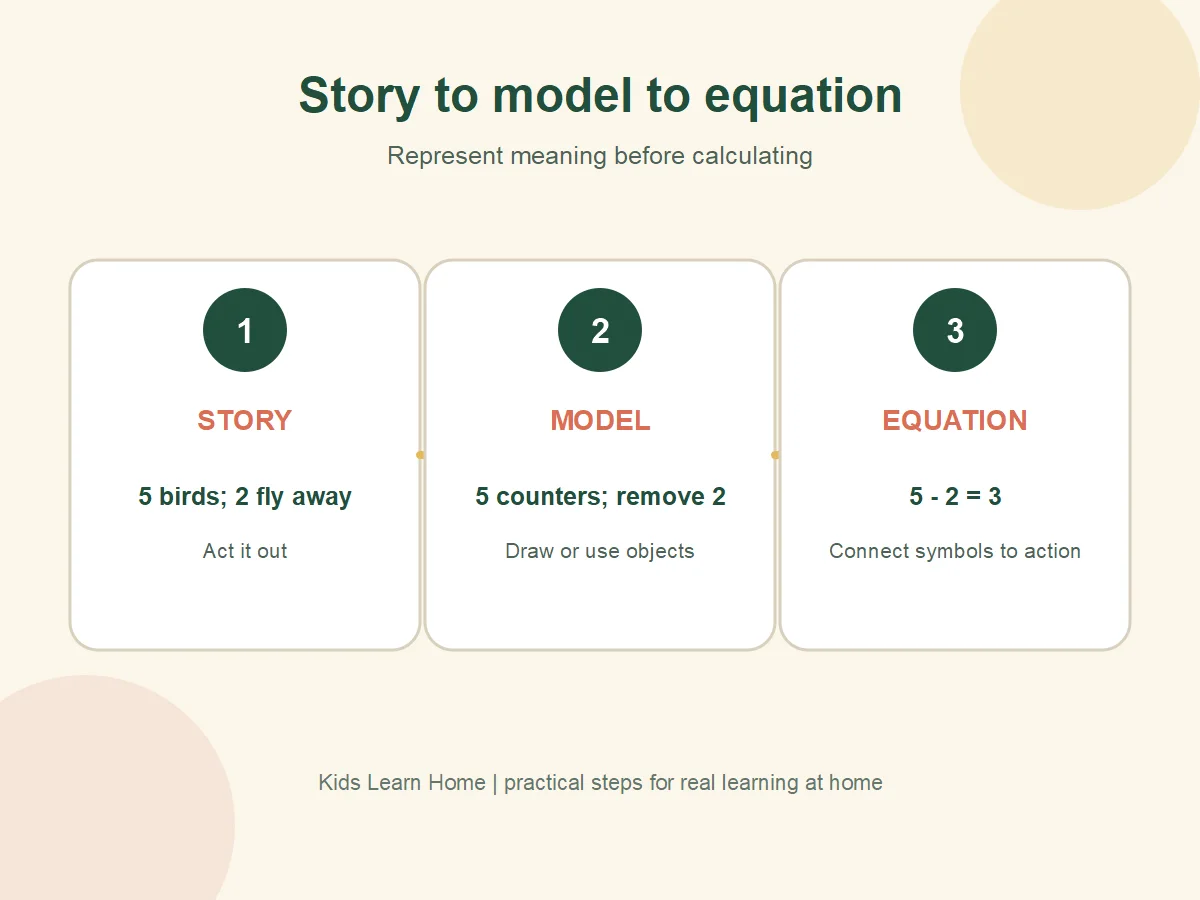
Suppose: “Five birds sit on a fence. Two fly away. How many remain?”
- Story: Act it out with five toy birds or counters.
- Model: Draw five marks and cross out two.
- Equation: Connect the action to 5 − 2 = 3.
The objects are not a reward for failing to do abstract math. They expose the relationship. Ask the child to point from each part of the story to the model and then to the equation.
For more printable practice after the meaning is secure, visit the math worksheets and games hub.
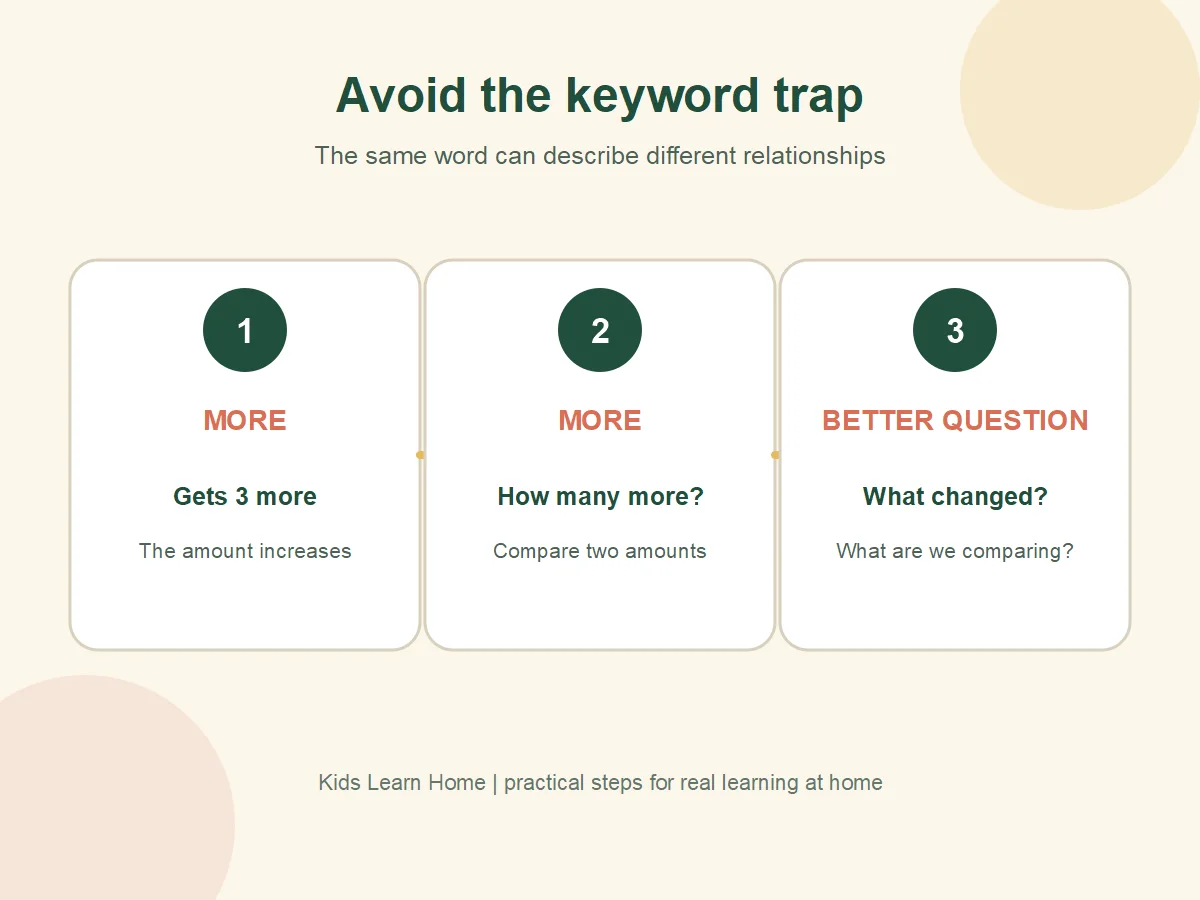
Do not teach “more means add”
Keywords are unreliable. Compare:
- “Lena has 4 cubes and gets 3 more.” This describes an increase.
- “Lena has 7 cubes. Sam has 4. How many more does Lena have?” This asks for a difference.
The same word appears, but the relationships differ. Ask “What changed?” or “What are we comparing?” instead of “Which keyword did you see?”
Four worked examples
Change unknown
“Kai has 6 stickers. His aunt gives him 4 more. How many does he have now?”
- Start: 6 stickers
- Change: 4 stickers join
- Unknown: new total
- Model: set of 6, add 4
- Equation: 6 + 4 = 10
Start unknown
“Kai had some stickers. His aunt gave him 4 more. Now he has 10. How many did he have first?”
The word “more” appears, but 10 − 4 finds the starting amount. Build 10, remove the 4 that were added, and count what was present first.
Comparison
“Mira has 8 red beads and 5 blue beads. How many more red beads are there?”
Line up the sets one-to-one. The unmatched red beads show the difference: 3.
Equal groups
“Three plates hold 4 crackers each. How many crackers are there?”
Build three equal groups of four. The structure—not the presence of the word “each” alone—supports 3 × 4.
Reduce reading load without removing mathematics
If the child understands when you read aloud, that is useful evidence. Continue teaching the math while separately supporting reading. You can:
- read the problem aloud once;
- replace unfamiliar names or contexts without changing the structure;
- underline the question after the child explains it;
- use shorter sentences and accessible numbers during initial teaching;
- let the child dictate an explanation;
- ask the child to match a story to one of two models.
Do not simplify every problem into a bare equation. The goal is to build access to mathematical situations, not avoid them.
Our reading comprehension practice can support broader meaning-making, but a math word problem also needs explicit attention to mathematical relationships.
When separate decoding practice is useful
If a five- to seven-year-old can reason with objects but short printed words consume all available effort, practise reading separately from the math lesson. Blend & Read: CVC Phonics Workbook is a paid 44-page printable focused on short vowels, CVC blending, and six short stories, supplied in A4 and US Letter with a printing/use guide.
Use it only if that is the child’s current reading target. It will not teach word-problem structures, and stronger decoding does not replace math instruction. Its possible value is narrower: reducing one barrier to accessing printed directions and simple stories over time.
What to observe for one week
Record which support changes the response:
- Can the child retell the problem when you read it aloud?
- Can the child model it with objects?
- Can the child select an equation after modeling?
- Does unfamiliar vocabulary change performance?
- Is one problem structure consistently harder?
- Can the child explain why an answer fits the story?
Patterns are more useful than a single bad afternoon. Persistent difficulty across settings may deserve discussion with the child’s teacher or a qualified professional; this article is not an assessment.
Teach one problem structure at a time—then mix it
Begin with several stories sharing the same relationship but different surface details. A child might act out three “change unknown” stories using shells, toy cars, and cups. Compare the models: the objects change, but each story starts with an amount, adds or removes something, and asks for the result.
Next, contrast it with a different structure. Put a change-unknown problem beside a start-unknown problem and ask what the question seeks. This prevents the child from treating the most recent operation as the answer to every story.
The IES Word Problems Module workbook demonstrates a consistent make-sense–represent–solve routine with concrete materials, equations, comparisons, and explanations. Its examples target classroom intervention and older elementary grades, so adapt the language and numbers rather than claiming the whole module is designed for a particular five-year-old.
Create a contrast: “Four frogs sit on a log. Two more arrive. How many now?” Then: “Some frogs sit on a log. Two arrive. Now there are six. How many were there first?” Build both with counters. Ask the child to point to the unknown before writing an equation. The same characters and total make the structural difference easier to see.
End with a reasonableness check
After calculating, return to the story. Ask the child to state the answer with its unit and decide whether it fits the action. If five birds lose two, an answer larger than five should prompt a review. Reasonableness is not a vague feeling; it comes from the relationship shown in the model.
Questions parents often ask
Should the child circle all the numbers?
Only after understanding the story. Some numbers may be irrelevant, and quantities need units and relationships. Circling numbers first can encourage calculation without meaning.
Should we use drawings forever?
Use representations until the child can explain the relationship and connect it to symbols. Gradually shorten the drawing; do not remove it merely because of age.
What if the answer is correct but the explanation is unclear?
Ask the child to show the story with objects or a diagram. A correct answer can come from reasoning, guessing, or calculation detached from the situation. The representation reveals more.
How many problems should we do?
Prefer a few varied problems with discussion over a long page completed by keyword guessing. Quantity depends on the child and purpose; stop when responses no longer provide useful practice.