
Reading fluency activities at home should help a child read accurately, with a manageable pace and meaningful expression—not simply finish a page faster. When a child sounds out nearly every word, a parent may be tempted to add a stopwatch or insist on another full chapter. A better starting point is to check the text, provide a clear spoken model, and practice a small section with a purpose.
This guide gives you five supported reading activities, an original passage and dialogue, a flexible home routine, and a way to notice progress beyond speed. It is for children already beginning to read connected text. If identifying sounds or joining them into words is still the main barrier, keep explicit word-reading instruction central.

Reading Fluency Activities at Home: Accuracy Before Racing
Fluency connects accurate word reading with efficient, expressive reading of text. The University of Florida Literacy Institute glossary describes fluency and prosody, including phrasing and expression. A child who races but changes words or loses the message is not meeting the whole goal.
Listen to a short sample and identify one priority. Does the child misread familiar spellings, pause between every word, ignore sentence endings, or read smoothly but struggle to explain the meaning? Each observation suggests a different next step. Avoid treating all slow reading as the same problem.
If the child is uncertain about joining sounds, our CVC blending guide offers an earlier teaching step. If a specific consonant group is repeatedly missed, revisit the blends and digraphs examples. Supported text practice can continue while those word-level skills receive attention.
The What Works Clearinghouse foundational reading guide recommends daily connected-text reading and describes supported reading practices. The activities and timings below are original home formats, not a claim that one fixed routine will produce a particular reading rate.
Choose a Text the Child Can Practice Successfully
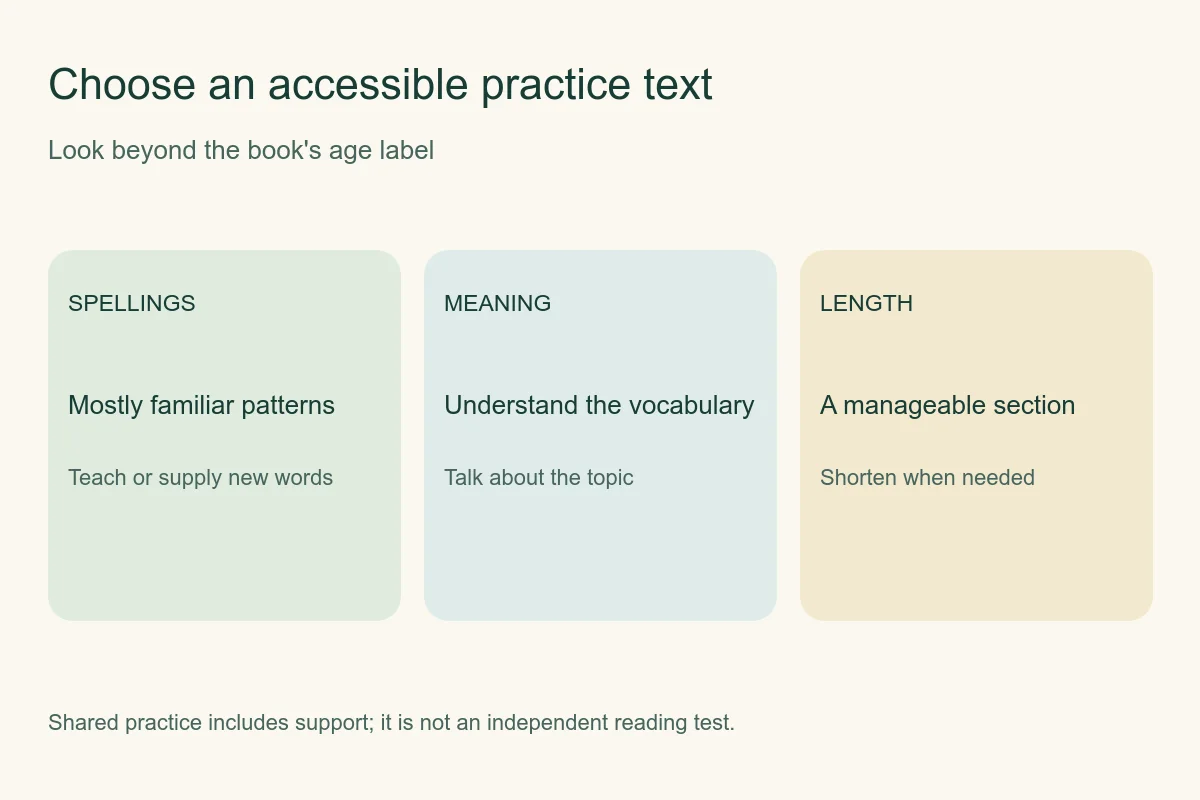
Choose a short section with mostly familiar spelling patterns and a topic the child understands. Read through it yourself first. Identify unusual names, new vocabulary, and any spellings not yet taught. A book’s age label or large print does not tell you whether its words match the child’s instruction.
For a new reader, a few sentences may be enough. For an older learner, choose respectful material on an interesting subject while reducing the length or providing help. Accessible practice does not have to mean babyish pictures, an entire page of repetition, or pretending that the child is younger.
Introduce the topic and explain an unfamiliar word’s meaning before reading. When the spelling is beyond the child’s current teaching, supply the word or select a different passage. Avoid a long guessing sequence based on the first letter or illustration.
Distinguish independent practice from shared reading. In independent reading, the child handles the text with little help. In shared practice, adult modeling and support are part of the plan. Neither activity should be described as a failure because it does not accomplish the other one’s purpose.
If a child struggles on nearly every line even after support, reduce the difficulty. Repeating an inaccessible page more times does not necessarily create useful practice. Keep richer read-alouds in family life so that access to stories and knowledge is not limited by the child’s current decoding level.
Five Supported Reading Fluency Activities
1. Echo reading
Read one short sentence aloud while the child follows the print. Use natural phrasing rather than an exaggerated performance. Then invite the child to read the same sentence. If a full sentence is too much, use a shorter meaningful phrase and gradually connect the parts.
Check that the child is attending to the written words rather than only repeating your spoken sentence from memory. Point to a selected word afterward, or return to the sentence later in a different order. Keep this a gentle check, not a trick designed to expose mistakes.
2. Read together, then reduce support
Read a short section together at a comfortable pace. Let your voice provide a model without overpowering the child’s voice. On a later attempt, lower your support and let the child lead. Step back in when needed, then return to a shared reading rather than insisting on an unsupported performance.
3. Reread for a different purpose
Use the first reading to work out the words, the next to attend to a sentence’s meaning, and another to practice a chosen phrase or character voice. You do not need to repeat the whole passage a fixed number of times. Stop when the task is no longer useful or the child has had enough.
Give a specific purpose: “This time, help the listener hear that this is a question.” That is more informative than “Read it better.” Rereading is practice, not proof of independent reading on unfamiliar text, so include a new accessible example later.
4. Mark meaningful phrases
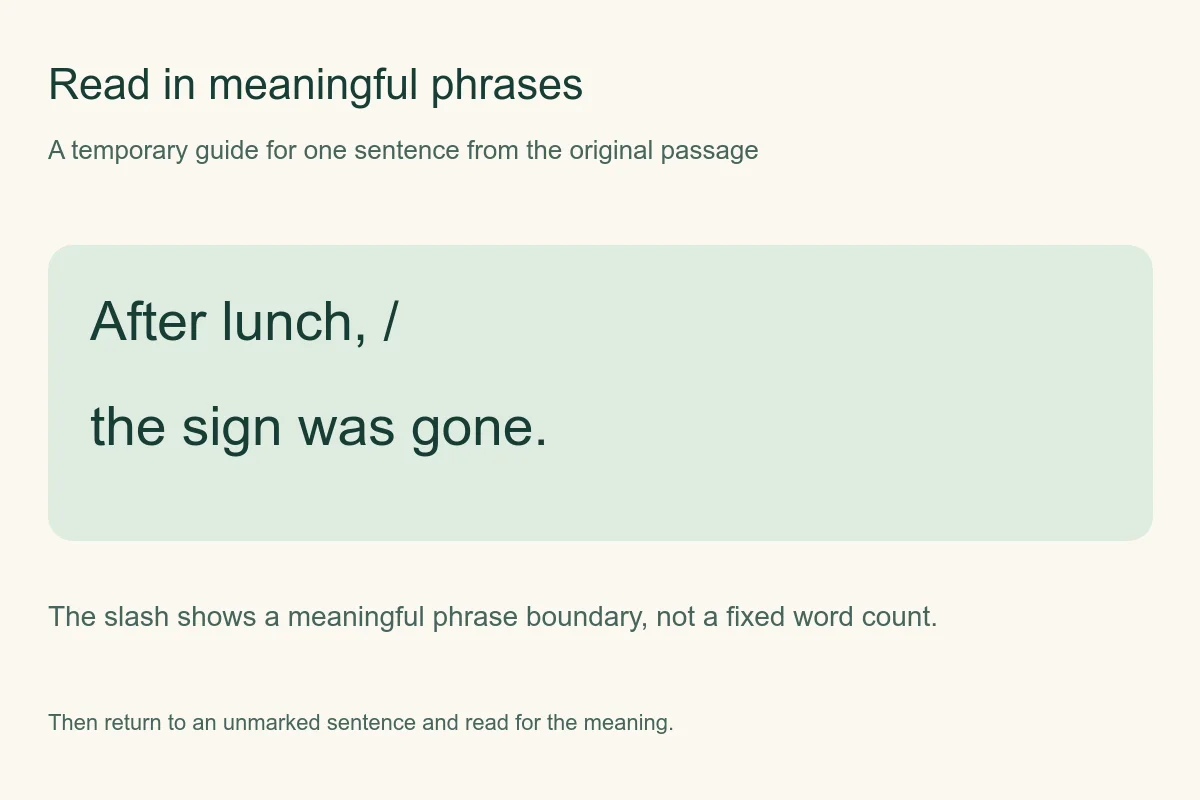
Copy one sentence and add light pencil slashes between sensible groups of words. For example: “After the rain, / we went to the garden.” Read it naturally, then invite the child to try. The slashes are temporary guides, not instructions to pause after an identical number of words.
Return to an unmarked version after practice. Ask whether the sentence still sounds like a complete thought. If marking creates more confusion, remove the visual cue and model the phrasing aloud instead.
5. Read to a real listener
Choose a short message, a dialogue, or a few lines the child wants to share with a family member or a toy audience. Practice enough to make the message clear. Let the child choose whether to perform; a public reading should not be the price of completing the lesson.
A listener gives expression a purpose. A question should sound like a genuine request, and an explanation should help someone understand. Resist turning every shared reading into a recording, a score, or a comparison with another child.
An Original Passage: The Missing Garden Sign
The passage below is written for this guide. It is not a controlled decodable text or a reading-level test. Check its words against the child’s instruction first. Names, longer words, and spellings such as those in garden and behind may need an adult model or a different text for a newer reader.
Mia put a small sign next to the beans. The sign said, “Please do not step here.” After lunch, the sign was gone.
“Did the wind take it?” Mia asked.
Dad looked behind the plant pots. Mia checked the path. At last, she found the sign under a bag.
“I put the bag there,” Dad said. “I did not see the sign.”
They moved the bag and put the sign back. This time, Mia set a stone beside it to help it stay in place.
Use the passage in three small steps
- Prepare: Talk about what a garden sign might tell a visitor. Model any unfamiliar words without asking the child to guess.
- Read: Share one paragraph or echo a short line. Choose a manageable section rather than insisting on the full passage.
- Connect: Ask one meaningful question and return to the relevant sentence together.
For phrasing, try “After lunch, / the sign was gone.” Then read the question “Did the wind take it?” with a natural questioning voice. Compare it with Dad’s explanation. Discuss how punctuation and meaning influence the reading, not only how loudly a character speaks.
Questions and suggested answers
- Where was the sign? Under a bag. Look back at the sentence where Mia finds it.
- Why had Dad covered it? He did not see the sign when he put the bag there. The text does not say he meant to hide it.
- What did Mia try at the end? She placed a stone beside the sign to help it stay in place. That was her solution; the story does not prove it will work in every situation.
If explaining the story is difficult, reread one short section with adult support. Compare the child’s understanding when listening with their understanding when doing the word reading themselves. This informal comparison may guide the next teaching conversation, but it is not a diagnostic assessment.
A Short Dialogue for Reading With Expression
Take one role each, model the exchange, and switch roles only if the child wants to. Check unfamiliar words before practice. The following dialogue is another original example, not a set of lines the child must memorize.
Sam: Is this your red bag?
Jo: No. My bag is blue.
Sam: Then whose bag is it?
Jo: Look at the name tag.
Sam: It says Kim!
Jo: Let us put it on Kim’s desk.
Ask which lines are questions and which supply information. Invite the child to make “It says Kim!” sound like a discovery, without insisting that there is only one correct performance. Then discuss how the speakers worked out what to do with the bag.
To create another dialogue, adapt our writing prompts for different abilities. The child can dictate a few lines while you write them. Keep the final reading task accessible instead of choosing vocabulary solely because it makes the script entertaining.
A Flexible Home Routine Without a Speed Target
Use a short block that fits the learner rather than a compulsory duration. One possible session is a minute of preparation, a few minutes of modeled or shared reading, a brief reread for meaning, and a final check-in. The exact timing is a planning choice, not an evidence-based dose for every child.
- Prepare one thing: Clarify a word, review a spelling, or discuss the topic.
- Read with the right support: Echo, read together, or take turns according to the task.
- Revisit one goal: Work on an accurate word, a meaningful phrase, or a sentence ending.
- End with meaning: Ask one useful question or invite a brief retelling.
For a familiar high-frequency word that repeatedly interrupts reading, use the first grade word-practice guide to examine its sounds and spelling. Avoid teaching the child to recognize only its outline or to ignore the letters because it appears often.
Keep independent reading, adult read-alouds, and explicit phonics in the wider routine as appropriate. Fluency practice is one part of literacy, not a substitute for teaching unfamiliar patterns or exploring new vocabulary and ideas. For broader resources, see our reading comprehension and literacy guide.
Notice Progress That Matters Beyond the Stopwatch
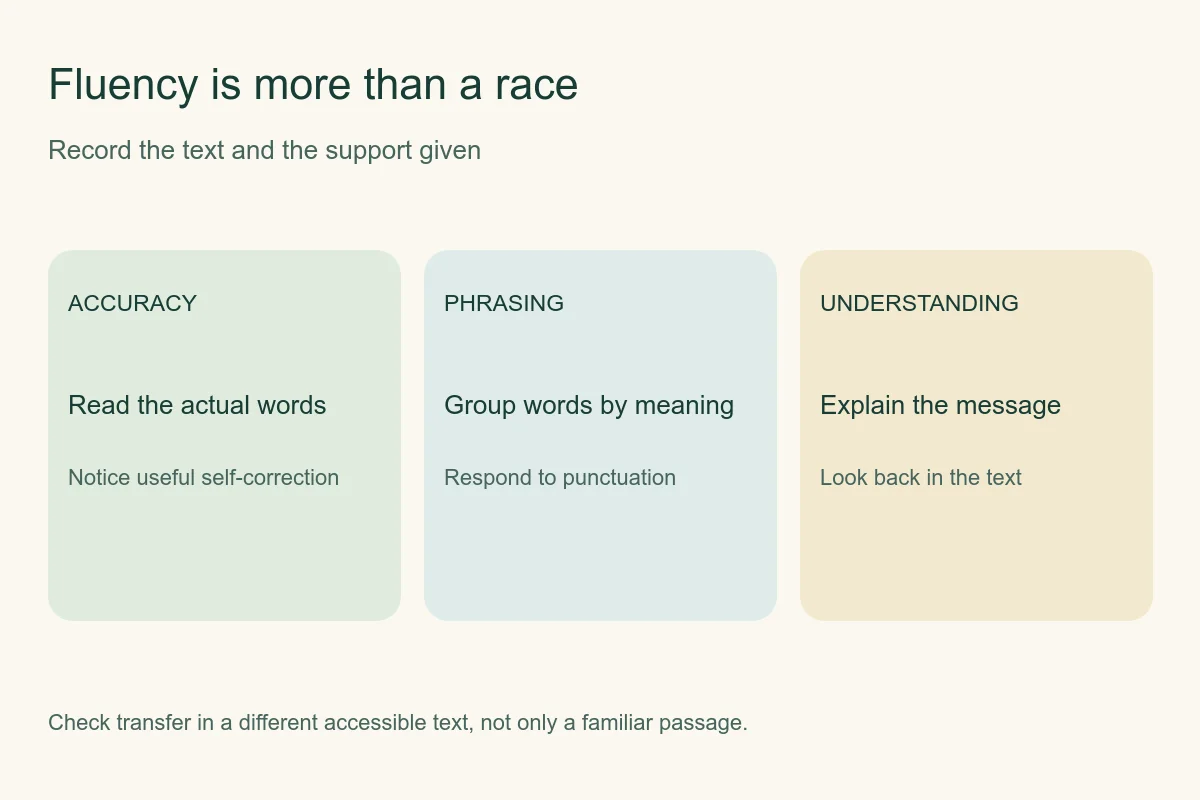
Write down the text, the help given, and one observation. For example: “Needed help with garden; reread the question naturally; explained where the sign was.” A record like this connects the practice to a next step instead of reducing the session to how many words were read.
Notice whether the child corrects a word after checking the print, groups familiar words into a phrase, responds to punctuation, or explains the message more clearly. Revisit the same passage if useful, but also try a different accessible text to see whether the learning transfers.
Formal fluency measures may include timing and standardized directions. This article does not provide grade norms or a replacement assessment. A home stopwatch score from an unstandardized passage should not be used to label a learning difficulty or compare children.
If the child consistently needs extensive help, becomes distressed, or makes little progress with well-matched instruction, bring work samples and notes to their teacher or a qualified reading specialist. Continue sharing interesting read-alouds while you seek guidance. A child can enjoy and discuss rich stories before independently reading every word in them.
Frequently Asked Questions
Should we use a stopwatch for every reading session?
No. Home practice can focus on accuracy, phrasing, expression, and meaning without a speed score. Formal timed measures have a different purpose and should use the appropriate materials and directions.
Is rereading a passage just memorizing it?
Rereading can provide supported practice, but a familiar passage alone does not show independent reading of new text. Keep attention on the print and include a different accessible example later to check how the learning transfers.
What if my child sounds out nearly every word?
Check that the text matches taught spellings, identify any uncertain patterns, and provide clear word-reading instruction alongside supported text practice. Reduce the length or difficulty when needed instead of simply demanding faster reading.
Do audiobooks replace reading practice?
Audiobooks can provide access to stories and vocabulary, but listening and independently reading print are different activities. Use listening as a complement while planning suitable opportunities for the child to read with the support they need.
Choose one useful next step: Find an accessible section, model a natural reading, and invite the child to share it with you. Revisit a clear goal and discuss the message. Smoother reading matters because it helps a reader understand and communicate—not because the page ends sooner.
One Response