
Screen-free phonics games can give children focused CVC practice without turning reading into another worksheet. Phonics games work best when the game changes but the reading target stays clear. If today’s target is blending short-a CVC words, a child does not need twenty unrelated rules, surprise spellings, or an app reward system. The child needs several useful chances to hear, build, and read words such as map, sat, and fin.
The eight screen-free phonics games below use simple materials and short rounds. They complement—not replace—explicit teaching. If joining sounds is the main difficulty, begin with our guide to CVC words blending practice before adding speed or competition.
Choose the game by the skill
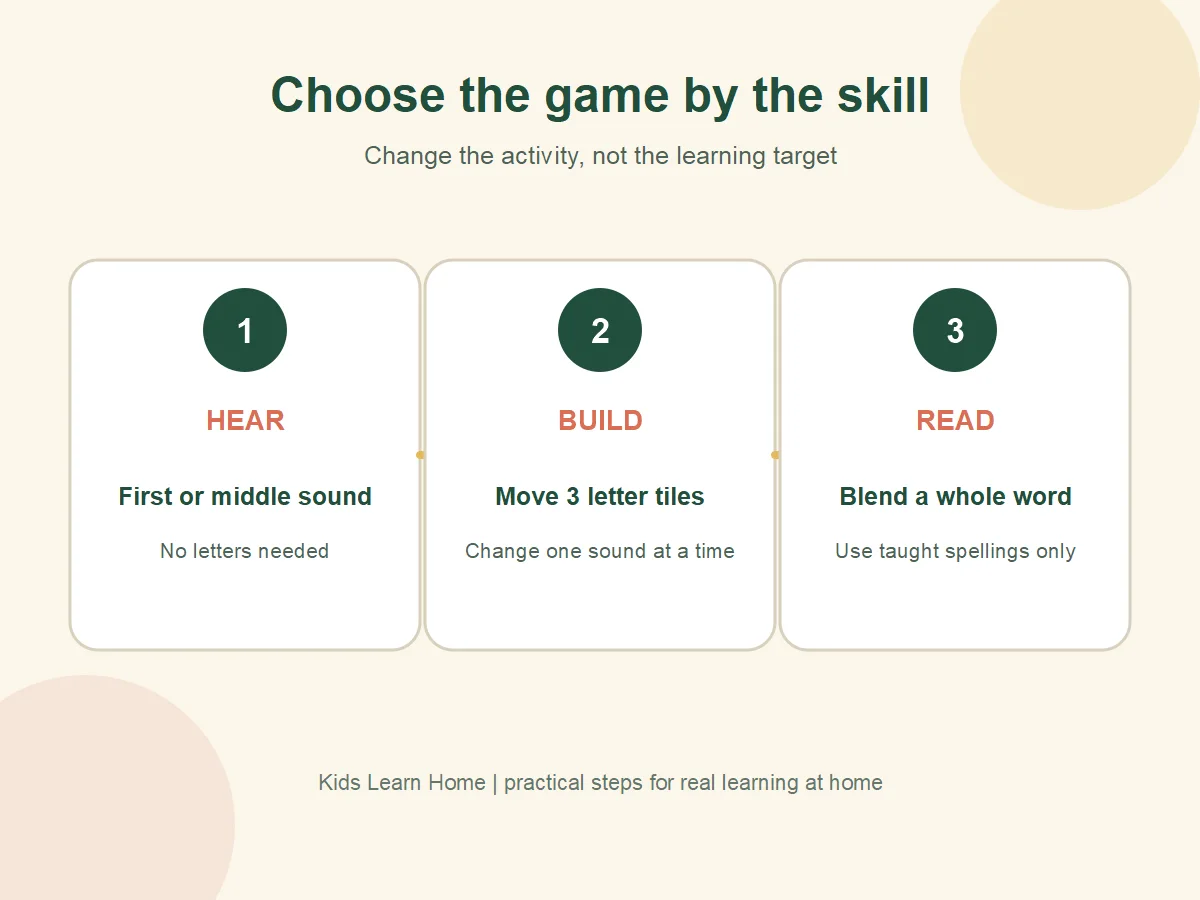
Before setting up, decide what the child will practise:
- Hear: identify a first, final, or middle sound without print.
- Build: choose and arrange letters for a spoken word.
- Read: look through the letters in order and blend the word.
The IES foundational reading guide recommends developing awareness of speech sounds and linking them to letters, then teaching children to decode words and read connected text. The games below are original practice ideas organized around those broad recommendations; they are not an evaluated curriculum.
Use spellings the child has already been taught. “Fun” does not require surprise difficulty.
1. Sound bag
Place six familiar objects or picture cards in a cloth bag. Choose items whose names begin with two target sounds, such as m and s.
On each turn, the child pulls one item, names it, stretches the first sound, and places it under the matching sound card. If naming the picture is difficult, supply the word before asking about its sound; vocabulary should not masquerade as a phonics failure.
Make it easier: use only two objects and say both names first.
Make it harder: sort by final sound.
Stop after: every item has been sorted once.
2. Build my word
Put three letter tiles in front of the child. Say a simple CVC word, stretching it naturally: “map.” Ask the child to touch a tile for each sound and then arrange the letters.
If the child cannot hold all three sounds in memory, build the word together and change only one tile: map → mat → sat. This reduces memory load while keeping attention on the changed sound.
Make it easier: give only the three needed letters.
Make it harder: add one extra letter as a distractor.
Stop after: three accurate builds or one sign of fatigue.
3. Continuous-blend slide
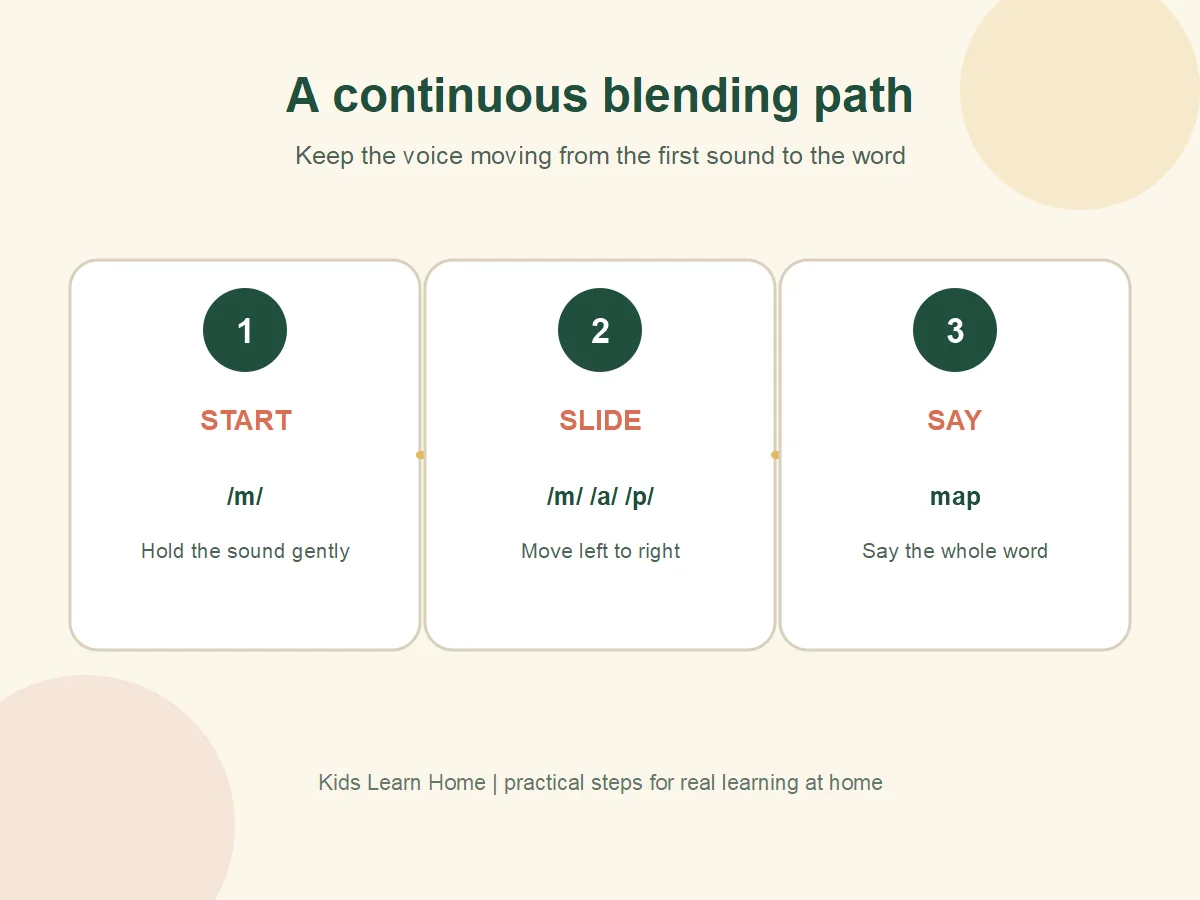
Write or build one word with wide spacing. Place a small counter under the first letter. The child begins the sound and slides the counter under the remaining letters without pausing between them, then says the word normally.
For map, the voice moves from /m/ into /a/ and then /p/. Avoid adding a strong “uh” after consonants; /muh-a-puh/ is harder to join than clean sounds.
The UFLI Foundations Toolbox includes official games, activities, and a decodable-text guide if you want resources aligned to a systematic sequence.
4. Change-one race
Build a starting word such as sat. Say a new word that differs by one sound: sit. The child changes the minimum number of tiles.
Do not race another child. Race the number of moves: “Can we make the new word by moving only one tile?” This keeps accuracy central.
Useful chains: map–mat–sat–sit; fin–fit–sit–sat. Check that every word is familiar and appropriate before the game.
5. Read-and-cover board
Make a 3×3 board of taught CVC words. Put nine counters nearby. The child reads a word and covers it. The adult can take a turn too, occasionally modeling a careful correction: “I said map, but the last letter is t. I’ll blend it again: mat.”
Make it easier: use six words with one vowel.
Make it harder: ask the child to find a word you say before reading it.
Stop after: one row is covered. A full board is optional.
6. Word detective
Display three words, such as map, mat, and sit. Give a clue based on sounds and letters: “I am thinking of a word that begins /m/ and ends /t/.” The child points, blends, and checks.
Avoid meaning-only clues if decoding is the target. “You sit on it” may invite picture or context guessing. Sound-based clues require attention to print.
7. Silly or real?
Mix real CVC words with pronounceable made-up forms using taught spellings. The child blends each item and places it under “real word” or “silly word.”
Explain that the point is to read what is printed, not to memorize a list. Keep made-up items pronounceable and culturally neutral. Do not use this game as a diagnostic test.
Stop rule: if the child is guessing or becoming upset, return to two familiar real words and finish successfully.
8. Tiny sentence builder
Prepare word cards the child can read, including one or two high-frequency words you will support. Build a short sentence such as “Sam sat.” Read it together, mix the cards, and rebuild it.
This game connects isolated word reading to meaningful text. The sentence must remain understandable; decoding practice should not crowd out language and comprehension.
For additional choices beyond phonics, visit our educational games collection or try the browser-based educational games for kids.
How to keep a phonics game from becoming a battle
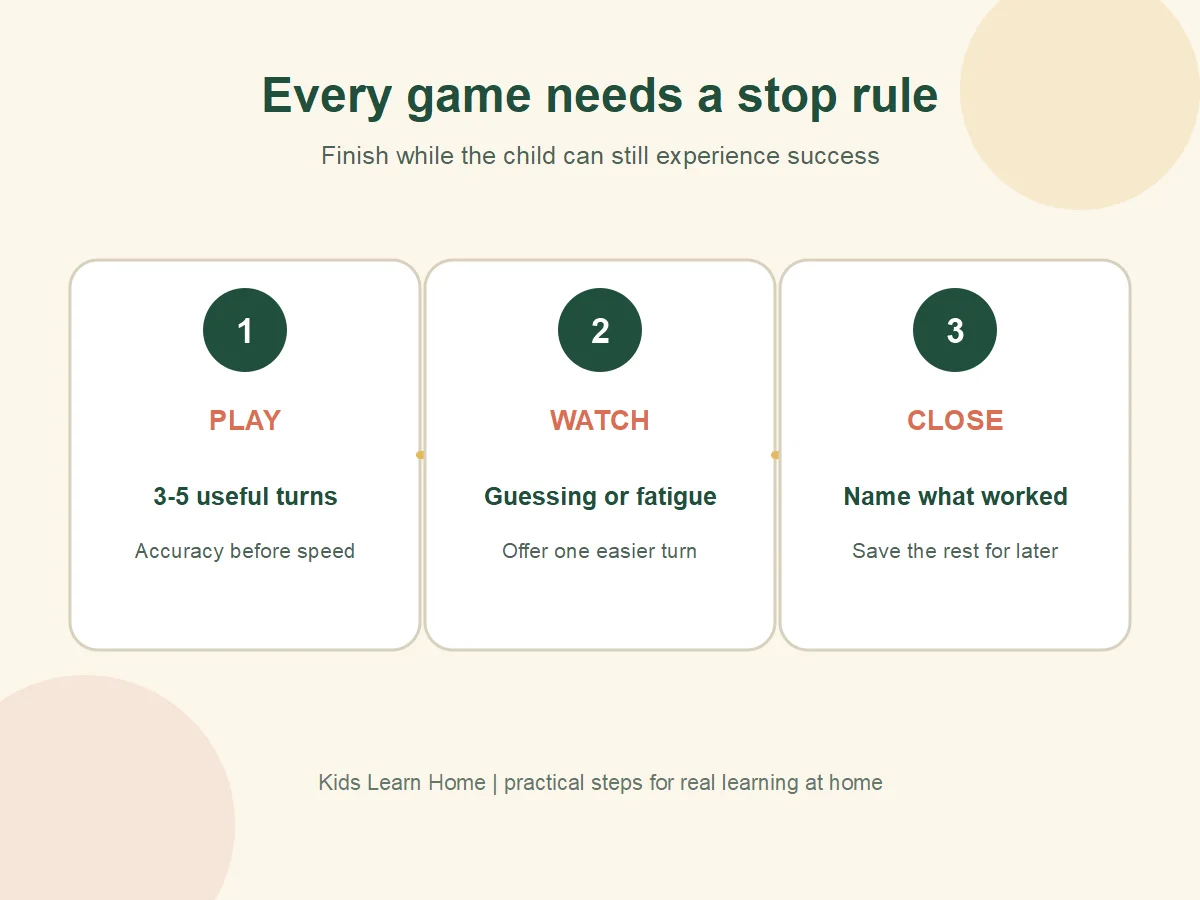
Every game needs a visible finish line. “We will take four turns” is clearer than “Let’s play until you know these.” Stop while the child can still name something that worked.
Use neutral prompts:
- “Point to each spelling.”
- “Start the first sound and keep your voice moving.”
- “Check the vowel.”
- “That guess does not match the last letter. Let’s try again.”
Avoid turning speed into the main score. Fast guessing is not stronger reading.
When a printable sequence would help
Games are useful for variety, retrieval, and connection. They can also become hard to organize: Which vowel should come next? Has this child practised the same skill in words and short text? What can we repeat tomorrow without rebuilding the materials?
For families who want that sequence, Blend & Read: CVC Phonics Workbook is a paid printable for ages 5–7. Its 44 pages combine short-vowel and CVC activities with six short stories; the download includes A4 and US Letter versions plus a printing/use guide. Use one manageable section at a time, then return to a game for a different kind of practice. It does not replace reading aloud, conversation, or professional support when concerns persist.
Plan a five-day game cycle
Repetition is easier to tolerate when the format changes. Keep one vowel pattern for several days while rotating the response:
- Day 1: hear and sort three words by first sound;
- Day 2: build a short word chain with tiles;
- Day 3: use the continuous-blend slide;
- Day 4: play read-and-cover with the same words in a new order;
- Day 5: read two or three of the words inside short sentences.
Record only what helps planning: which sound was clean, which vowel was confused, and whether the child blended or guessed. Do not turn the game into a secret test. The NAEYC developmentally appropriate practice statement is a useful reminder that intentional teaching must still respond to the individual child and context.
If a word remains difficult, reduce the set instead of inventing a louder reward. One accurate contrast—map versus mat—can be more informative than a board of twenty words.
Before putting the materials away, ask the child to choose one word to read once more. End with accurate evidence, not a score.
Questions parents often ask
Should I correct every error during a game?
Correct errors that change the target skill, but keep the correction brief. Point to the mismatched spelling, model once if needed, and offer another attempt. Do not interrupt a sound-sorting game for unrelated handwriting or vocabulary lessons.
Can siblings play together?
Yes, if turns are adjusted so both children can succeed. Give each child a separate word set or role. Avoid asking an advanced reader to answer before the beginning reader has time to think.
How long should a game last?
Use turns rather than a universal number of minutes. Three to five useful turns may be enough. Stop earlier when the child begins random guessing, leaves the task, or becomes distressed.
What if the child wins by memorizing the cards?
Change the order, build new words from the same taught spellings, and ask the child to point through the letters. Memorizing a few cards is not harmful, but the activity should still reveal whether the child can decode a new example.