
Homeschool friendships need more than a busy calendar. A child may attend a class, recognize several names, and still wish for someone to play with again. Families often need a practical bridge between meeting another child and making a second, comfortable plan together.
This guide focuses on parent-supported friendships for roughly ages 4–10. It covers choosing a recurring setting, making a clear invitation, supporting the first visit, and noticing whether the connection feels mutual. For the broader skills involved, explore our life and social skills collection. The sample messages and planning steps are original suggestions, not promises that a particular schedule will create a best friend.
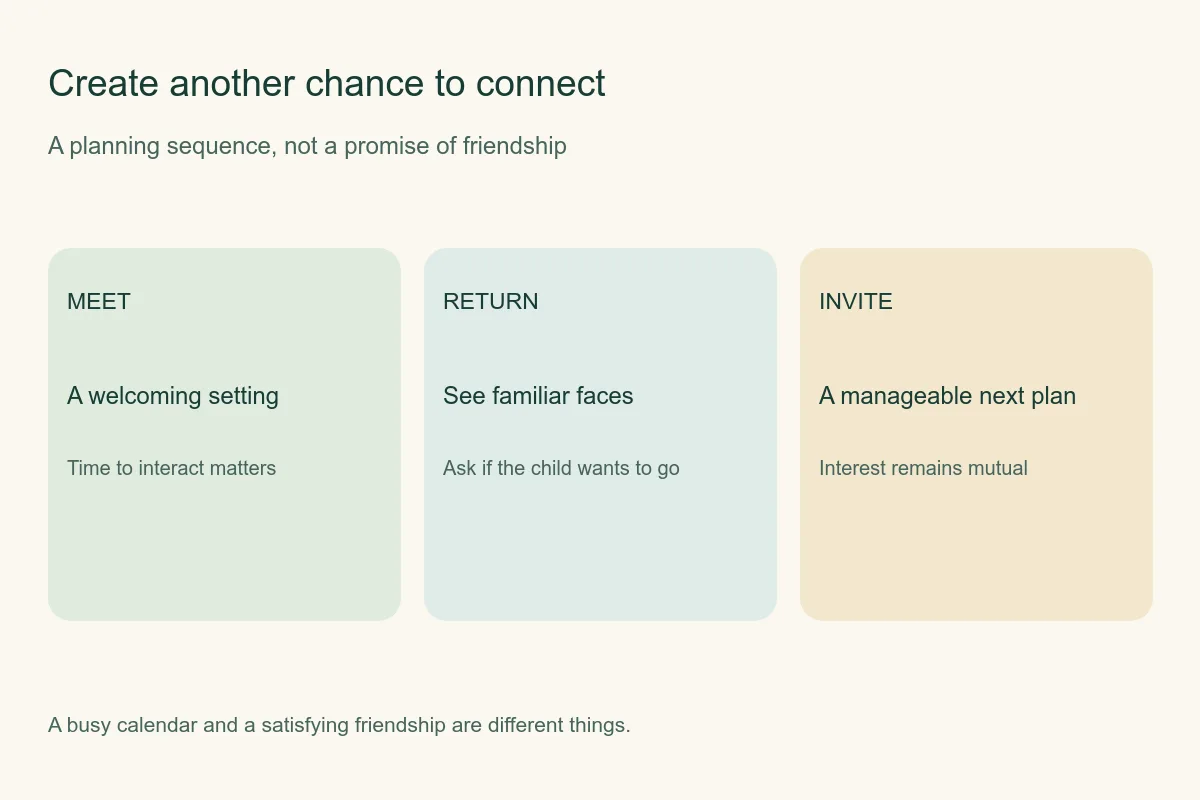
What Helps Homeschool Friendships Become Familiar?
Meeting people and developing a friendship are related but different experiences. A large event gives children many faces to notice. A recurring small group gives them another chance to remember a game, continue a conversation, or discover a shared interest. Neither guarantees closeness, but each serves a different purpose.
Ask the child about the experience rather than the label: “Who did you enjoy being with?” or “Would you like to play that game again?” Some children call everyone a friend; others reserve the word for a very close connection. What matters is whether they have welcome, satisfying opportunities with peers.
Do not treat shyness as a problem to eliminate or assume an outgoing child needs no help. A quieter child may prefer a shared task beside one person. A child who talks easily may still need support listening, making room for another idea, or finding a setting where the same children return.
The American Academy of Pediatrics’ guidance on supporting friendships emphasizes adult availability, communication, and help with interactions. It is general guidance, not a comparison proving that one school setting produces better friendships than another. Make decisions from your child’s actual experience.
Choose a Setting With Time to Interact
For homeschool friendships, look at what happens inside an activity, not just its name. A lesson may be excellent but allow little child-to-child conversation. A library club, park group, community art session, accessible sports activity, or homeschool co-op may provide a better opening when it includes time to talk or play.
Ask the organizer practical questions. Do similar ages attend regularly? Is there informal play before or after the session? Can a caregiver stay while a child becomes familiar? What supports exist for communication, sensory, mobility, or other access needs? Are the cost, travel, and expectations manageable enough for your family to return?
Choose one promising setting rather than filling every afternoon immediately. Repeated visits can reveal whether the atmosphere is welcoming. Notice how adults respond to exclusion, whether a child can opt out of an activity, and whether newcomers receive help joining in. An impressive program is not automatically the right fit.
Offer choices without making the child responsible for the whole search. “Would you rather try the building club or the park group?” is more manageable than “Go make friends.” An adult still handles the arrangements, transport, supervision, and follow-up for younger children.
If there are few local options, consider a small recurring meet-up with another family you already know. A shared drawing, a walk on a suitable route, or building at a community table can be enough. You do not need to create a formal co-op before offering a second opportunity to play.
Support Homeschool Friendships With Clear Invitations
A specific, low-pressure invitation is easier to answer than “We should get together sometime.” Talk to the other caregiver privately and offer a place, a general activity, and a possible time. Keep the first plan simple enough that either family can leave comfortably.
Here is an original message you can adapt: “The children seemed to enjoy building together today. Would you like to meet at the library’s family table next Tuesday after the session? We could bring paper and crayons. It is fine if that day does not work.” Send it through an agreed adult contact route.
Ask your child first, without announcing that you have found their new best friend. They may like the activity but not want a separate meeting yet. Offer another visit to the original setting instead. Homeschool friendships develop between children; adult arrangements create opportunities rather than obligations to feel close.
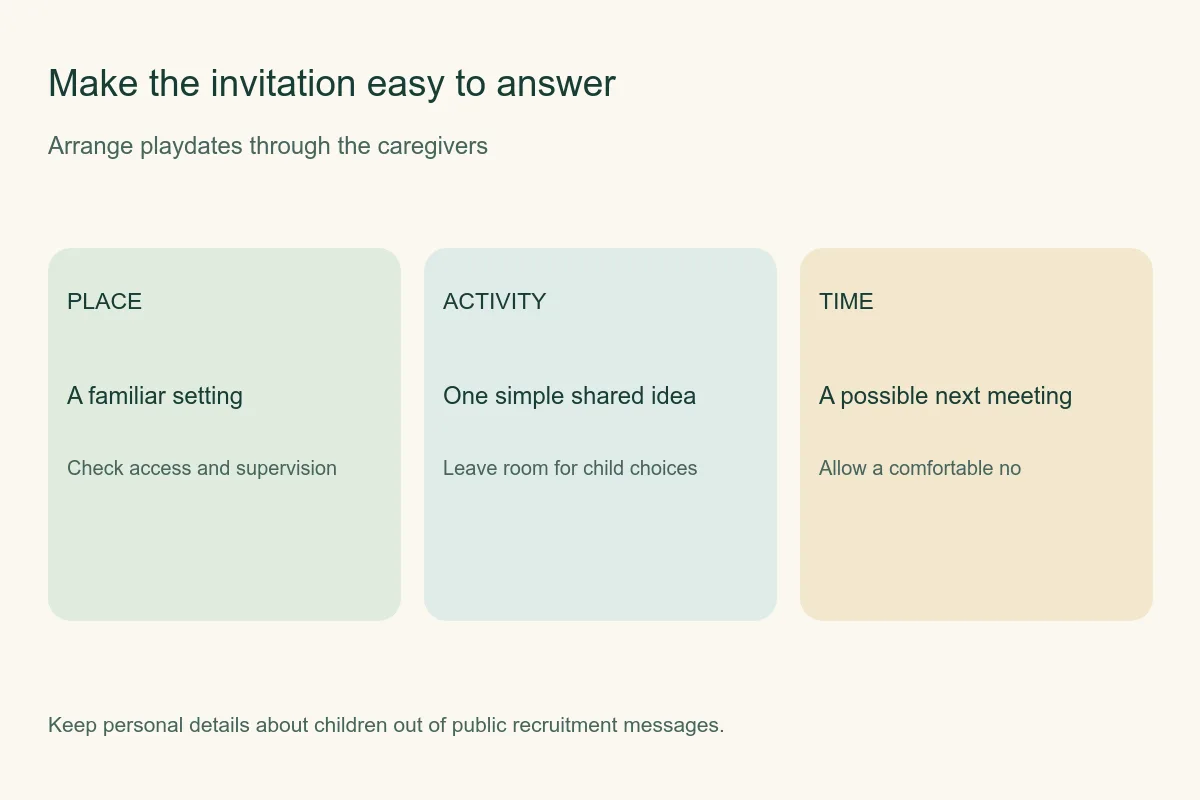
If the answer is no or there is no reply, do not make the child interpret it as rejection. Work, transport, health, and family schedules can affect a response. One polite follow-up may be useful if a plan was already discussed. Repeatedly chasing an uninterested family usually adds strain without creating a mutual connection.
Keep your child’s privacy in mind when arranging homeschool friendships. Adults can exchange contact details without sharing children’s accounts, addresses, or personal difficulties in a group chat. Do not post a child’s loneliness publicly to recruit friends. Describe the activity and age range when asking an organizer about suitable opportunities.
Support the First Playdate Without Directing Every Move
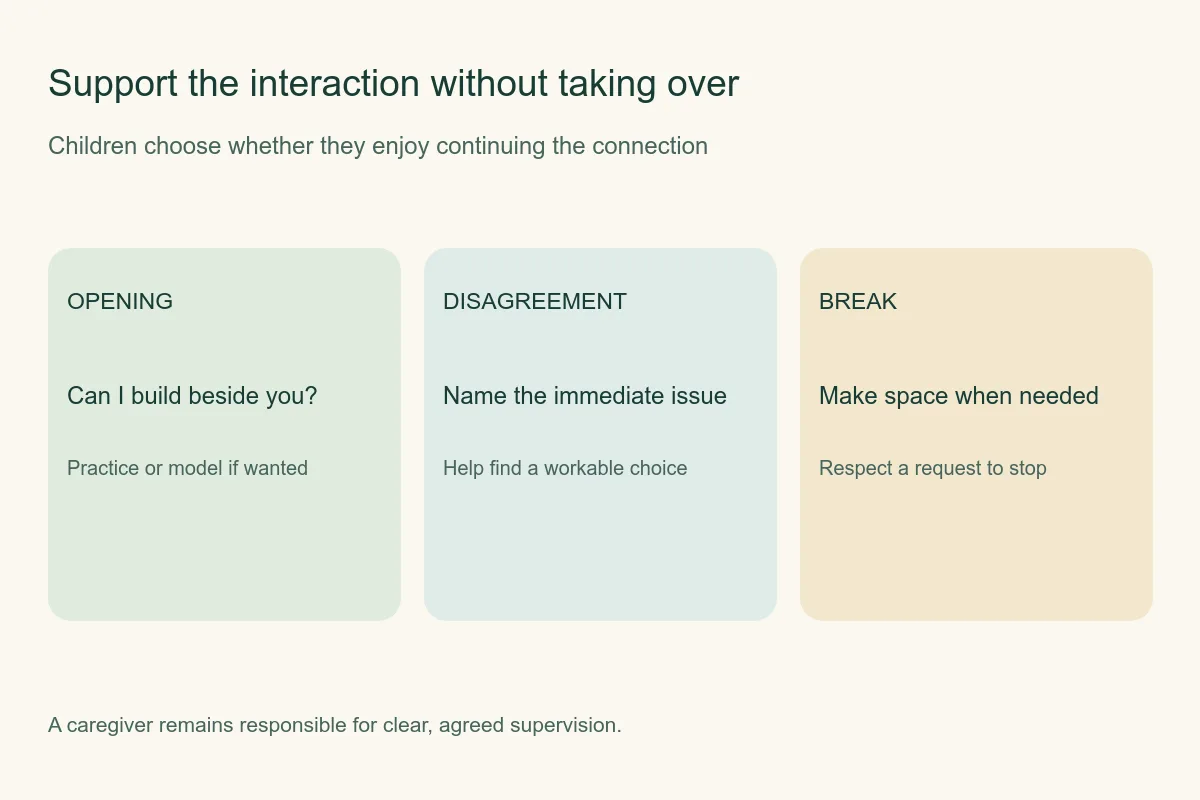
Choose a familiar, manageable activity with room for both children to contribute. A drawing together, a shared construction, or pretend play can offer an opening. Have an alternative available, but avoid presenting a long entertainment schedule. The children need some freedom to discover what they enjoy together.
Before visiting another home, discuss supervision, household rules, pets, food allergies, and any relevant hazards with the caregiver. The AAP’s questions to ask before a playdate provide a useful conversation starter. Decide explicitly who is responsible for the children rather than assuming another adult has taken over.
Help with an opening phrase if needed: “Can I build a house next to yours?” Practice it at home through pretend play, but accept the child’s own wording. Pointing, showing an object, or using a communication aid can also start an interaction. Speech performance should not become a condition for joining.
If a disagreement occurs, first make people safe, then describe the immediate problem. “Both of you want the same large block. What are two ways we could use it?” Offer help if they are stuck. Avoid assigning one child a fixed role such as bossy, shy, or difficult.
A child may need a break or may decide this is not someone they enjoy playing with. Respect that information. Shared interests are helpful, but consent, kindness, and mutual enjoyment matter too. Our adaptable group game ideas can supply a neutral activity when both children want another chance and need a clearer starting point.
Make a Realistic Plan for Homeschool Friendships
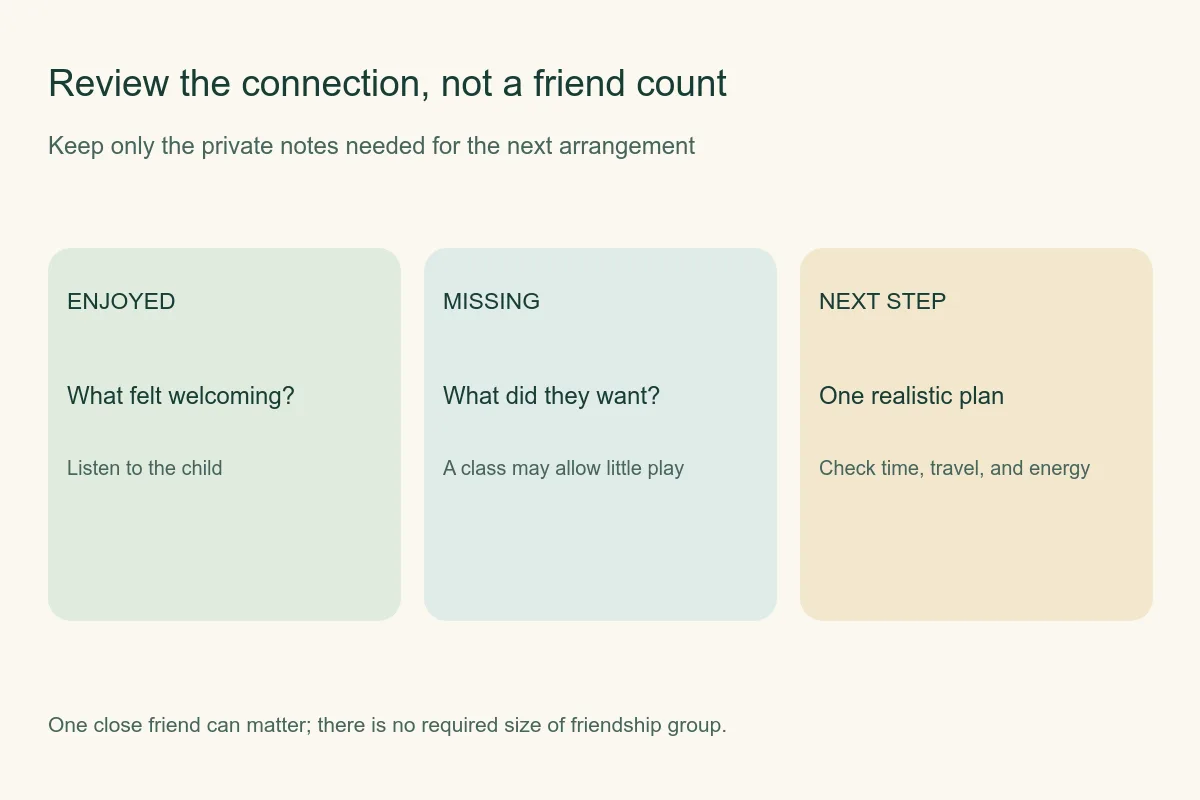
Use a small review cycle rather than a quota of social hours. First, identify one setting where the child felt comfortable. Next, return when feasible. Then, if both children seem interested, offer a second opportunity. Review what happened before adding another commitment. This sequence is a planning tool, not a developmental timetable.
Keep a private parent note with only necessary details: the setting, whether the child wanted to return, and the next arrangement. You do not need a score for sociability. A child saying “I want to finish our pretend shop next week” tells you more than counting every person they spoke to.
Protect space for friendship in the family routine. Our flexible schedule for multiple ages can help you plan around teaching turns and younger-sibling care. Treat meeting a friend as a meaningful part of the week, while keeping transport and caregiver energy realistic.
When plans repeatedly fall through, examine the arrangement instead of blaming a child. A fixed public meeting after an existing class may be easier than coordinating a new home visit. Sharing transport may help when adults know each other well and agree on safety. A shorter plan nearby can be more sustainable than a distant event.
If your child feels lonely, listen directly: “You wish you had someone to see again.” Avoid answering only with a list of activities they already attend. Ask what kind of connection they miss, then make one concrete change. Persistent distress, withdrawal, or bullying deserves attention from a trusted professional or responsible organizer, not simply another calendar entry.
Distance does not have to end an established friendship. A caregiver-arranged call, shared letter, or occasional visit can help children keep in touch. For a simple message idea, adapt one of our writing prompts for different ages. Keep online contact appropriate to the child’s age and supervised by the adults responsible.
Frequently Asked Questions
How often do homeschooled children need to see friends?
There is no single schedule that fits every child or family. Consider the child’s wishes, the quality of the interactions, access, and whether there are regular chances to meet again. A full calendar does not necessarily provide close connections. Ask what feels satisfying or missing, and adjust the plan using that information.
Is a homeschool co-op necessary for making friends?
No. A co-op is one possible setting for homeschool friendships, alongside neighborhood play, libraries, clubs, and existing family connections. Look for a welcoming environment where children can interact and return. Check practical matters such as supervision, access, cost, and free play time rather than choosing solely because a group carries a homeschool label.
What if my child is happy with one friend?
A child does not need a large friendship group to justify feeling content. Listen to what they value about the connection and keep other welcoming opportunities available. Avoid treating one friend as a deficit or pressuring the child to collect more. Notice whether the relationship is kind, mutual, and comfortable for both children.
What should I do if other parents never initiate?
Try one clear invitation tied to a convenient recurring activity, then notice whether the arrangement feels workable and mutual. Some families have barriers you cannot see, so avoid guessing their motives. You can remain friendly while putting more effort into connections that respond. Your child should not carry responsibility for managing adult schedules.
Choose One Connection to Support This Week
Homeschool friendships need opportunities to meet again, invitations adults can act on, and space for children to choose each other. Start with one setting your child liked, ask whether they want to return, and make a manageable next plan. Keep supervision and access clear. Afterward, listen to what felt enjoyable or difficult instead of judging success by a friend count. The next step may be a second park meeting, a shared drawing after class, or trying a different group. Follow the connection your child actually wants to continue.