
A nature journal for kids is a place to record something noticed outdoors: a leaf’s edge, a bird’s movement, or a puddle that looks different today. It does not need beautiful drawings, long sentences, or an expensive curriculum. A child can point, dictate, sketch, count, or add a photograph taken with adult help.
This guide shows how to start with one familiar spot, offers an original observation page you can copy, and explains how to revisit a question. Adapt the ideas for roughly ages 3–10. For other ways to explore, browse our kids science and STEM collection. The aim is careful noticing and curiosity, with writing and drawing serving that aim rather than becoming a barrier.
Start a Nature Journal for Kids With One Place
Choose a spot you can reach again: a safe part of a park, a courtyard plant, a tree seen from the pavement, or a view through a window. Returning to a familiar place makes change easier to notice. A long trip is optional, and a distant nature reserve is not a requirement.
Bring plain paper or a notebook, a pencil, and something firm to lean on. Add crayons or a ruler only if they help the chosen observation. A clipboard can support loose sheets, which you can store in a folder afterward. Let the child help choose a format that feels usable rather than precious.
Check the location and materials first. Stay on suitable paths, establish boundaries, and keep an adult responsible for supervision. Observe unfamiliar plants, fungi, and animals without touching or tasting them. Do not collect from protected areas or disturb nests. Look at the sun’s effects on the scene without looking directly at the sun.
The National Park Service’s nature-journaling lesson includes observation, questions, and context such as date and weather. That particular lesson is labeled for middle school. The shorter activities here are our adaptations for younger learners, not a claim that the original lesson was designed or tested for preschoolers.
Make a Useful Entry in a Nature Journal for Kids
Look before naming
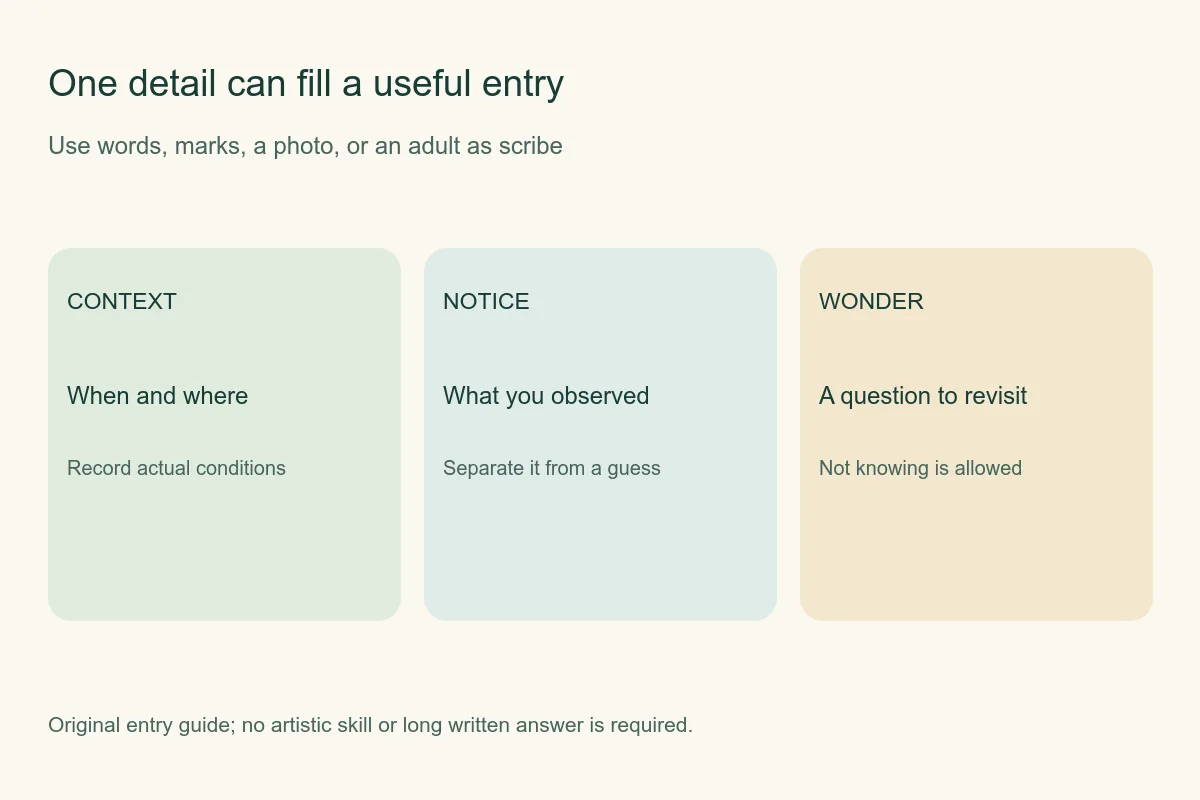
Ask the child to choose one thing that catches their attention. Give them time to look before asking a string of questions. They might notice a leaf has a torn edge, a bird hops instead of walks, or rain gathers along a window frame. You do not need to identify a species to describe a visible feature.
Start with “What do you notice?” If that is too open, offer a concrete choice: “Is the edge smooth or pointed?” Accept pointing and gestures. A child may need you to describe what the words mean before using them. Avoid turning every observation into a guessing game with one hidden correct answer.
Separate what you see from what you think
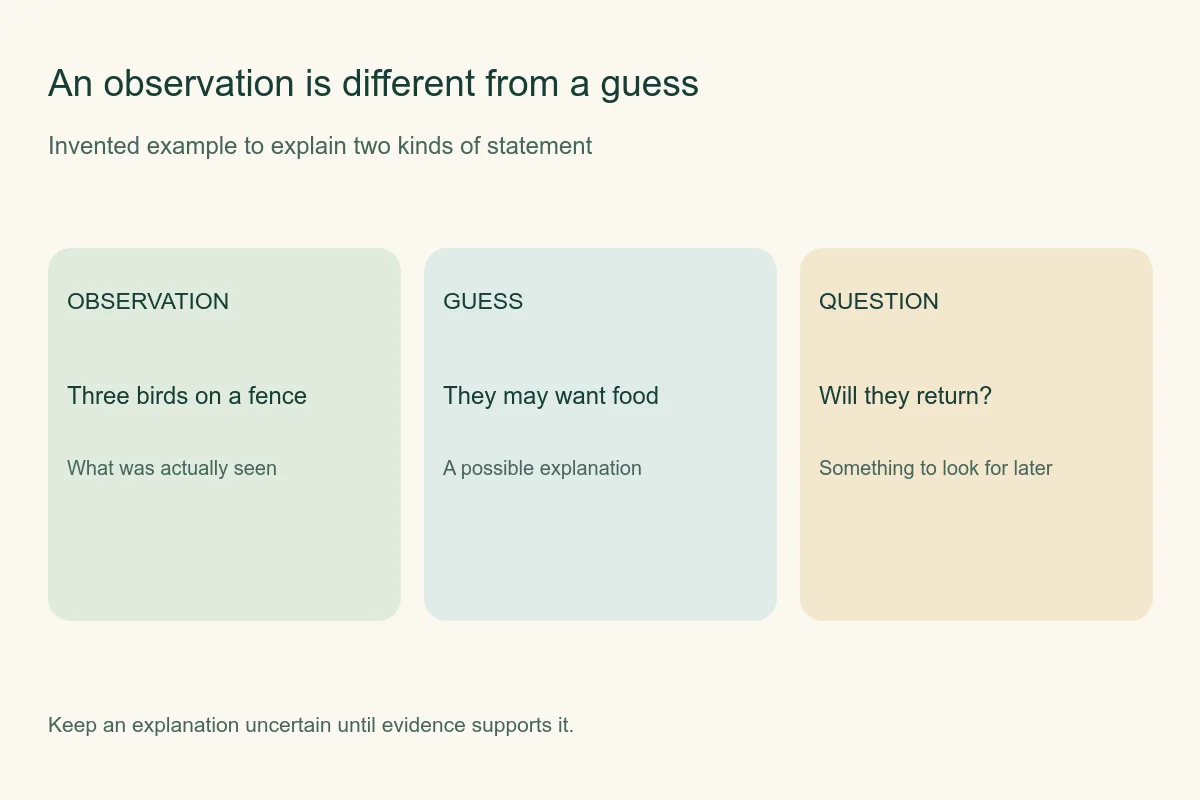
Write an observation and an idea in different spaces. “Three birds are on the fence” describes what was seen. “They may be waiting for food” is an interpretation. Both can belong in a nature journal for kids, but keeping the distinction visible helps children understand how a question differs from evidence.
If a child says “The tree is sad,” acknowledge the story, then ask what they can observe: drooping leaves, a broken branch, or dry soil. Record their imaginative comment if they want, alongside a concrete description. Scientific noticing does not require removing imagination; it asks us to label the kind of statement we are making.
Add a question you could return to
Help the child turn curiosity into a manageable question. “Why does everything grow?” is a large conversation. “Will this bud look different next week?” gives you something you can revisit. A younger child might simply ask whether the same bird will be there again.
It is fine to write “We do not know yet.” A field guide, a librarian, or a relevant museum resource can help with later identification. When you look something up, record the source separately from the child’s original observation. A name found online should not replace details the child actually noticed.
A Nature Journal for Kids: Copyable Page Format
The following format is an original starting page, not a standardized assessment. Copy it onto paper or use it as spoken prompts. Leave most of the page open for the child’s choice of marks, drawings, or dictated words. One detailed observation can be enough for a session.
| Space on the page | What to record |
|---|---|
| When and where | Date, approximate time, general place, and simple weather notes. |
| I noticed | One or more details you actually saw or heard. |
| My record | A drawing, adult-written words, a count, or a photograph. |
| I wonder | A question, with guesses clearly marked as guesses. |
| Next visit | What you would like to look at again. |
Here is an invented example to show the difference between the spaces. Date: October 29. Place: courtyard planter. Weather: cloudy. Observation: “I see two open flowers and one closed bud.” Record: a rough drawing with a line pointing to the bud. Question: “Will the bud be open when we return?” Next visit: look at the same plant.
This is a model entry, not a report of a real child or a prediction that every bud opens on schedule. The outcome might be an open flower, an unchanged bud, or a plant that is no longer there. All three give you something to discuss honestly.
Keep private information out of pages you share publicly. A general place name is enough; you do not need a home address, exact daily route, or a child’s full name. Ask permission before sharing the child’s work, and check that photographs do not reveal other children’s identities or location details.
Adapt a Nature Journal for Kids of Different Ages
For a preschooler, a nature journal for kids might hold one scribble and a sentence an adult wrote exactly as spoken. Offer a choice between looking at a leaf and listening for a sound. Do the writing yourself if needed. There is no need to complete every box in the template.
For an early reader, invite labels, a counted group, or one short comparison. “Today the leaf is browner” can be more useful than a copied paragraph about trees. If handwriting is tiring, let the child dictate and add one chosen word. The journal should show their observation, not measure how much copying they can tolerate.
An older child can record units, compare dates, label an uncertainty, or explain how they counted. If measuring a leaf, use a consistent method and keep the ruler’s units visible. Do not compare two numbers as though they represent growth if they were taken from different leaves or from different starting points.
Some children prefer a spoken recording, large paper, a photograph, or marks made with an adapted tool. Support those choices. Our age-adapted writing prompts can help a child tell a later story inspired by the outing. Keep that creative story separate from the observation record so neither purpose becomes confusing.
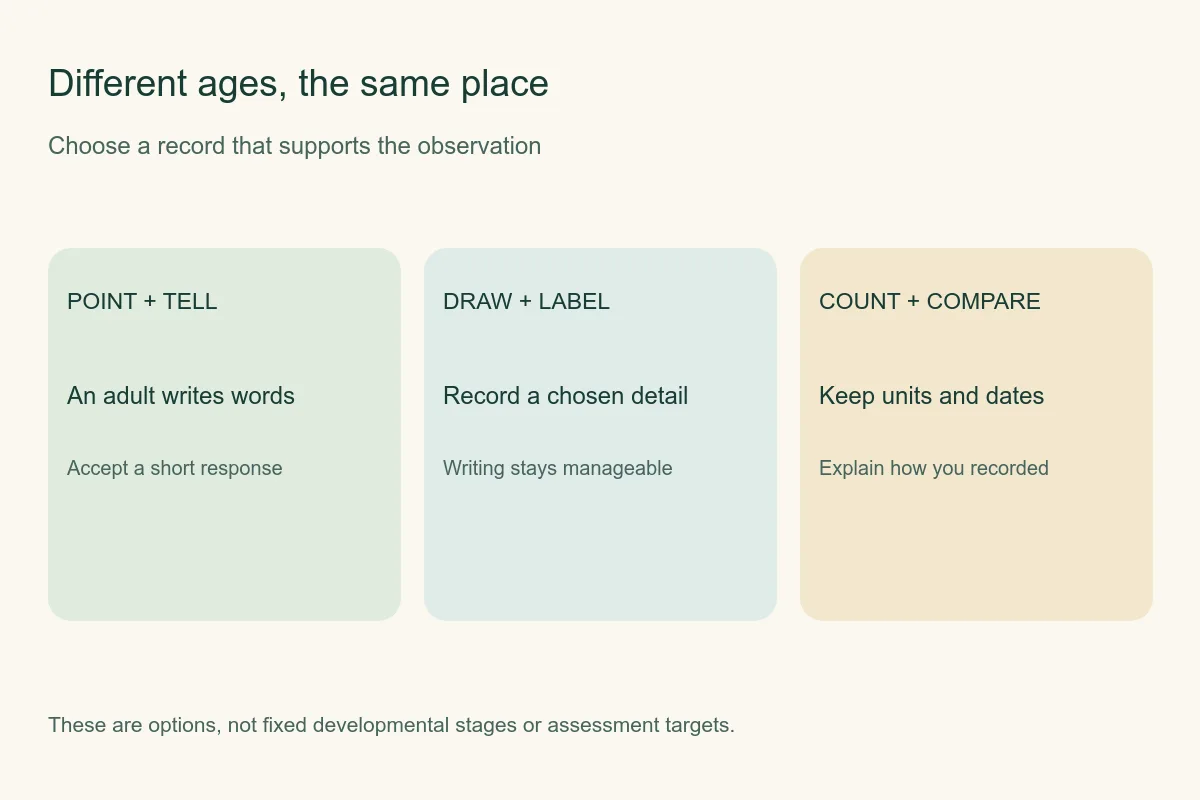
For siblings, share the same place without requiring identical pages. One child might point to a color while another compares shapes. Invite them to show each other something they noticed. Do not grade the younger child’s drawing against the older child’s labels or require everyone to finish at the same moment.
Return to the Same Question and Compare Carefully
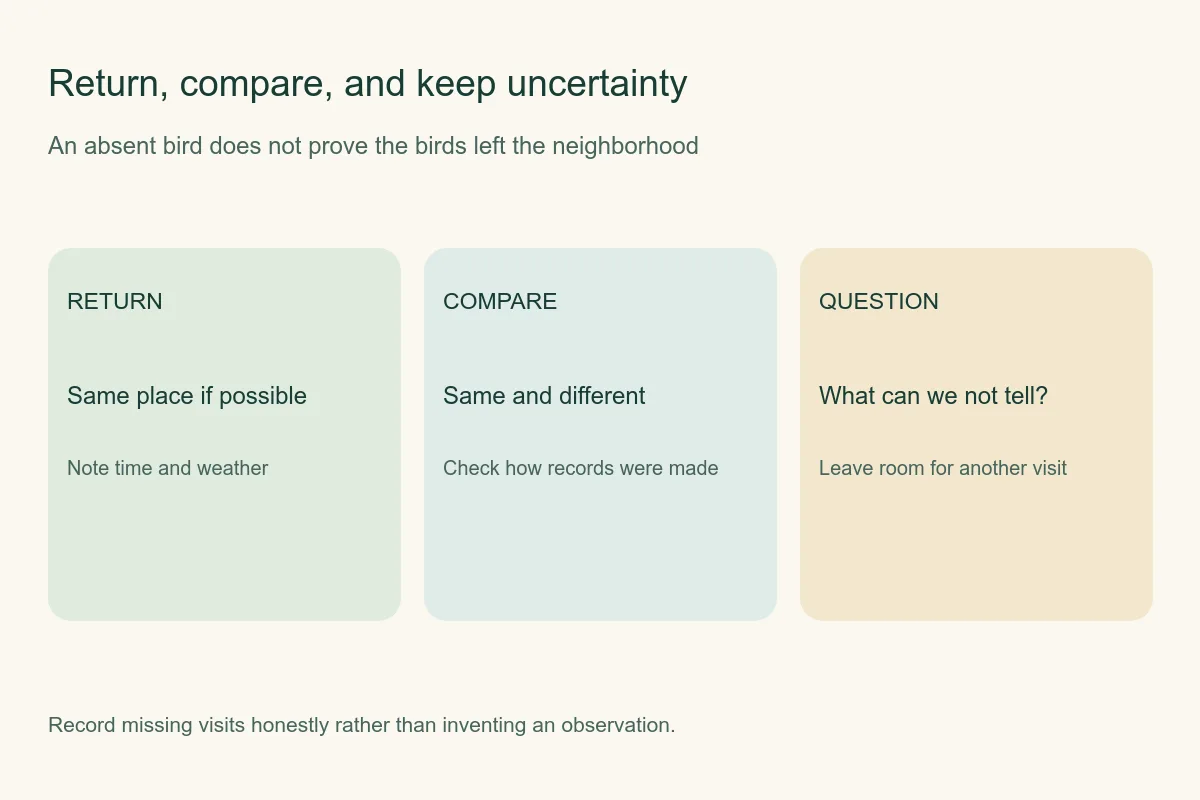
Revisit when it fits the family and the question. Some changes are visible within a day; others need longer, and some will not happen during your visits. Record the new date and conditions rather than making the journal look consistent by filling gaps from memory.
Place two entries side by side. Ask, “What stayed the same? What looks different? What can we not tell?” If birds are absent on one visit, that does not prove they have left the neighborhood. Time, noise, weather, and the length of your observation may differ. A small record can raise a question without proving its answer.
Use a simple comparison: the same viewpoint, the same subject when possible, and a similar way to record it. If the subject changes, say so. A photograph of a different flower is still interesting, but it is not evidence that the first flower changed color.
The Smithsonian’s Discovery at Home activity packet includes a supervised nature walk with a notebook or observation sheet. It supports the general idea of observing and recording outdoors. Our page format and example entries are original, and they do not establish a measured learning outcome.
When the child wants to investigate a comparison more deliberately, use our guide to planning a fair science investigation. Observing a plant is different from deliberately changing one condition. Keeping those approaches distinct makes both more useful.
For another supervised activity after journaling, the science experiment finder can suggest a next step. Review its materials and precautions first. A nature journal for kids does not need an experiment every time; returning to notice more carefully can be the whole activity.
Frequently Asked Questions
What if my child does not like drawing?
Offer dictation, a spoken description, a simple tally, or an adult-assisted photograph instead. Drawing is one way to record an observation, not an entrance requirement. Ask the child which detail they want to remember. Keep the record connected to that detail, and avoid adding a drawing assignment merely to fill the page.
Can a preschooler keep a nature journal?
Yes, with a very small task and adult support. A preschooler might choose a leaf to look at, make marks, and dictate a short comment. The adult manages supervision and records words if needed. Do not expect a complete page, accurate scientific drawing, or the same recording method used by an older sibling.
Do we need to know plant and animal names?
No. A nature journal for kids can start with visible features and behavior, with names added later when useful. Record uncertain identifications as uncertain. Use a suitable field guide rather than guessing confidently from one picture. Observe unfamiliar living things without touching or tasting them, and follow the rules of the place you visit.
How often should we write in the journal?
Choose a rhythm you can return to without pressure. A regular short visit may help you compare changes, but daily entries are not required. Let the question and the family’s circumstances guide the timing. Write the actual date and conditions, and leave gaps honestly rather than inventing observations to complete a schedule.
Begin With One Detail Worth Remembering
Choose a reachable place, record something actually observed, and leave space for a question. Those three steps give a nature journal for kids a clear purpose. Let the child use words, marks, photographs, or your help as a scribe. On the next visit, compare carefully and say what you still do not know. Start with the copyable page above and one detail today. The notebook does not need to become a polished art book; it needs to help your child look again and remember what made them curious.