
Decodable books vs early readers is not a contest between one good format and one bad format; each serves a different reading purpose. “Level 1,” “beginning reader,” and “easy reader” do not tell you exactly which words a child will meet. One book may repeat predictable sentences with many untaught spellings. Another may tightly control the spelling patterns but sound less natural. A third may be perfect for an adult read-aloud and completely unsuitable for independent decoding.
The useful question is not “Which label is best?” It is “What is this book for, and does its print match what this child has learned?”
Browse our free printable books collection for available resources. Use the five-minute check below before assigning any text as independent practice.

What is a decodable book?
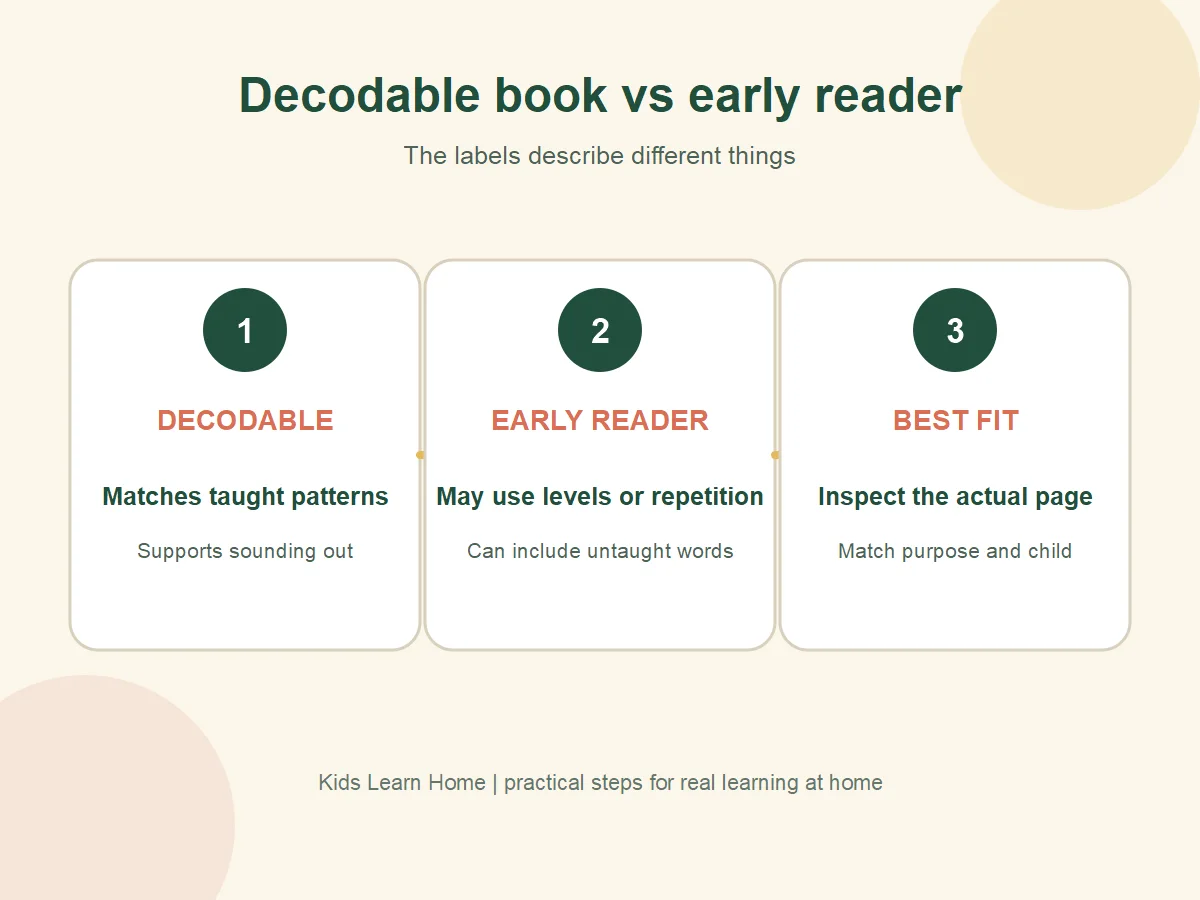
A decodable text is designed so that a high proportion of its words can be read using sound-spelling patterns the learner has already been taught. The exact fit depends on the instructional sequence. A book decodable after short a, i, and several consonants may not be decodable to a child who has learned a different set.
Decodable does not mean the child must read without help. A text can include a small number of irregular or not-yet-taught words that the adult previews or supplies.
What is an early reader?
“Early reader” is a broad publishing or library label. The book may use short sentences, repeated patterns, familiar topics, large print, picture support, or a leveling system. It may also contain spellings beyond the child’s current phonics knowledge.
An early reader can be valuable for shared reading, language, enjoyment, or a child who already knows its patterns. The label alone does not establish decoding fit.
The IES foundational reading practice guide recommends teaching decoding explicitly and giving children supported practice in connected text. The UFLI Foundations Toolbox includes a decodable-text guide and aligned resources. These sources support matching practice to taught skills; they do not declare one commercial label universally superior.
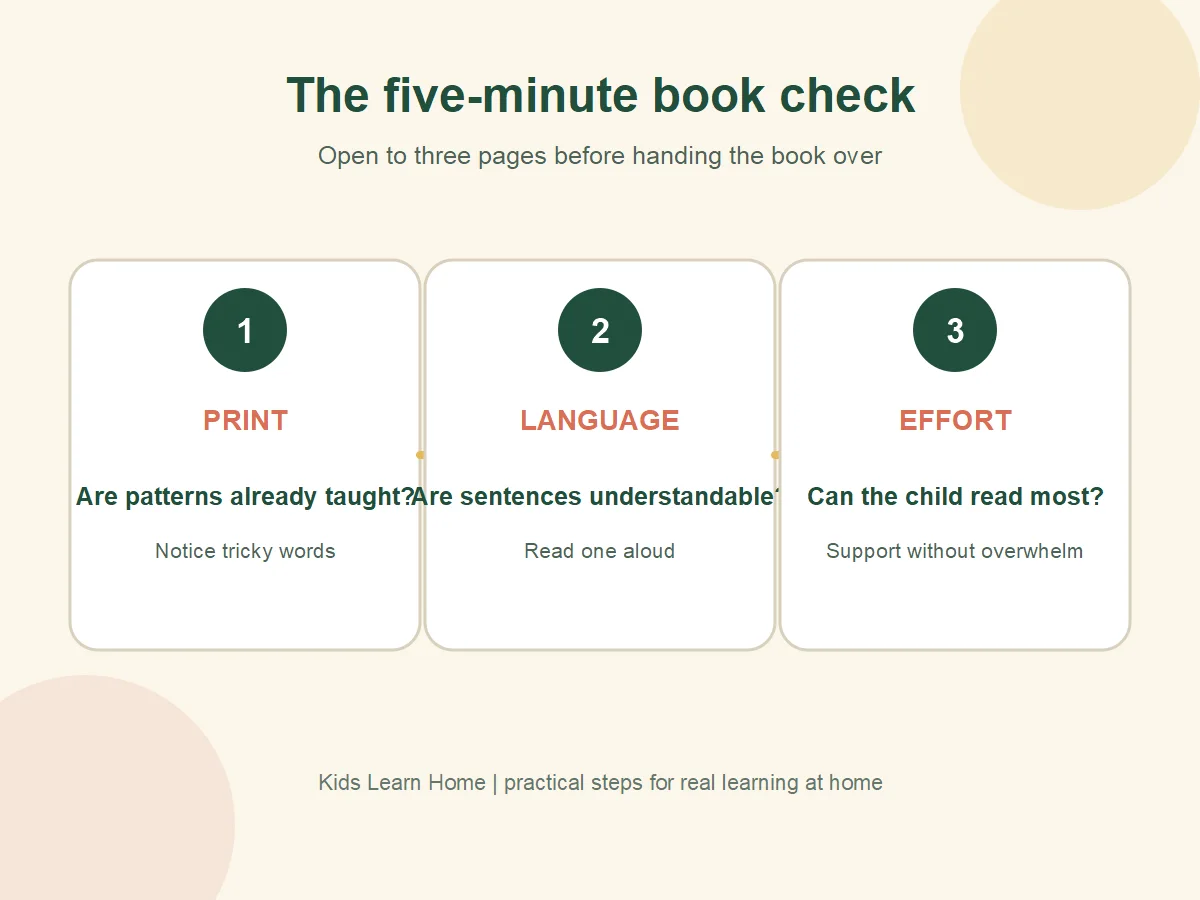
The five-minute book check
Open to three ordinary pages—not only the first page.
1. Check the print
Underline or note several words. Can the child decode their sound-spelling patterns? How many require guessing or adult supply? Look beyond word length: ship may be accessible after sh is taught, while one is short but irregular.
2. Check the language
Read a sentence aloud. Is the grammar understandable? Are key words familiar, or can you explain them briefly? A decodable sentence can still be confusing if it uses unfamiliar language.
3. Check picture dependence
Would the child identify the printed word from its letters, or only because the illustration makes one answer obvious? Pictures should enrich meaning, not replace attention to print.
4. Check emotional load
Can the child read most of the page with available support? A page that demands help on nearly every word is probably better used as an adult read-aloud or saved for later.
5. Check interest and dignity
Does the topic respect the child’s age and interests? A struggling older reader may need simple print without babyish content.
Analyze one sample page
Imagine the text: “Sam sat. A cat sat. Sam can pat the cat.”
For a child taught s, a, m, t, c, p, n and simple CVC blending, much of the text may be accessible. The adult may need to support punctuation and natural phrasing.
Now consider: “Sam looked at the playful kitten and laughed.” The sentence may be engaging, but it contains several more advanced spellings and word forms. It may be excellent for an adult to read and discuss while being poorly matched to early independent decoding.
Neither sentence is morally better. They serve different jobs.
How to use pictures without encouraging guessing
Before reading, explore the cover and discuss the topic. During decoding, ask the child to attend to the whole printed word. After identifying it, check whether it makes sense in the sentence and picture.
If the child says dog for dig, respond: “Dog fits the picture, but the middle letter spells /i/. Read all three sounds.” Keep the correction factual.
For a detailed live resource on attending to sounds in sequence, use our CVC blending guide.
Build a balanced reading menu
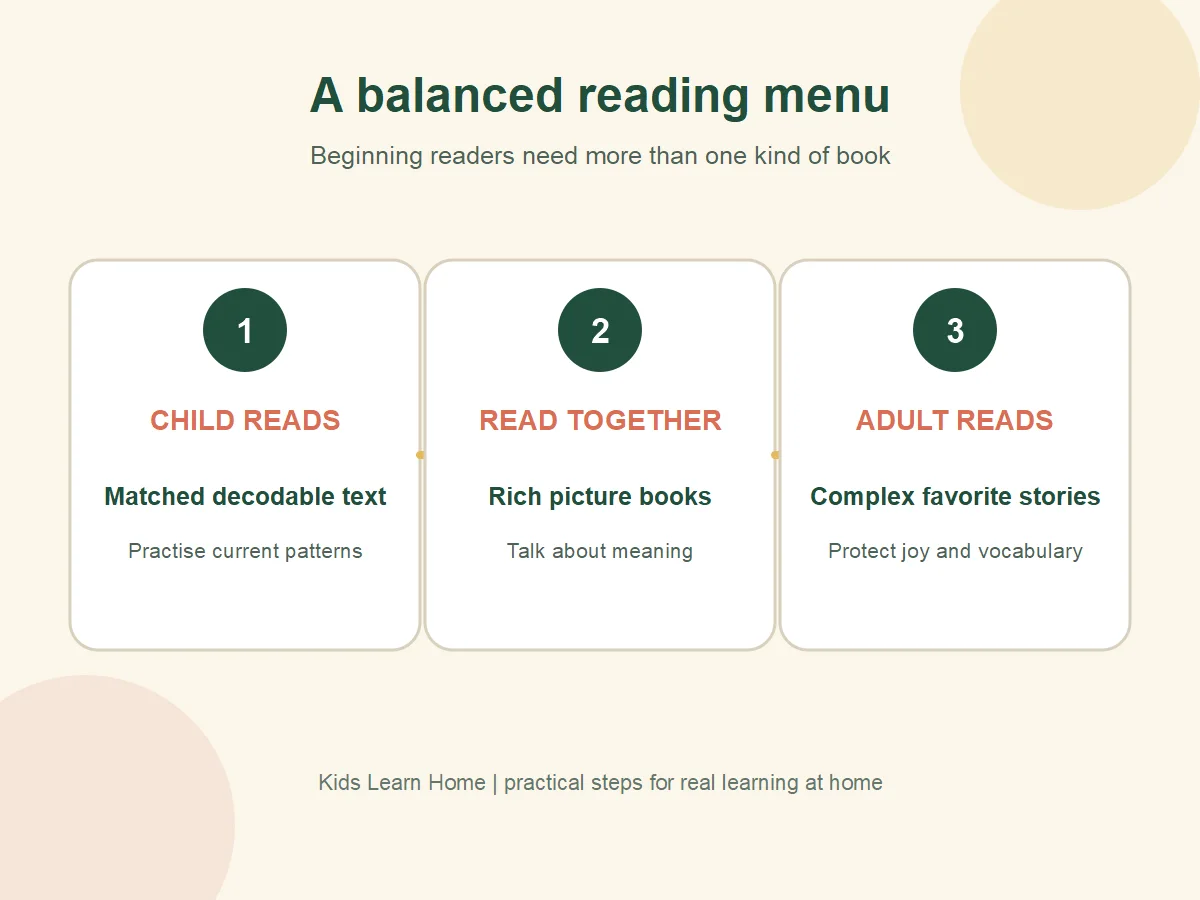
A beginning reader benefits from different text roles:
Child reads
Use short text closely matched to taught patterns. Support one or two exceptional words and discuss meaning afterward.
Read together
Share patterned books, poems, dialogue, and favorite pages. The adult can handle difficult words while the child joins accessible parts.
Adult reads aloud
Choose rich picture books, nonfiction, chapter books, and stories beyond the child’s independent level. Talk about ideas and vocabulary. Independent decoding level should not cap knowledge or imagination.
When to move to a harder book
Move forward when the child can read most words accurately, use taught patterns without constant prompting, and maintain enough attention to understand the page. A few supported words are normal. Persistent guessing, frustration, or loss of meaning suggests the jump is too large.
Do not move up solely because a friend, sibling, or age label suggests it. Do not keep a child in overly controlled text after it no longer provides useful practice. Continue checking actual pages.
Where a CVC workbook fits
A workbook and a book serve different purposes. A workbook can isolate a short-vowel pattern, provide word-building repetition, and prepare the learner for connected text. A book carries meaning across sentences and supports the experience of reading.
Blend & Read: CVC Phonics Workbook is a paid 44-page printable for ages 5–7. It includes short-vowel/CVC activities, six short stories, A4 and US Letter versions, and a printing/use guide. It can act as a bridge before or alongside carefully matched decodable books. It is not a replacement for shared reading, library visits, or rich read-alouds.
You can also review the free kindergarten phonics workbook before deciding whether a paid structured resource fits your family.
Create a simple home book record
You do not need a complex reading-level spreadsheet. For each practice book, note:
- the sound-spelling patterns it expects;
- two irregular words you will preview;
- whether the child decoded, guessed, or needed supply;
- whether the child could retell the page;
- whether the book should be repeated, shared, or saved.
Avoid recording speed as the only measure. A slower reading with accurate word identification and understanding may be more useful than fast guessing. Do not turn the record into a public scorecard.
The UFLI printable-resources page includes supplemental decodable passages and guidance that can help you understand alignment. Use official materials according to their instructions and do not copy commercial or copyrighted books into your own worksheets.
Support multilingual beginning readers
Ask whether the child understands the English vocabulary before interpreting a pause as a decoding problem. A child may accurately sound out a word without knowing its meaning, or know the concept in another language without knowing the English label.
Preview essential meanings, connect them to the child’s languages and experience, and still ask the child to attend to English spelling when reading English text. Reading aloud in the family’s strongest language supports knowledge and connection; it does not compete with carefully taught English phonics.
The decision in one minute
Use the book for independent practice when most spellings are taught, the language is understandable, and the child can maintain meaning with modest support. Use it for shared reading when the story is appealing but the print is too demanding. Read it aloud when ideas and vocabulary are the main value.
The same book can change roles as instruction progresses. Label the purpose on a removable note—child reads, read together, or adult reads—and revisit it later. That is more informative than permanently declaring the book too easy or too hard.
Questions parents often ask
Are decodable books boring?
Some are limited by the patterns available, while others use humor, illustration, and cumulative storytelling effectively. Evaluate the actual book. Pair decoding practice with rich read-alouds so vocabulary and ideas are not restricted.
Must every word be decodable?
No. A small number of previewed or supported words can make a text meaningful. The key is that the child can genuinely practise the target patterns rather than guess most of the page.
Are level numbers comparable across publishers?
Often they are not. Inspect sample pages and compare them with the child’s taught sound-spelling knowledge instead of assuming two “Level 1” books are equivalent.
What if my child wants a book that is too hard?
Read it aloud, take turns, supply difficult words, or choose one accessible sentence per page. Interest is valuable; the book does not need to become an independent decoding test.