
Learning stations for ages 5–7 do not require a miniature classroom or hours of preparation. A learning station is not a miniature classroom center that requires hours of laminating. At home, it can be one basket, one visible action, and one clear finish point. The child knows what to do, which materials belong there, and how to tell the task is complete.
Ten minutes is a convenient planning unit for ages 5–7, not a universal attention-span rule. Some stations will last four minutes; a building challenge may hold attention for twenty. Use the child’s engagement and the task’s purpose—not the timer alone—to decide when to move.
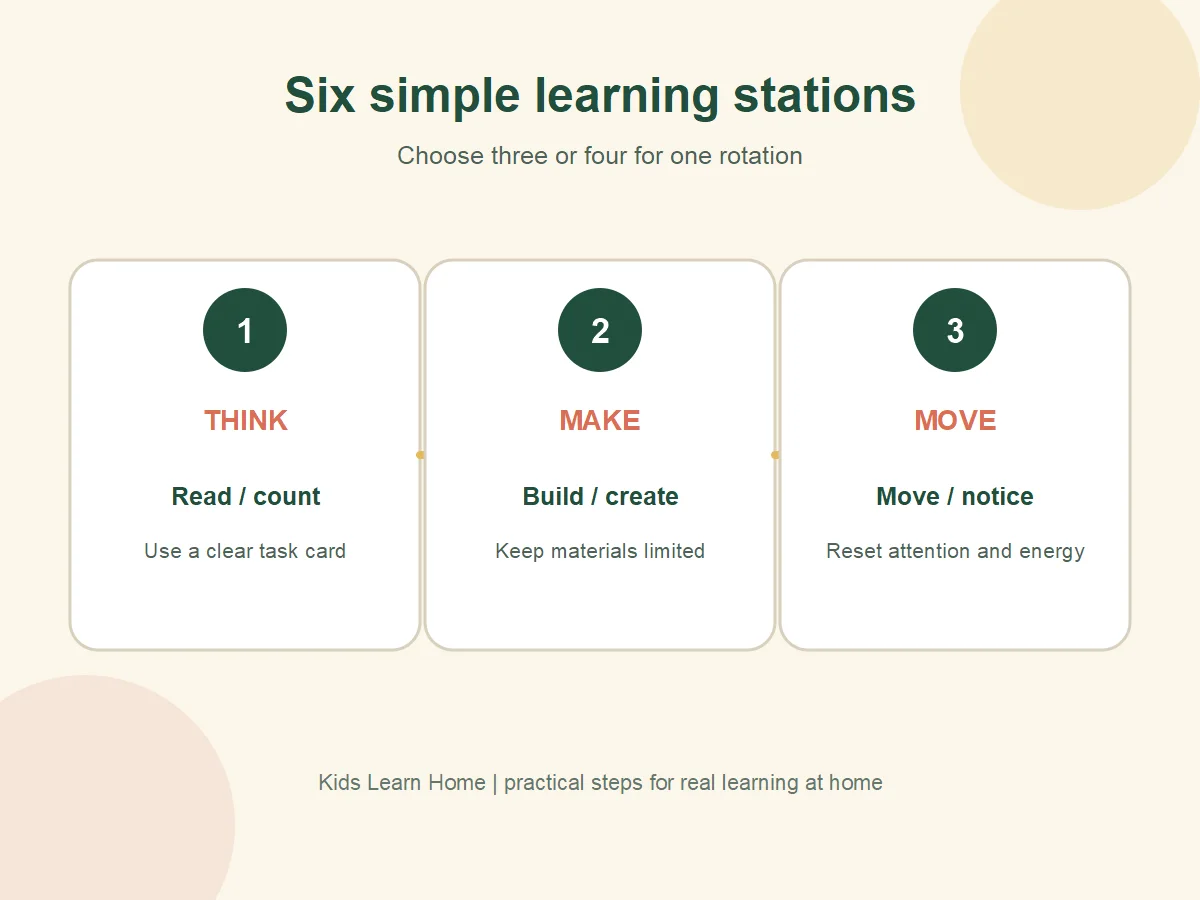
For broader choices, browse kids activities by setting and learning goal. These stations are designed to form a short rotation.

The anatomy of a useful station
Every station needs three answers:
- Do: What single action should the child take?
- Use: Which limited materials are available?
- Finish: What visible condition ends the station?
“Play with blocks” is open but vague. “Build a bridge that holds two toy animals; test it once; return the blocks to the basket” is independent enough to begin and bounded enough to finish.

Station 1: Read
Do: Read one matched page, retell a familiar book, or listen while following the print.
Use: one book or one short printable, a pointer, and a help card.
Finish: place a marker at the stopping point and tell one thing you understood.
Do not use an independent station to introduce a difficult phonics pattern. Teach first. The station is for supported review or meaningful reading.
Station 2: Build
Do: solve one design challenge.
Use: a small container of blocks, cups, craft sticks, or recycled card plus one or two toy figures.
Finish: test the design against the stated goal and take a photo or draw it if desired.
Examples:
- build a bridge for two animals;
- make a tower taller than one book;
- design a shelter with a roof and entrance;
- build two different shapes using the same ten pieces.
Avoid dumping every construction toy into the station. Constraints make the task easier to enter.
Station 3: Count
Do: represent one number or solve three carefully chosen problems.
Use: counters, ten frame, number cards, and pencil.
Finish: show the same quantity in two ways.
For example, represent 8 as 5 and 3, then as 4 and 4. Ask the child to explain what stayed the same. For targeted printable practice, visit the math worksheets hub.
Station 4: Make
Do: explore one art technique or create within one constraint.
Use: paper plus two or three tools.
Finish: choose one part to keep and name one thing tried.
Examples include tearing a collage using only two colors, drawing with three kinds of line, or making a pattern from stamps. A defined technique prevents “make something” from becoming another demand for inspiration.
Station 5: Move
Do: complete a short movement sequence.
Use: floor spots, tape line, soft ball, or no equipment.
Finish: complete the sequence twice and reset the space.
Try: step–jump–balance–crawl. Let the child rearrange one step for the second round. Movement is a legitimate station, not a reward for finishing “real work.”
Station 6: Notice
Do: observe, compare, or sort.
Use: a tray with leaves, stones, household objects, magnifier, and paper.
Finish: record one similarity, one difference, or one question.
Do not collect unsafe plants, unknown substances, sharp objects, or choking hazards. Adult judgment and supervision still apply.
Two sample rotations
A quiet three-station morning
- Read one matched page.
- Count one quantity in two ways.
- Make a two-color collage.
An active restart
- Complete the movement path.
- Build and test a bridge.
- Read or listen to one short page.

Choose three or four stations, not all six. Repeating a familiar station reduces setup and supports independence.
Prepare a reset basket
Keep a small basket with pencils, blank cards, tape, counters, a timer used only if helpful, and a cloth. Store each station’s special materials separately. A picture or word label can show where items return.
Resetting is part of the station. Give the child one concrete job—stack the cards or return the counters—while the adult handles anything fragile or messy.
Our guide to independent play can help when the longer-term goal is child-directed activity. Stations are more structured and usually have a learning target.
How to introduce stations
On the first day, introduce only two. Demonstrate how to read the task card, where help is available, and what “finished” looks like. Stay nearby. Independence grows from a known routine; it is not created by walking away.
Use the visual homeschool schedule maker if the child benefits from seeing the order. The tool can organize the sequence, but the actual timing should remain flexible.
A reading station with Blend & Read
If a child age 5–7 is practising short vowels and CVC blending, one page segment from Blend & Read: CVC Phonics Workbook can become the read station. The paid digital workbook has 44 pages, six short stories, A4 and US Letter versions, and a printing/use guide.
Show the exact row or page section to complete. Keep adult help available. Do not assign the whole workbook as one station or imply that finishing pages equals mastery. On another day, use a library book or read-aloud instead.
For no-prep alternatives on a difficult day, choose from our indoor activities for kids.
Make stations accessible without making them identical
For siblings or a mixed-age group, use a shared material with different goals. One child builds a bridge for two animals; another measures span or records two designs. One child sorts counters by color; another represents the same total with equations. Shared materials reduce setup while preserving appropriate challenge.
Use picture cues, large print, uncluttered cards, and a consistent left-to-right layout when helpful. A child who cannot yet read the card should receive a verbal or picture-based direction. Independence does not require decoding instructions above the child’s level.
The NAEYC developmentally appropriate practice statement emphasizes decisions informed by the child, context, and learning goal. The Center on the Developing Child at Harvard also publishes an age-banded activities guide with games that engage attention, working memory, and self-regulation. These sources do not prescribe our six-station rotation; they support the broader need to match challenge and adult scaffolding to the learner.
Troubleshoot the rotation
The child rushes: remove the timer, define quality with one observable action, and reduce the number of stations.
The child stays forever: offer a choice to continue after the rotation or photograph the work and return later.
Materials spread everywhere: shrink each basket and add a reset photo.
The child waits for directions: introduce one station at a time and rehearse the first action.
Siblings interrupt: give distinct roles or duplicate only the most contested basic material.
Review the system after a week. Keep the station the child can enter independently, reteach one unclear station, and remove anything that creates more adult work than learning value.
A practical first day
Choose read, build, and move. Prepare the three baskets the night before, place them in order, and tell the child that the rotation is an experiment for the family—not a test of independence. Demonstrate the finish condition for each station. Stay close enough to help without repeatedly redirecting.
Afterward, ask two questions: “Which direction was easiest to understand?” and “Which basket needed something removed or added?” Adjust the cards and materials before the next rotation. A useful station system becomes simpler with evidence; it should not expand into a display that the adult cannot maintain.
If the child completes only two stations with useful engagement, the rotation worked. Save the third rather than attaching failure to an arbitrary sequence.
Repeat the same three stations once before changing the system; familiarity often reveals whether the directions, materials, and endpoints are genuinely workable.
Questions parents often ask
Should stations be independent?
Not initially. Teach the routine and remain available. Some stations may always need adult support, especially reading instruction, science materials, or scissors.
Must we use a timer?
No. A timer can make transitions predictable for some children and stressful for others. A task-based endpoint is often better.
What if the child refuses one station?
Check whether the task is clear, matched, and reasonably sized. Offer a bounded choice between two stations or simplify the first action. Do not turn the rotation into a contest of endurance.
How often should I change materials?
Change the task before replacing every material. Familiar tools reduce cognitive load. A new challenge with the same blocks can be more useful than a completely new bin.