
A weekly science routine for kids can be simple, repeatable, and meaningful without requiring a spectacular experiment every day. Home science does not need a foaming reaction every afternoon. Children also learn science when they notice a pattern, ask a testable question, build a model, compare observations, or explain what their evidence suggests.
That matters for a busy family. Instead of asking, “How many experiments should we complete?” build a weekly science routine around four kinds of work: notice, learn, investigate, and explain. One investigation can support several short conversations across the week.
Our Kids Science & STEM collection can supply topics and follow-up activities. This guide gives you the reusable rhythm.
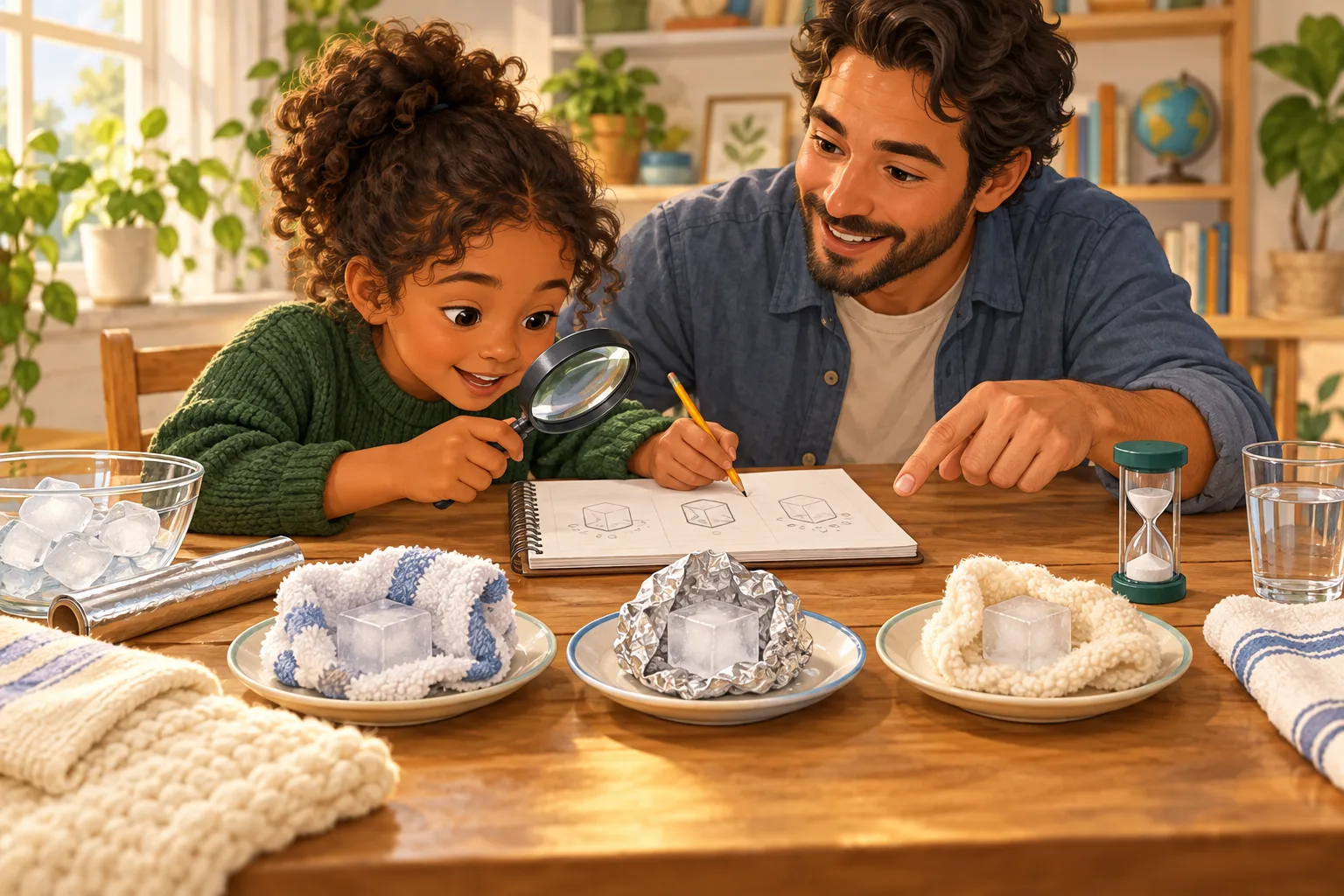
The four-part weekly loop
1. Notice and ask
Begin with something observable: a shadow moves, ice melts, a seed changes, a block tower falls, or one fabric dries faster than another. Invite questions without promising to test every one.
Useful prompts include:
- What do you notice?
- What changed?
- What seems the same?
- What could we compare safely?
- Which question could we answer by observing or measuring?
Write or draw two or three questions. Choose one that fits your materials, time, and safety needs.
2. Learn enough to investigate
Read a short nonfiction passage, look at a diagram, watch a carefully selected explanation, or talk about relevant vocabulary. The goal is not to front-load every fact. Give the child enough background to make a sensible prediction and recognize what to observe.
If the material is above the child’s reading level, read it aloud. Science knowledge should not be limited by independent decoding.
3. Investigate or model
The hands-on part might be a comparison, observation, model, design, or classification—not always a controlled experiment. Keep the question visible. Change only what is useful for answering it, and keep important conditions as similar as practical.
4. Record and explain
Young children can draw a before-and-after picture, make tally marks, place samples in order, dictate a sentence, or take a supervised photo. Then ask: “What does our record show?” and “What would we change next time?”
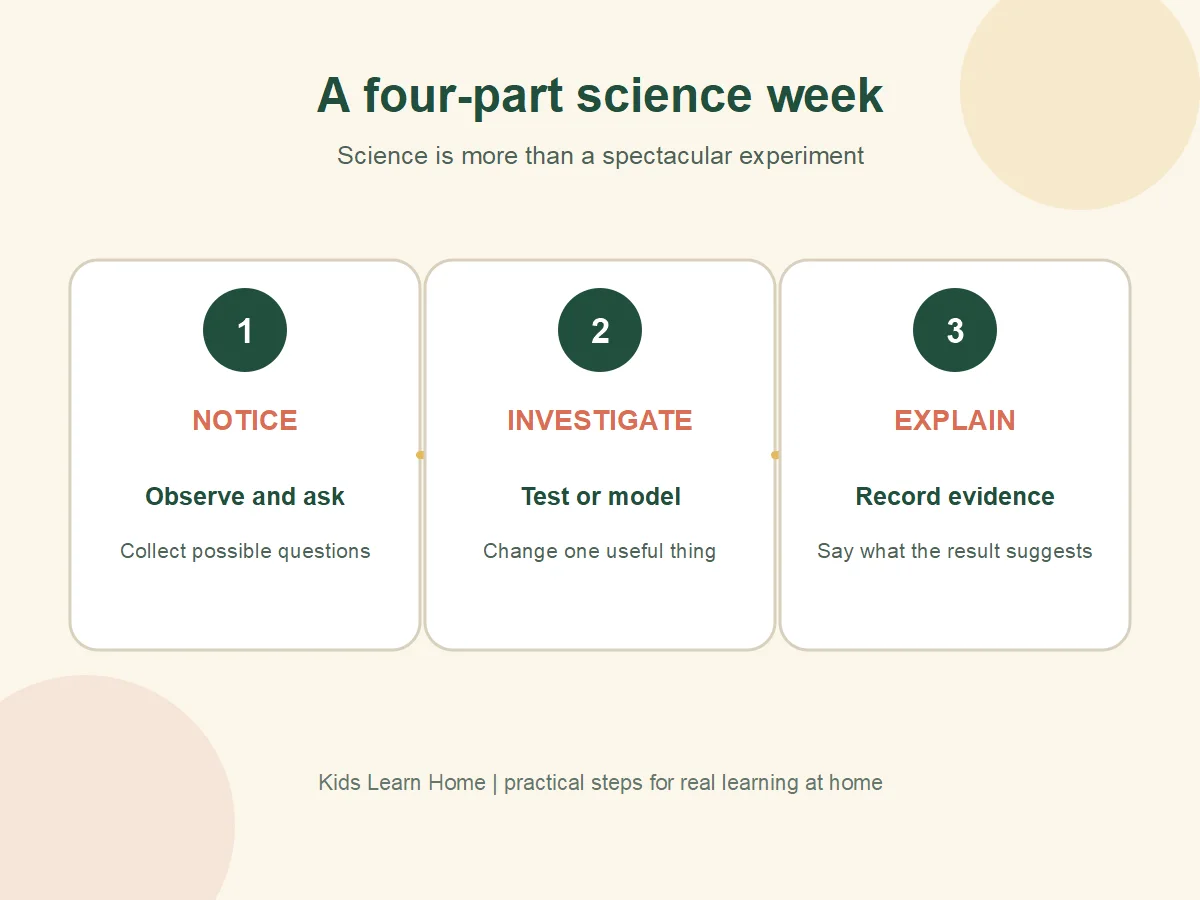
The NGSS Science and Engineering Practices describe practices such as asking questions, planning investigations, analyzing data, developing models, and communicating information. NGSS is a US standards framework, not a universal homeschool schedule; the four-part rhythm here is our practical way to make several of those practices visible at home.
A complete example: Which material keeps ice from melting longest?
This comparison uses familiar materials, but an adult should choose and supervise everything.
Prepare
You need three similar ice cubes, three small plates, a timer, and three wrapping materials such as a cotton cloth, aluminum foil, and paper towel. Avoid materials that are unsafe, dirty, or irritating. Protect the surface from water.
Ask and predict
Ask: “Which material will keep an ice cube solid longest?” Let the child choose and give a reason. Record the prediction without correcting it.
Make the comparison fair enough to learn from
- Use ice cubes from the same tray.
- Put them on similar plates in the same room.
- Wrap them at about the same time.
- Check them at equal time intervals.
This is a home investigation, not laboratory-grade testing. Say what you controlled and what remained imperfect.
Record
At each check, the child can draw the cube, circle “mostly solid / partly melted / mostly water,” or measure pooled water with adult help. Use the same recording method for all three materials.
Explain
Complete the sentence: “In our test, ___ kept more ice solid at ___ minutes.” Then point to the drawing or measurement that supports the statement.
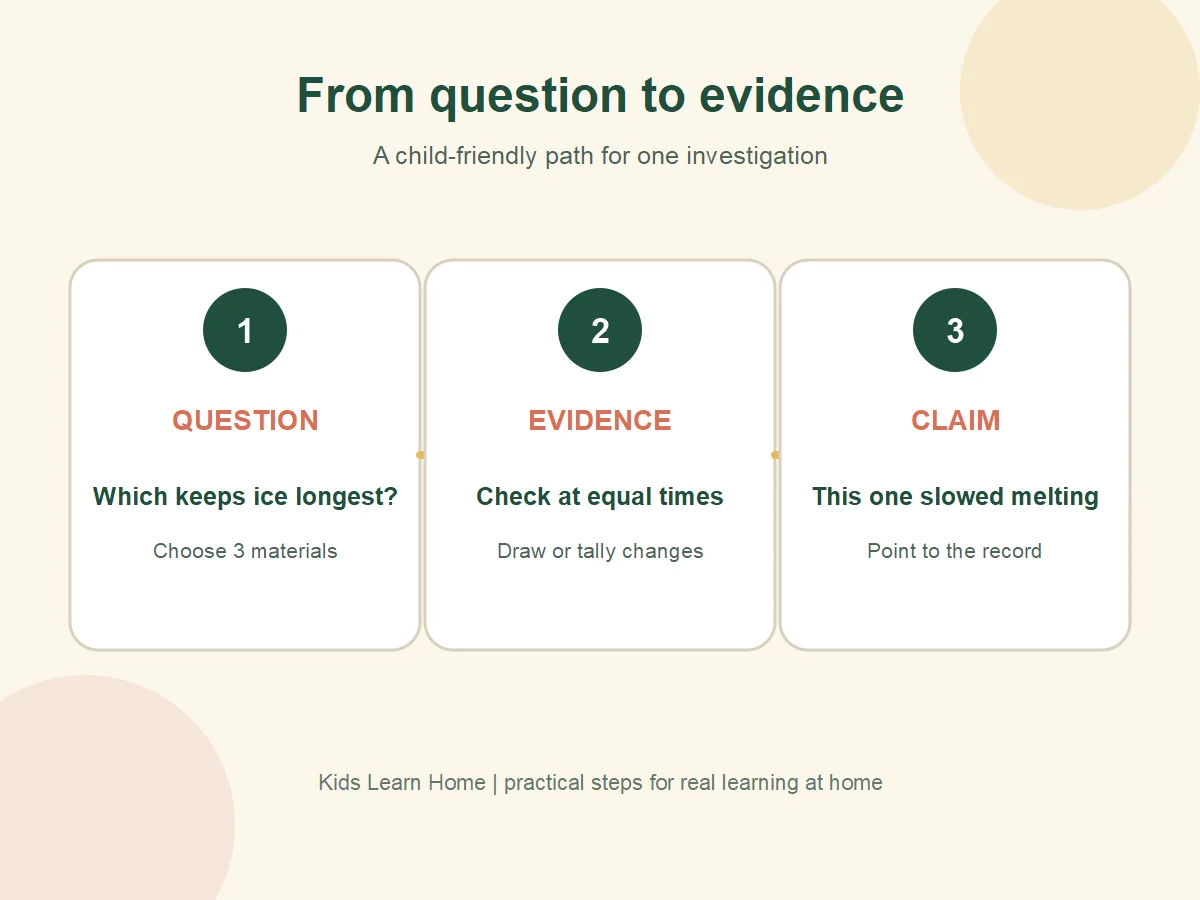
Do not turn one result into a universal claim. A different amount of material, room temperature, ice size, or wrapping method could change the outcome.
What counts as science when there is no experiment?
A meaningful science week can include:
- Observation: track the same tree bud or shadow position.
- Classification: group leaves by a stated feature and explain the rule.
- Modeling: build a simple model of a habitat or a moving joint and name what the model leaves out.
- Engineering: design, test, and improve a paper bridge under a clear constraint.
- Data talk: graph the week’s temperatures from a trustworthy source and describe the pattern.
- Explanation: compare two claims and ask which observation supports each one.
For outdoor observation, our nature journal guide for kids shows how to record without needing a polished drawing. For a more formal comparison, use our guide to planning a fair science investigation.
Share the work without taking over
Adults should handle safety decisions, hot or sharp materials, uncertain substances, and setup that exceeds the child’s ability. The child should still do the intellectual work: predict, choose what to observe, compare records, and explain.
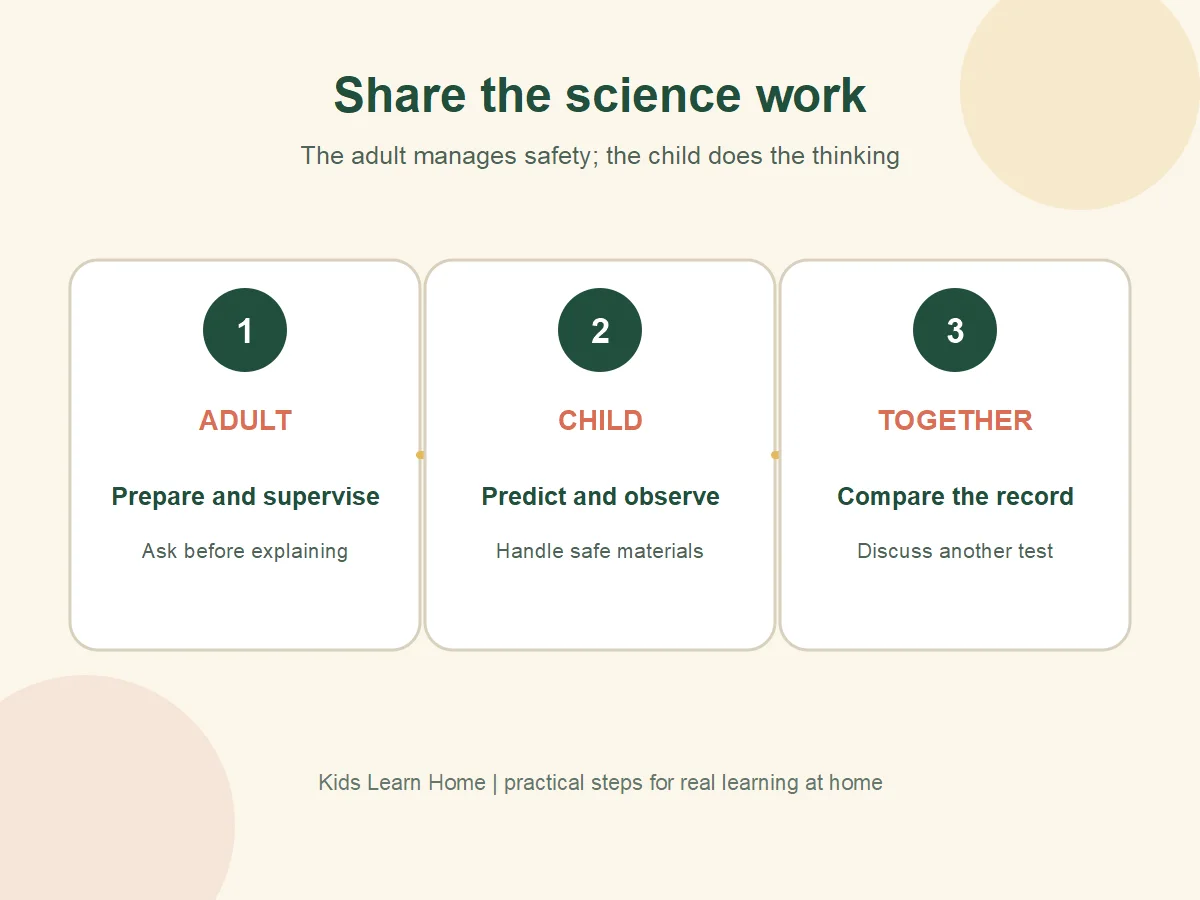
Try this division:
- Adult: prepare safe materials, read complex directions, supervise, and ask questions.
- Child: make a prediction, handle safe items, observe, draw, tally, and talk.
- Together: compare the record, discuss limitations, and choose a possible next test.
If the adult performs every step while the child watches, the activity may be entertaining but offers fewer chances to practise scientific thinking.
A realistic rhythm for a busy week
You could use four short encounters:
- Monday: notice and collect questions during a walk or daily task.
- Tuesday: read or watch one focused source and choose a question.
- Wednesday or Thursday: investigate, model, or classify.
- Friday: review the record and explain the result to another person.
Or complete the same loop in one afternoon. The routine is a planning tool, not a developmental requirement. Use the science experiment finder when you want an activity filtered to your needs, then place it inside the loop instead of treating it as an isolated spectacle.
When reading is the barrier to science participation
A five- to seven-year-old may understand an investigation but struggle to read short labels or directions. Read the science material aloud so knowledge can continue growing. Practise decoding separately at the child’s current level.
If that separate target is short vowels and simple CVC words, Blend & Read: CVC Phonics Workbook provides 44 printable pages, six short stories, A4 and US Letter files, and a printing/use guide for ages 5–7. It is a paid literacy resource, not a science curriculum. Its role is to strengthen access to print over time, not to decide whether a child can participate in science today.
Build a reusable science basket
Keep only safe, multipurpose items: magnifier, ruler, timer, sticky notes, pencils, index cards, clear cups, craft sticks, string, and a washable tray. Store anything that could be swallowed, spilled, heated, cut, or misused out of children’s independent reach. The basket reduces setup; it does not replace adult review of each activity.
Add three cards: I notice… for observations, I think… because… for predictions and explanations, and I wonder… for the next question. Children can draw instead of write. An adult can transcribe the child’s words without improving the claim. Preserve the difference between what was observed and what is inferred.
For an age-banded example of guided investigation, the NGSS page for K–2 planning and carrying out investigations includes expectations such as observing material properties and conducting simple tests with guidance. Treat these as US standards context, not a checklist that every child worldwide must meet on the same date.
At the end of the month, review four records. Ask which questions produced useful evidence and which setups need redesign. That reflection turns separate activities into a growing practice of science.
Keep an evidence wall
Reserve one small space for the current question, one drawing or table, and one careful claim. Replace it when the next investigation begins. The wall is not a gallery of perfect products; it makes the reasoning sequence visible.
Invite the child to explain it to another family member using three sentences: “We asked… We observed… We think…” If the explanation goes beyond the evidence, ask which record supports that part. Communication is another round of scientific thinking, not a performance to memorize.
Questions parents often ask
Do we need one experiment every week?
No. Observation, modeling, design, classification, data interpretation, and explanation are all legitimate science work. Choose a sustainable mix that lets the child think rather than merely watch.
Should I explain the correct answer before the activity?
Give enough background for safety and understanding, but preserve a real question when possible. Afterward, help the child compare the result with a reliable explanation and identify limits in the test.
What if our investigation does not work?
Record what happened. Check the setup, materials, and measurement. A failed setup can support useful reasoning if you avoid pretending it proved the expected answer.
How much should a young child write?
Use drawing, tallying, oral dictation, labels, photos, or shared writing. The recording method should preserve evidence without making handwriting the hidden purpose of the science lesson.