
CVC words blending practice helps a beginning reader turn separate letter sounds into a whole spoken word. But what should you do when your child says every sound in sun correctly, pauses, and then guesses something completely different? More flashcards are not always the answer. First, find the exact step that needs support: hearing sounds together, connecting sounds to print, or moving smoothly across the word.
This guide gives you a clear model, carefully chosen word lists, five low-prep activities, and a short practice plan. Use it alongside your child’s reading instruction, not as a test of intelligence or readiness. The aim is accurate, meaningful reading with gradually less adult help—not finishing the longest list.

What Are CVC Words, and Why Practice Them?
CVC stands for consonant–vowel–consonant. In straightforward examples such as map, sit, and sun, three letters represent three sounds, with a short vowel in the middle. These words offer a manageable way to apply letter–sound knowledge without introducing a consonant blend, a silent-e pattern, or a vowel team at the same time.
Not every three-letter word belongs in a beginner CVC list. The does not have the same simple pattern, and day includes a vowel team. Keep the first practice set consistent so that your child can focus on joining sounds rather than solving several unfamiliar spelling patterns.
Blending is also different from reciting letter names. Saying “ess, you, en” names the letters in sun; it does not supply the sounds needed to read it. Letter names remain useful for talking about spelling, but during decoding, model the sounds represented in that particular word.
The What Works Clearinghouse foundational reading guide recommends linking speech sounds to letters, teaching decoding and writing, and providing connected-text reading. The activities below are original home-practice examples of those broad priorities, not a separate research-validated intervention. If you need resources for a wider reading session, explore our early literacy activities.
When a Child Knows Letter Sounds but Cannot Blend
Set aside a long worksheet and make a few low-pressure observations. You are choosing a teaching starting point, not diagnosing a learning difficulty. Use words and sounds your child has already encountered, and stop if the activity becomes upsetting.
Check oral blending without printed letters
Say, “I am thinking of a word: /s/ /u/ /n/.” Say the sounds close together, then ask what word they make. If your child cannot join them, model the whole word and try an easier two-sound word such as in. Avoid turning this into repeated guessing. A child can also listen while you demonstrate several examples.
Check the actual sound–letter links
Show the letters needed for today’s words in a mixed order. Can your child give their usual sounds without a long search? If not, work with fewer letters before adding more words. Knowing an alphabet song is not the same as recognizing a particular letter and retrieving its sound in a reading task.
Notice where the sequence breaks down
A child may say the first sound and guess from a picture, omit the middle vowel, or leave such long gaps that the original sounds are hard to remember. Record what you actually hear: “Read the first two sounds; needed a model to include the final sound.” That note is more useful than “bad at reading.”
If your child reads the word correctly after your model but not alone, the model is helping. Keep it available, then reduce support in small steps. Do not treat one successful repetition as evidence that the skill should already work in every setting.
How to Model CVC Words Blending Practice
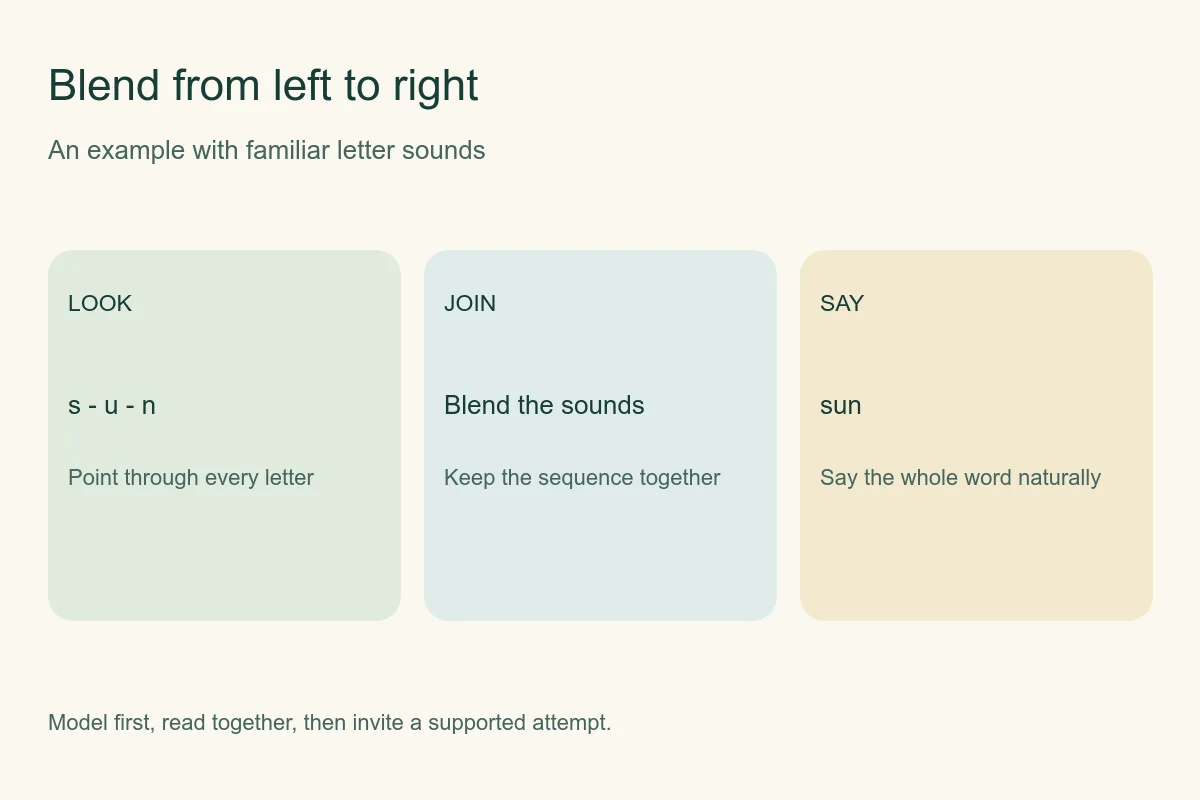
Write sun clearly on a card. Sit so you and your child can both see it the right way up. Point under the first letter, move toward the vowel, and continue through the final letter. Use a smooth spoken model, then say the word naturally: “sun.” Ask what the word means or use it in a short spoken sentence.
Some sounds, including /s/, /m/, and /f/, can be held briefly without adding another sound. Stop sounds such as /t/ and /p/ cannot be stretched in the same way. Keep them brief. Try not to add an extra “uh,” as in “tuh,” which changes the sound sequence your child is trying to combine.
The University of Florida Literacy Institute glossary explains blending, continuous sounds, and the importance of producing blendable consonant sounds. Its definitions are useful if you want to check the terminology used in your child’s phonics lessons.
Use an “I do, we do, you try” sequence
- I do: Point through sun, blend it, and say the whole word while your child watches.
- We do: Repeat the same process together, keeping your pointing and speech coordinated.
- You try: Invite your child to read the word. Wait briefly rather than immediately supplying the answer.
- Reconnect: Ask your child to say a sentence about the sun, or explain what the word means.
If your child gets stuck, return to the shared step. You can also temporarily cover the final letter, join the first two sounds, and then reveal the ending. This is a scaffold, not a requirement to split every word forever. Finish by looking across the complete word again.
A Small CVC Word List for Each Short Vowel
Choose a few words whose letters and vowel sound have already been taught. These lists are a menu, not a five-day deadline. Check that your child knows each spoken word; an unfamiliar word can make an otherwise accurate decoding attempt seem wrong.
- Short a: map, mat, sat, fan, pan, tap.
- Short e: pet, pen, ten, hen, net, bed.
- Short i: sit, pin, fin, lip, pig, dig.
- Short o: hop, top, pot, log, dog, cot.
- Short u: sun, fun, run, cup, mug, bug.
Vowel pronunciation varies by accent. Use your family’s natural pronunciation and the sound model used in the child’s teaching materials. You do not need to force a different accent to make a printed list fit a recording.
At first, work within one familiar vowel pattern. Later, mix previously taught vowels so that the child must attend to the middle letter rather than assume the same sound every time. Keep new and familiar material separate in your notes: a mixed review can be harder than a practiced word family.
For an existing printable resource, look through our kindergarten phonics workbook and select only pages that match the sound patterns already taught. A page being available does not mean the child needs every activity on it today.
Five Low-Prep CVC Blending Activities
1. Slide and read
Write three widely spaced letters on paper. Your child moves a finger underneath from left to right while joining the sounds. After the first attempt, bring the written letters closer together on a second card. Read the whole word again. The movement supports attention to order; it is not a race.
2. Change one letter
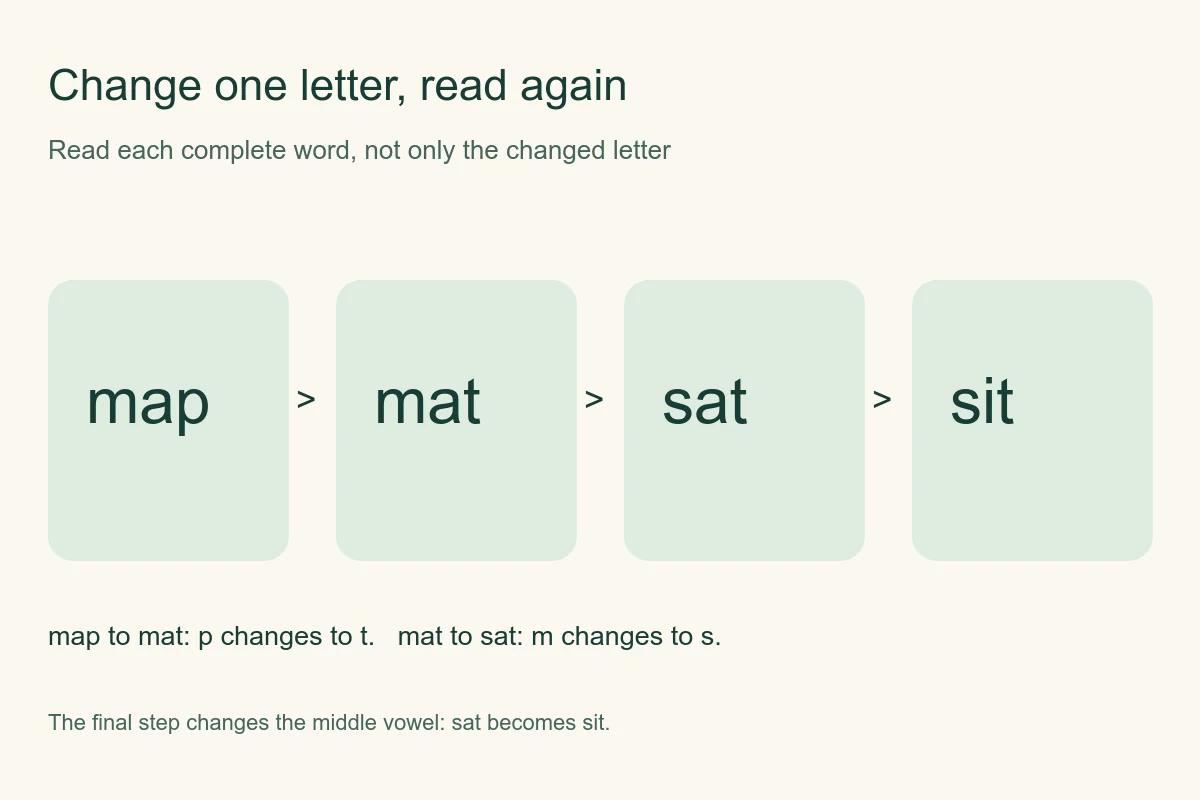
Build map, then change it to mat, then sat, and finally sit. Ask, “Which letter changed? What sound changed?” Read each new word from the beginning. Changing the middle letter is particularly useful for checking whether the child is looking beyond the first and last letters.
3. Read before revealing the picture
Put a word card over a simple drawing. Read the print first, then uncover the drawing to check meaning. For example, read cup before revealing your sketch of a cup. If your child guesses, gently cover the picture again and return to the letters. Pictures can support conversation without replacing decoding.
4. Build a spoken word
Say mat. Help your child hear the sounds and choose the matching letter cards in order. Then ask them to read the word they built. This switches between spelling and reading while keeping the set small. Use paper cards rather than small tiles around younger siblings who might put objects in their mouths.
5. Read a tiny message
Try “Sam sat.” or “A cat sat.” only after checking every spelling in the sentence. Explain any word not yet taught instead of asking the child to guess it. After reading, ask a meaning question: “Who sat?” You can draw the scene together, then reread the message without relying on the drawing.
As reading expands, our first grade word-practice guide explains how to study common words through sounds, spelling, and sentences. Keep that work connected to phonics rather than treating all common words as shapes to memorize.
A Flexible Ten-Minute Blending Routine
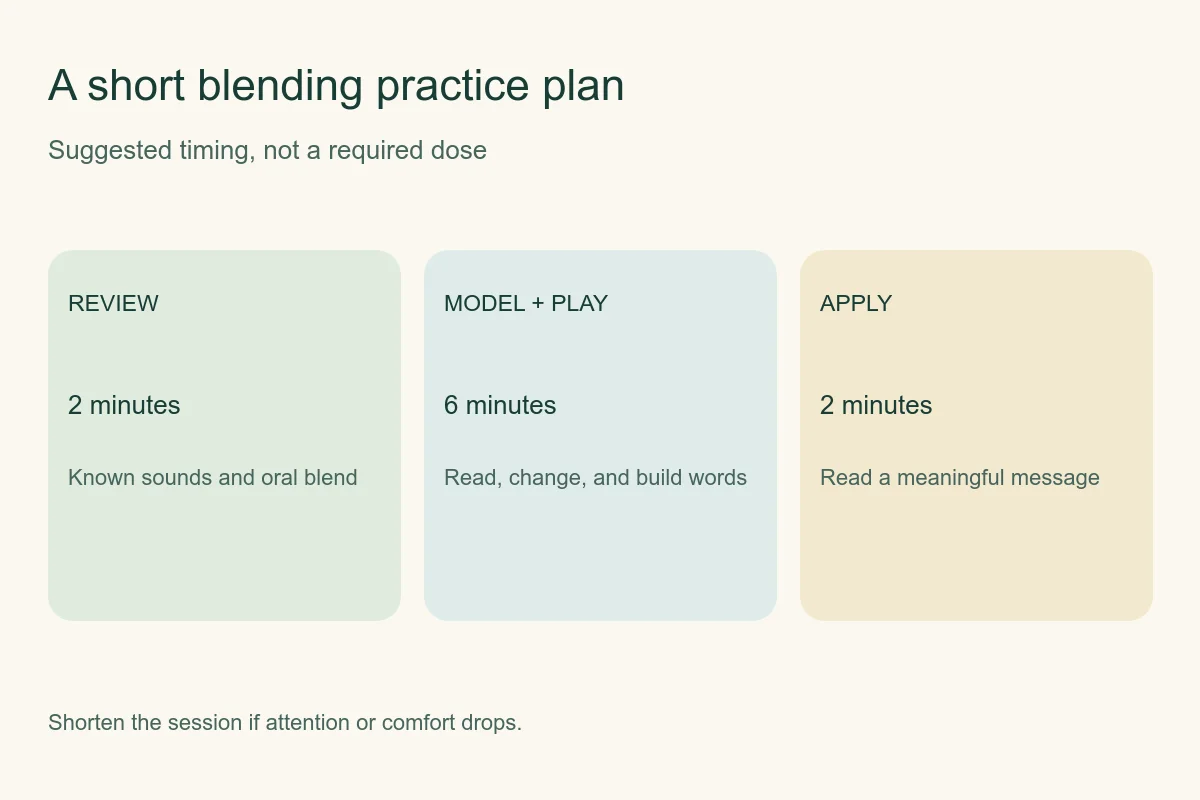
The following timing is a practical example, not a minimum dose or a promise of results. A calm five-minute session is preferable to continuing when the child is no longer engaged. Use the same broad order so that less attention is spent figuring out what happens next.
- Two minutes: Review a few familiar letter sounds and one oral blending example.
- Three minutes: Model and share two or three words with one familiar vowel.
- Three minutes: Play one word-changing or word-building activity.
- Two minutes: Read a short message, discuss its meaning, and note one next step.
Across a week, vary the task rather than constantly adding new letters. One session might focus on a shared model, the next on changing an ending, and another on revisiting the same words in a different order. Later, introduce a new example with familiar letters to see whether the child can apply the process beyond a memorized sequence.
If siblings need attention at the same time, reserve one short adult-supported block for reading and use a familiar independent task for the other child. Our flexible schedule for multiple ages shows how to organize those turns. Do not assign a brand-new decoding lesson as independent work simply because the adult is busy.
Track the Help Needed, Not Just the Score
Keep three simple columns: word, support given, and next step. A useful entry might read, “sun — joined sounds after a shared model — revisit tomorrow, then try fun.” Another might read, “map — independent — use in a short message.” The record should help you choose instruction, not rank your child against someone else’s timeline.
Watch for patterns across different sessions. Can your child include all three sounds? Do they look at the middle letter? Can they read a new word made from known spellings? Are they starting to explain what the word means? These observations reveal more than repeatedly presenting a familiar card in the same position.
If handwriting makes the reading task much harder, let your child move paper letters or answer aloud. You can work on comfortable letter formation separately with our short handwriting routine. Keeping the goals separate helps you see whether the difficulty lies in reading, writing, or managing both at once.
If progress remains limited despite clear, consistent teaching, or the child becomes increasingly distressed, share your observations with their teacher or a qualified reading specialist. This article cannot identify a learning disorder, and extra support does not require waiting until a child feels defeated. Bring examples of what was taught and the help that was needed.
Frequently Asked Questions
Does my child need to know every letter before blending?
No. Begin with a small set of taught sound–letter relationships that can form useful words. The important point is that the letters in the selected practice words are familiar, not that the entire alphabet has been mastered first.
Should we practice whole word families?
A short word family can make a pattern clear, but also include mixed review later. Otherwise, a child may repeat the shared ending without checking the print. Ask them to look through each complete word.
What should I do when my child guesses?
Respond calmly, point back to the letters, and model the needed step. Read the word together, then invite one supported retry. Avoid asking for repeated guesses or using a picture as the main route to the answer.
How many CVC words should we practice each day?
There is no fixed number for every child. Start with a few words, watch accuracy and effort, and end while the practice is useful. Revisit known words alongside a manageable new example rather than aiming for a large daily total.
Your next step: Choose three familiar letters, model one word smoothly, and let your child read it with you. Then use the word in a message with meaning. Small, well-observed steps give you a clearer path forward than another full page of disconnected sounds.
If joining sounds is improving but the middle vowel still causes confusion, try our short vowel listening and spelling activities with clear contrasts and practice answers.
2 Responses