
Addition and subtraction practice works best when children understand what the numbers represent before completing long rows of equations. This guide shows families how to move from objects to drawings to written problems, choose an appropriate number range, and use mistakes as information. Create a level-matched practice set and answer key with our Addition & Subtraction Worksheet Generator, then explore the broader math worksheets and games guide.

Start With the Meaning of the Operation
Addition can describe joining groups, increasing a quantity, or comparing parts that make a whole. Subtraction can describe taking away, finding a missing part, or comparing two quantities. Children need experience with all of these situations so they do not depend on one keyword or one procedure.
| Situation | Example | Question |
|---|---|---|
| Join | 4 red counters and 3 blue counters | How many counters altogether? |
| Take away | 8 blocks, then 2 are removed | How many blocks remain? |
| Missing part | 8 birds in all, with 5 visible | How many birds are hidden? |
| Compare | 9 buttons and 6 beads | How many more buttons are there? |
Ask the child to explain what is happening before asking for an equation. A correct answer with no understanding is less useful than a careful model that leads to a corrected answer.
Use the Concrete–Drawing–Equation Sequence
1. Build It With Objects
Use counters, blocks, buttons, toy animals, or pieces of cereal. For 7 − 3, build seven objects, physically remove three, and count what remains. Keep the groups organized so the child can see the quantity rather than recounting a scattered pile.
2. Draw or Mark It
Replace the objects with dots, boxes, a ten frame, or jumps on a number line. The drawing does not need to be artistic. It is a bridge that records the child’s thinking.
3. Write the Equation
Connect each part of the model to the symbols. Say, “We started with seven, took away three, and four remain, so 7 − 3 = 4.” Later, ask the child to choose the equation that matches a model or story.
Choose the Right Practice Level
| Level | Suggested focus | Useful supports |
|---|---|---|
| Beginning | Add and subtract within 10 | Counters, fingers, five frames, simple stories |
| Developing | Facts within 20 and make-ten strategies | Ten frames, number lines, fact families |
| Grade 1 extension | Two-digit addition and subtraction without regrouping | Bundled sticks, base-ten drawings, place-value chart |
| Grade 2 practice | Two-digit work with regrouping | Base-ten blocks, expanded form, written explanation |
Move to a larger range only when the child can solve the current work accurately and explain the strategy. Speed is not the only sign of readiness. Flexible thinking—such as recognizing that 8 + 7 can become 10 + 5—is more valuable than racing through isolated facts.
A Fifteen-Minute Practice Session
- Three-minute number talk: show one problem and invite two possible strategies.
- Five-minute hands-on model: solve two or three problems with counters, a number line, or base-ten materials.
- Five-minute written practice: complete a short set at the correct level.
- Two-minute reflection: check one answer, explain one strategy, and choose the next practice goal.
A short set of eight carefully chosen problems is often more informative than thirty repetitive equations. The generator offers 8, 12, 16, 20, and 30-problem options so you can match the page to the child’s stamina.
Strategies Children Can Use
- Count on: for 6 + 3, start at 6 and count three more.
- Count back: for a small subtraction such as 9 − 2, step back twice.
- Make ten: change 8 + 5 into 10 + 3.
- Use doubles: connect 6 + 7 to the known double 6 + 6.
- Think addition for subtraction: solve 13 − 8 by asking, “8 plus what equals 13?”
- Break apart by place value: solve 34 + 20 by combining tens first.
Encourage the child to choose a strategy rather than requiring the same method for every problem. Our math resources guide includes additional ways to combine worksheets with games and hands-on learning.
How to Learn From Errors
Do not simply mark an answer wrong and move on. Ask the child to rebuild the problem and compare the model with the equation. Common patterns reveal the next teaching step:
- Answer is off by one: check whether the starting number was counted twice on the number line.
- Adds instead of subtracting: return to the story and act out what changed.
- Reverses digits or signs: separate handwriting practice from number understanding, then use a clear model.
- Regrouping errors: rebuild the tens and ones with base-ten materials before repeating the written procedure.
- Random answer: reduce the number range and require a drawing or object model.
Five Everyday Addition and Subtraction Activities
- Snack math: count a small group, add or eat a few pieces, and describe the change.
- Build to a target: roll dice and add blocks until a tower reaches 20.
- Missing cup: hide part of a known set under a cup and find the missing quantity.
- Store game: use play coins to combine prices or find simple change.
- Walk the number line: place a tape number line on the floor and make forward or backward jumps.
For another low-pressure option, use the number activities in My First Math & Coloring Workbook or browse the free printable worksheet library.
A Worked Example: Solve 8 + 5 by Making Ten
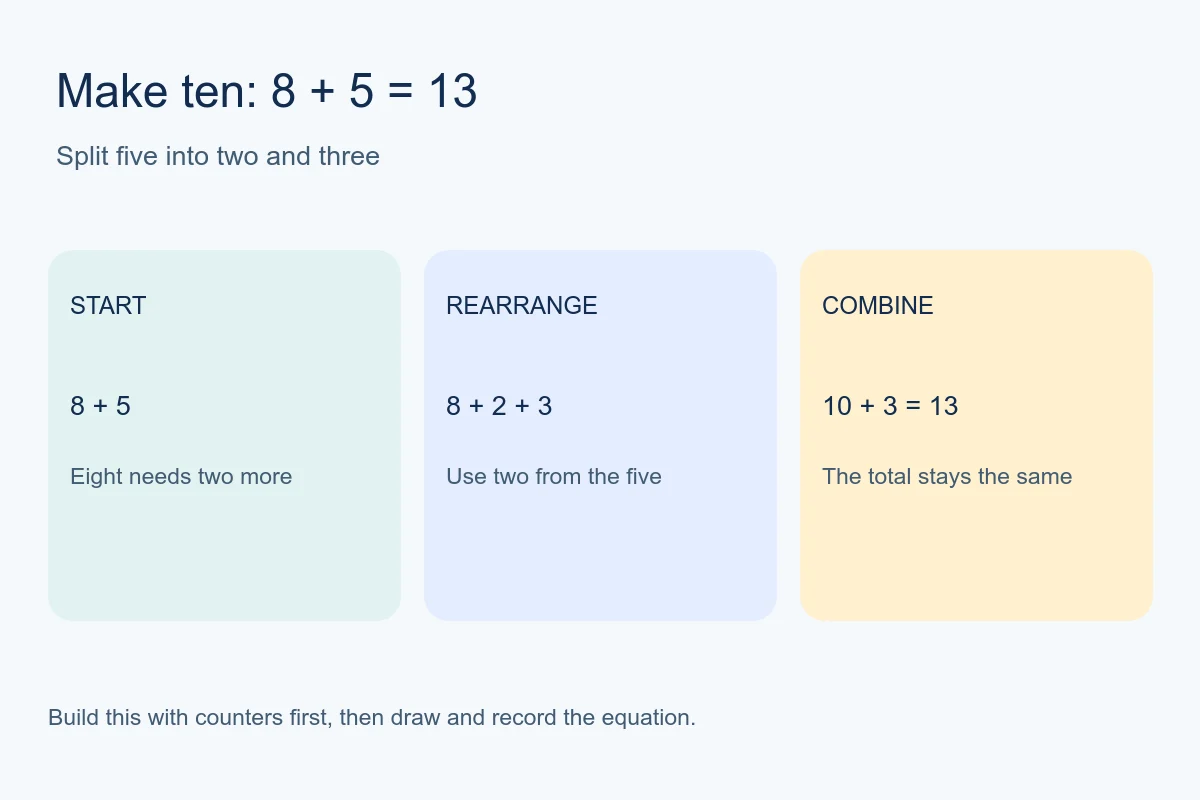
Put eight blue counters in a ten frame and place five yellow counters beside it. Ask, “How many empty spaces are in the frame?” Move two yellow counters into those spaces. The frame now holds ten counters, and three yellow counters remain outside. Explain that the total did not change when the counters moved: 8 + 5 became 10 + 3, which equals 13.
Next, draw a simple picture of the same action. Write 5 = 2 + 3 beneath the yellow group, then record 8 + 2 + 3 = 13. Ask the child to explain why the two was useful. On another day, try 9 + 4 or 7 + 6. A child who understands the strategy can choose how much to move rather than copying a memorized layout.
Connect Addition and Subtraction With Fact Families
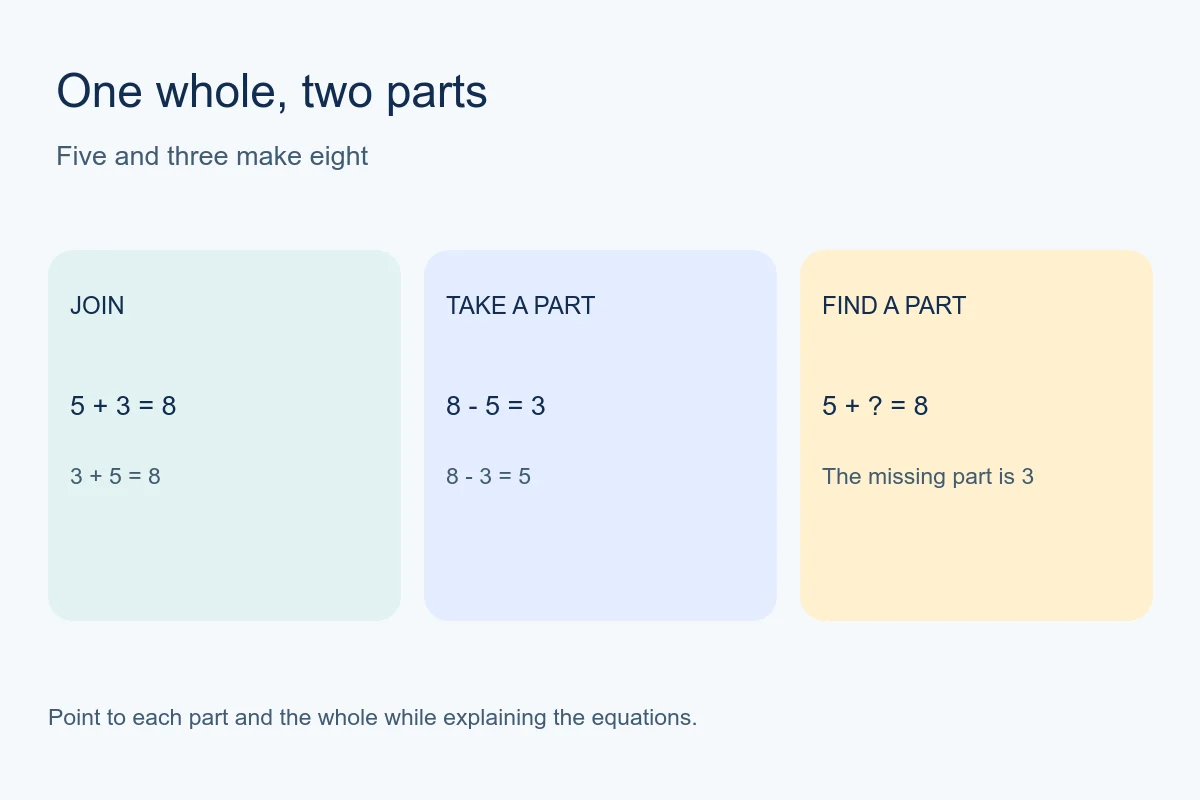
Use five counters of one color and three of another. Together they make eight. Record the related equations: 5 + 3 = 8, 3 + 5 = 8, 8 − 5 = 3, and 8 − 3 = 5. Ask the child to point to the whole group and each part while reading an equation. This makes the relationship visible instead of treating four facts as unrelated answers.
Then cover one part with a cloth and ask how many counters are hidden. If the child can explain that eight includes five and three, they can use addition to solve a subtraction problem. Later, write 8 − □ = 5 or □ + 3 = 8. Keep the missing number in different positions so the child attends to the relationship rather than always writing an answer after the equals sign.
A Mini Practice Set With Answers and Explanations
Choose the questions that fit the child’s current level. Let the child use objects or a drawing, then explain one answer aloud. The answer key is included for checking; it is not a reason to skip the modeling stage.
| Problem | Answer | Possible reasoning |
|---|---|---|
| 4 + 3 | 7 | Start at four and count three more. |
| 9 − 4 | 5 | Remove four from a set of nine. |
| 8 + 5 | 13 | Make ten with two, then add three. |
| 14 − 6 | 8 | Count up from six to fourteen: four and four. |
| □ + 7 = 12 | 5 | Find what must join seven to make twelve. |
| 32 + 15 | 47 | Combine three tens and one ten, then two and five ones. |
| 42 − 18 | 24 | Exchange one ten for ten ones, then subtract. |
| Ada has 11 cards; Leo has 7. How many more does Ada have? | 4 | Compare the groups or find the gap from seven to eleven. |
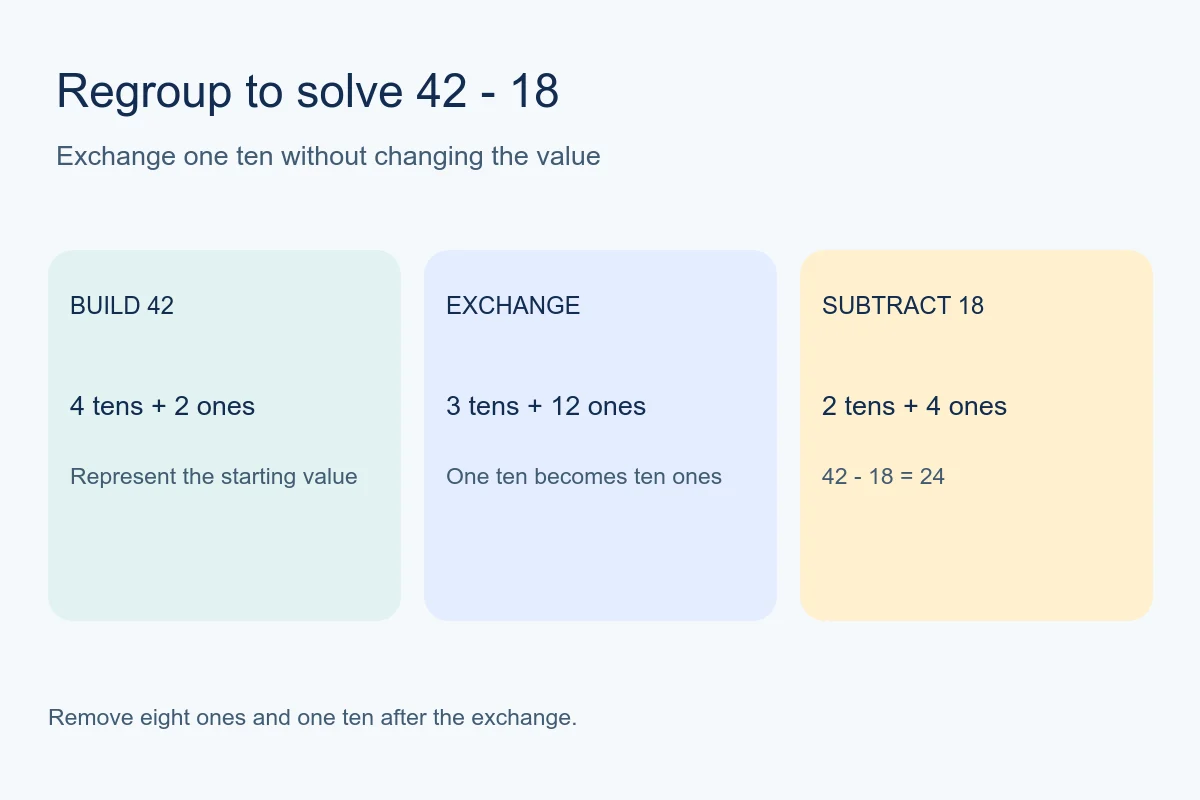
For the regrouping example, show 42 as four tens and two ones. Exchange one ten to get three tens and twelve ones. Remove eight ones and one ten. Two tens and four ones remain. Emphasize that exchanging changes the representation, not the value. Avoid teaching the written crossing-out marks before the child understands the exchange.
Plan a Balanced Week of Addition and Subtraction Practice
On Monday, model one strategy with objects. On Tuesday, draw the same kind of problem and complete a small written set. On Wednesday, play a missing-part game or compare two collections. On Thursday, revisit the strategy in a short word problem. On Friday, review a few mixed examples and select the next teaching goal. Repeat a stage whenever the child’s explanations show that more practice would help.
Keep a simple note with three items: the problem type, the strategy used, and whether help was needed. For example: “Within 20; made ten; needed a reminder to split five.” The next session can begin with that exact action. This is more useful than recording only that six out of eight answers were correct, because it tells you what to teach next.
Read Word Problems for Meaning
Ask the child to retell the situation before choosing an operation. Words such as more do not always mean addition. In “Maya has nine shells, which is three more than Ben,” finding Ben’s amount requires thinking about the comparison. Draw two rows or use counters to show which quantity is larger and what the difference represents.
The Institute of Education Sciences’ elementary mathematics intervention guide supports clear mathematical language, carefully chosen representations, number lines, and deliberate work with word problems. Use those principles to explain what a model means. If reading the story is the main obstacle, read it aloud; arithmetic understanding and independent reading can be practiced separately.
Frequently Asked Questions
How many worksheet problems should a child complete?
Use the smallest set that gives useful practice. Eight to twelve problems may be enough for a new skill, especially when the child also models and explains the work.
Should children memorize addition facts?
Fluent recall is useful, but it should grow from understanding patterns and relationships. Children need strategies and models before repeated retrieval practice becomes productive.
When should regrouping begin?
Begin when a child understands tens and ones and can compose ten ones into one ten with objects or drawings. The written procedure should represent that place-value action.
Are timed tests necessary?
Timed tests are not necessary for every learner and can hide strategy use. Short, low-pressure retrieval games can build fluency while keeping accuracy and understanding visible.
What to Do Next
Choose one number range and one operation, solve two problems with objects, then print a short practice set from the addition and subtraction worksheet generator. Review errors by rebuilding the problem rather than repeating the same page.
Helpful reference: Institute of Education Sciences, Teaching Math to Young Children.
2 Responses