
Free coloring book for kids ages 3-5 is a 100-page printable collection that combines coloring, observation, counting, shapes, patterns, simple storytelling, and calm conversation. Color & Discover was designed for short, unhurried learning moments at home, in preschool, or during quiet time. Every child-facing activity uses large black-and-white illustrations and a clear prompt, while a short read-aloud story and grown-up cue help adults extend the page without turning it into a test. Download the complete PDF below, print the pages you need, and let your child choose where to begin.
Inside this guide
Color & Discover Book Overview
This printable book contains exactly 100 US Letter pages for children ages three to five. The first pages give adults a concise guide to adapting activities for different ages and abilities. The child pages then move through familiar themes such as gardens, oceans, forests, kitchens, weather, animals, transport, and everyday objects. A final reference page lists the developmental and early-learning sources consulted during creation. The PDF is approximately 9.8 MB, so it is much easier to download than the original production file while retaining searchable text and clear printable artwork.
The book is not a formal curriculum or developmental assessment. It is a flexible play resource. A three-year-old may point, name, color broadly, and listen to the tiny story. A four-year-old may compare pictures, count a small group, trace a path, or describe what is alike and different. A five-year-old may add details, extend the story, explain a pattern, or invent a new example. Adults can simplify or extend any prompt according to the child in front of them.
Families looking for additional downloads can visit our free educational books library. You can also pair this book with preschool learning activities or choose a creative follow-up from our arts and crafts guide.
What Is Inside the Free Coloring Book for Kids?
Look, color, and tell
Most activity pages follow an easy rhythm: look carefully, color the picture, then tell something about it. That sequence gives children time to notice before adults ask questions. Illustrations are intentionally spacious, with bold outlines and limited visual clutter. Children can color the whole page, select one part, or simply point and talk. There is no required color choice and no single “correct” finished picture.
Short stories to read aloud
Each child activity includes a tiny story connected to the illustration. The story is brief enough to read while a child is coloring and open enough to invite another idea. An adult might read it once, ask what the child noticed, and pause. If the child wants more, continue with a prediction, a new character, or a question beginning with who, what, where, or why. This supports conversation without demanding a performance.
Grown-up cues without pressure
A small cue suggests one way to extend the page. Some cues invite counting or comparison; others encourage sound play, pattern recognition, imagination, or describing a scene. The cue is optional. It should help an adult join the activity, not control it. When a child gives an unexpected answer, ask how they decided instead of immediately correcting the page. Creative explanations often reveal more thinking than a perfectly copied example.
Skills Children Can Practice Through Coloring and Stories
Fine-motor and pre-writing control
Holding a crayon, changing direction, making short marks, and coloring a chosen area all involve hand and finger control. Use thick crayons or washable markers when a child needs an easier grip. Large movements and broad coloring are appropriate; staying perfectly inside the lines is not the goal. A child can trace with a finger before using a tool, take breaks, or complete only one small section.
Early language and listening
The pictures and stories create a shared subject for conversation. Adults can name objects, repeat a child’s phrase with one extra word, or ask the child to describe an action. A child who does not want to answer can point, gesture, or listen. The CDC notes that development is observed across how children play, learn, speak, act, and move; its milestones and activity guidance for three-year-olds can help families understand development while remembering that a printable activity is not a screening tool.
Counting, shapes, and patterns
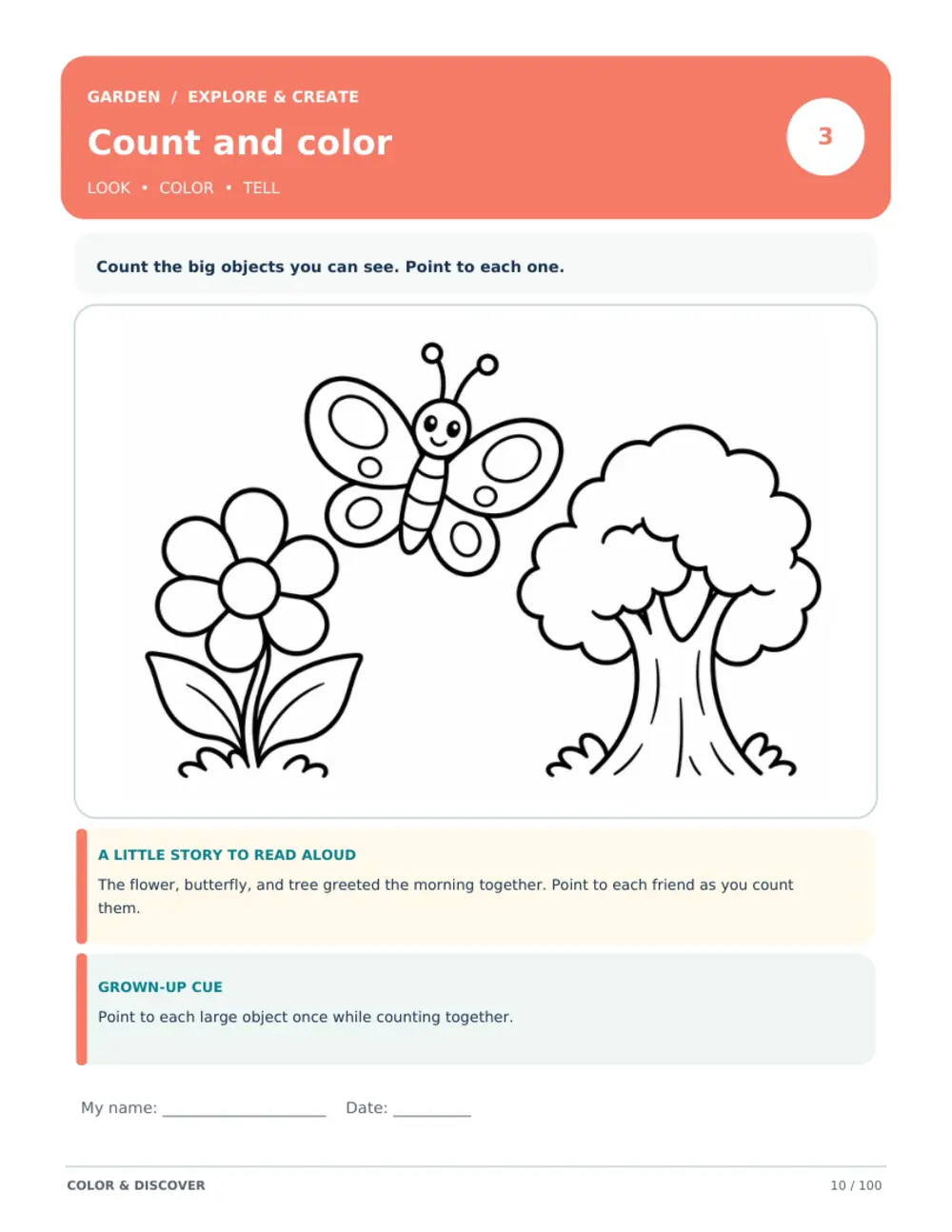
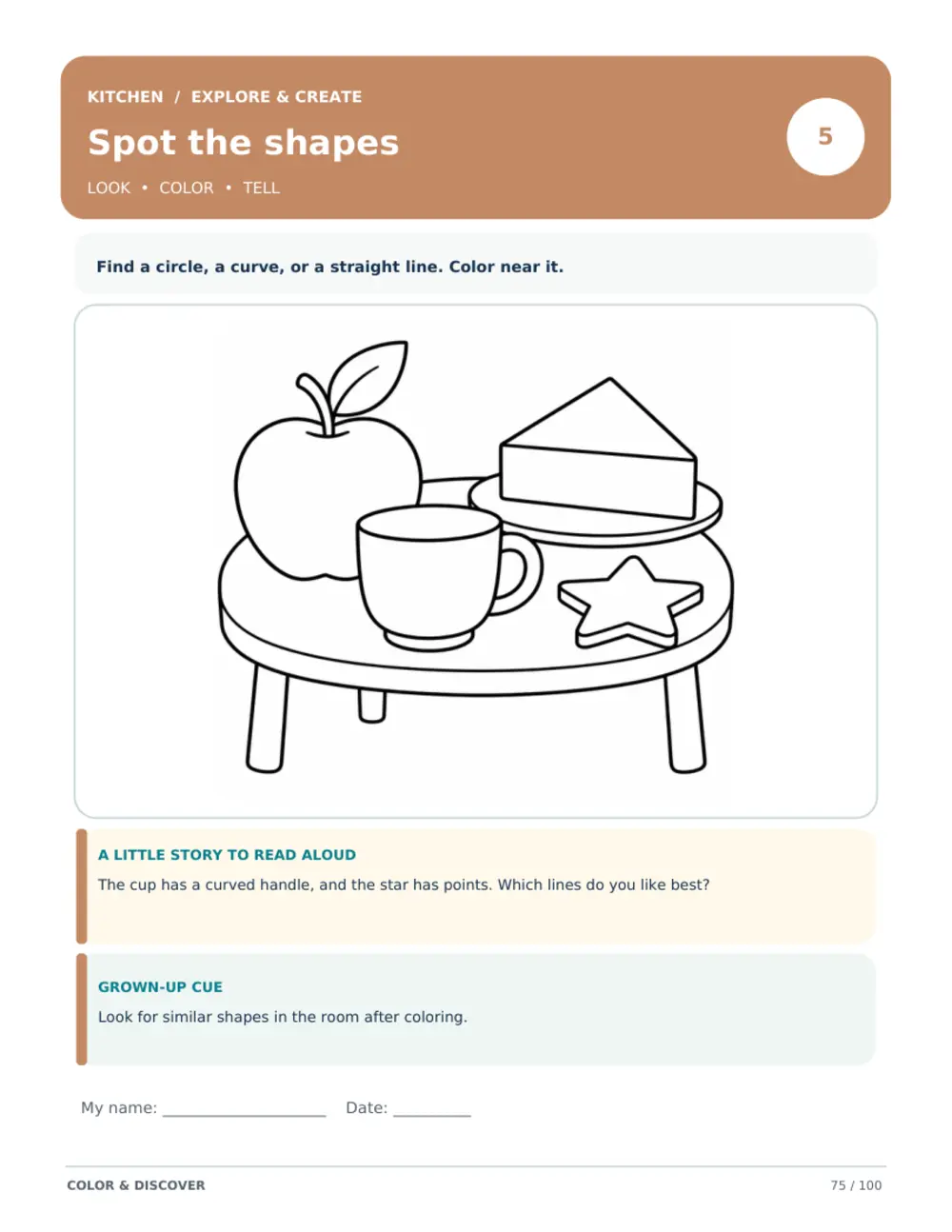
Selected pages ask children to count a few large objects, identify a basic shape, notice which item is different, or continue a visual pattern. Keep quantities small enough for accurate one-to-one counting. Invite the child to touch each object once and say the final total. For shape pages, look for similar lines or forms around the room after coloring. Pattern activities can be extended with blocks, socks, fruit, or simple body movements.
Observation and creative thinking
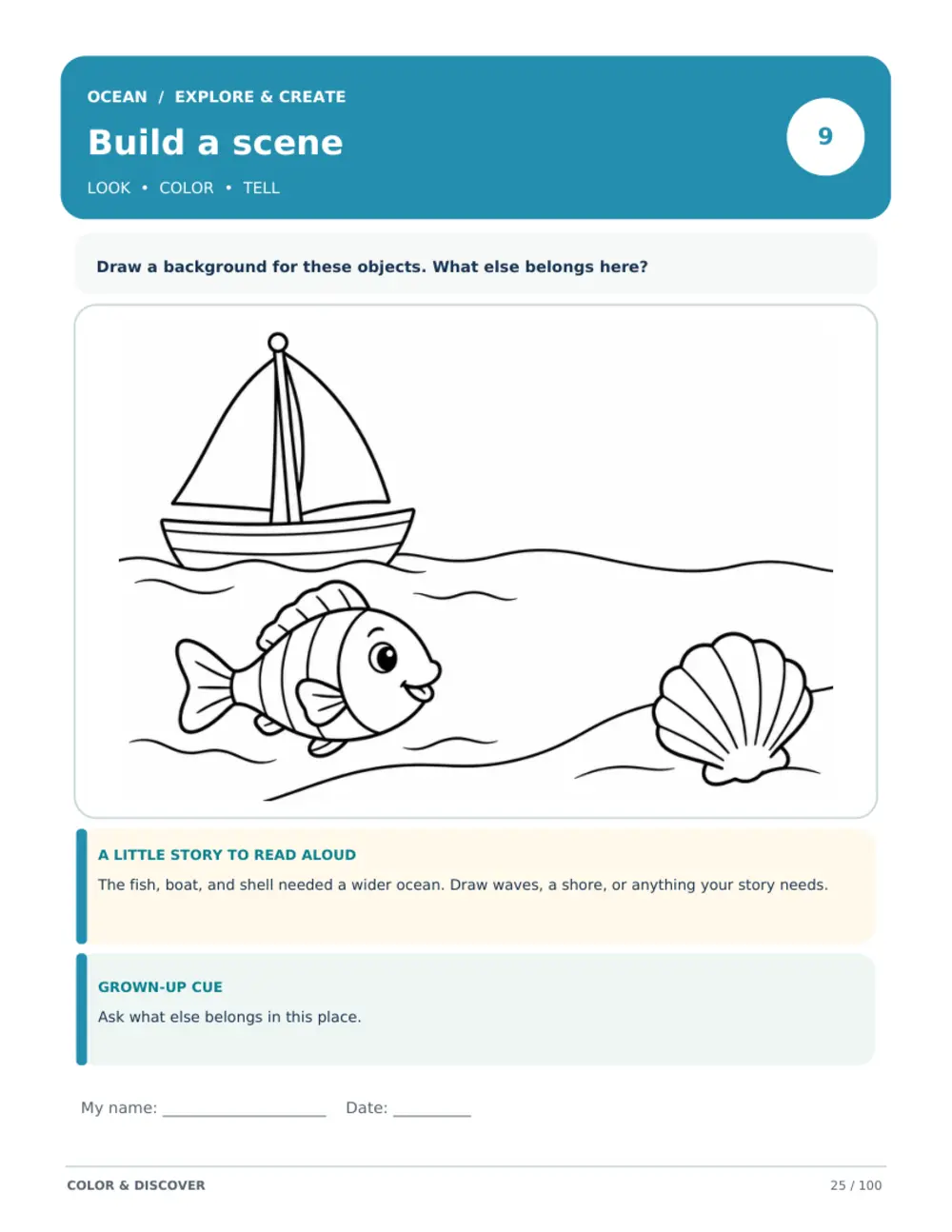
Some prompts ask what belongs in a scene, what might happen next, or how two objects are alike. These questions have room for more than one reasonable answer. Let the child add a background, invent a sound, name a character, or change the story. When the adult follows the child’s lead, the page becomes a starting point for sustained play rather than a worksheet to finish quickly.
How to Print and Use the PDF
The pages are formatted for US Letter paper. In the print dialog, select actual size or 100 percent when possible. Print one-sided if you want to display or reuse pages, and choose grayscale or black-and-white printing for the activity sheets. The colorful cover and parent-guide pages are optional; families who want to save ink can print only selected child pages. Always preview the page before printing because browser and printer margins vary.
Create a small invitation rather than placing all 100 pages in front of a child. Offer two or three choices, prepare crayons or pencils, and use a washable surface. Stop when interest fades. Favorite pages can be repeated because children often notice new details or tell a different story the second time. Date completed pages if the child enjoys seeing progress, but do not rank or compare artwork.
For group use, print separate copies so each child can make independent choices. Adults should supervise drawing tools and follow age guidance for small items. If a child needs adapted tools, try a crayon holder, a vertical drawing surface, larger paper, or shared drawing in which the adult follows the child’s directions. For structured letter-sound practice after a coloring session, download our free phonics workbook for kindergarten.
A Simple 10-Minute Color & Discover Routine
Begin by letting the child choose between two pages. Name the theme together, look quietly for a few seconds, and ask one open prompt such as “What do you notice?” Read the tiny story aloud, then place two or three coloring tools within easy reach. During coloring, describe what the child is doing instead of judging the picture: “You made a long blue line” or “You found all three flowers.” If the child talks, follow that idea. If the child prefers silence, allow the page to remain a calm independent activity.
After several minutes, use the grown-up cue only if attention remains. Count together, search for a shape, continue a pattern, or invite one new detail in the scene. Finish before the child becomes tired. Ask whether the page should be displayed, saved, shared with someone, or recycled; giving that choice respects ownership of the work. The same free coloring book for kids can support a different kind of play on another day: tell a new story, add a background, copy one shape onto blank paper, or use toys to act out the scene.
For children who resist coloring, try pointing, stickers, a paintbrush with water on a washable surface, or shared drawing in which the adult colors only where directed. Participation does not require completing the page. The purpose is to create a manageable moment of attention, language, choice, and creativity that can be repeated without pressure.
Download Color & Discover
The download is free and available directly from Kids Learn Home. It contains 100 pages, including adult guidance, themed coloring and discovery activities, short stories, optional conversation cues, and source notes. Save the PDF to your device, print only the pages you need, and return to the book whenever your child wants a calm creative activity.
Frequently Asked Questions
Is Color & Discover really free?
Yes. The complete 100-page PDF is available as a free direct download from Kids Learn Home. You may print selected pages for personal, family, or classroom learning use.
What age is this coloring book for?
It was designed primarily for children ages three to five. Adults can simplify prompts for younger children or extend stories, patterns, counting, and drawing for children who want more challenge.
Do I need to print all 100 pages?
No. Preview the PDF and print only the pages that match the child’s interests. One or two carefully chosen pages are often more inviting than a large stack.
Does the book teach reading?
The book supports listening, vocabulary, picture discussion, and storytelling. It is not a complete reading program. Pair it with systematic phonics instruction and enjoyable shared reading.
Can I use the pages in preschool or homeschool?
Yes. The activities work for quiet time, learning centers, homeschool routines, and small-group conversation. Adapt the tools and prompts to the children and supervise materials appropriately.
Is this a developmental assessment?
No. The book is a play and learning resource, not a screening or diagnostic tool. Discuss developmental concerns with the child’s healthcare provider or qualified education professional.