
Independent play for kids can start with an adult nearby, a familiar material, and a small idea the child can make their own. If your child keeps asking what to do, the answer may be a clearer starting point, protection from sibling interruptions, or a task they already know how to use.
This guide focuses on roughly ages 5–9 and the step from adult-led entertainment to child-directed play. It offers a practical setup, original play starters, and ways to handle interruptions and cleanup. For more activity choices, visit our kids activities collection. Choose a starting point that fits your child today, without treating a long stretch of solitary play as a required milestone.
What Independent Play for Kids Can Look Like
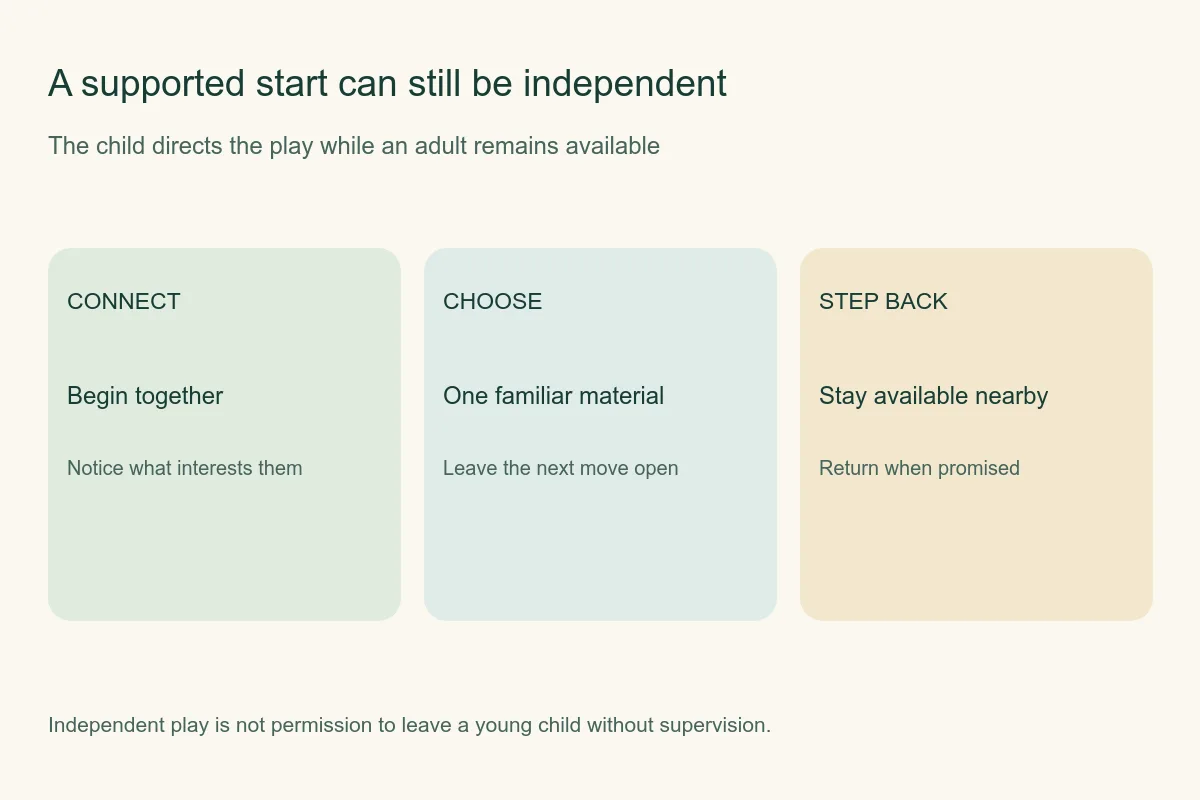
Independent play means the child directs the play without an adult supplying every next move. It can be noisy, active, imaginative, or quiet. It can happen in the same room as a caregiver. It does not mean a young child is ready to stay home alone or that supervision can stop.
A child might turn blocks into a bus station, rearrange toy animals, invent a drawing game, or tell a story aloud. Moving from one idea to another does not automatically mean the play failed. What looks like a scattered collection of objects may have a story that only the child knows.
Ask a useful question before changing anything: “What happens when you try to start?” Perhaps the scissors are difficult to use, the building pieces keep falling, or the child expects a sibling to knock everything down. Those situations need different support. Buying more toys will not necessarily solve any of them.
The American Academy of Pediatrics’ guidance on screen-free play during breaks discusses unstructured time and choosing activities around a child’s interests. It does not set a universal independent-play target by age. Use actual observations rather than a number from another family’s routine.
Prepare a Space for Independent Play for Kids
For independent play for kids, start by making one familiar choice easy to reach. Put a manageable amount of a known material on a tray or low shelf. Keep the rest available through a clear system rather than presenting every toy at once. The aim is a usable space, not an empty room.
Check the setup from the child’s position. Can they open the container, see the pieces, and reach the work surface? Does a puzzle have a place where it can stay unfinished? Can they get a pencil without climbing? A small practical barrier can create repeated calls for help even when the child knows exactly what they want to make.
Explain the boundaries before play: where it happens, which materials need help, and how to find you. Keep sharp tools, cords, small magnets, batteries, and unsuitable small pieces out of the setup. Review the needs of younger siblings who may enter. Independent choice and adult responsibility belong together.
Offer a protected area when siblings have different needs. A table can hold an older child’s work while a younger child uses a separate supervised space. Say which construction may stay up, and help siblings respect it. The older child should not have to entertain or supervise the younger one as the price of having play time.
Five Play Starters That Leave the Next Move Open
1. A cardboard neighborhood
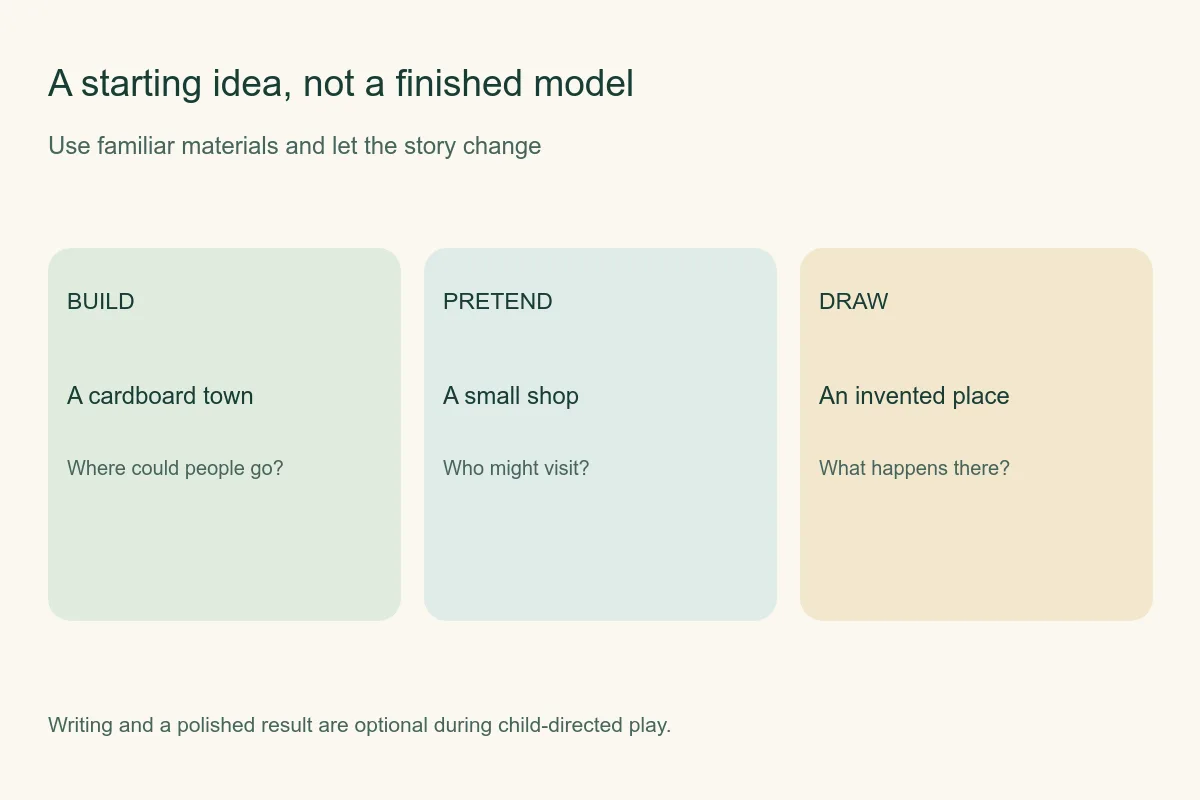
Offer a few clean, pre-opened cardboard boxes, large blocks, paper, and crayons. Remove staples and sharp edges beforehand. Ask, “Where could people go in this neighborhood?” Then let the child choose whether to make roads, homes, a park, or something entirely different.
You can help with one difficult connection, then return control: “I can hold this while you place it.” Avoid drawing the whole town or asking for a finished model. The purpose is a play world that can change, not a craft result to match a photograph.
2. A small pretend shop
Use empty food cartons, a basket, and slips of paper for labels or orders. Choose large items appropriate for everyone in the room. A child can arrange a shop, make deliveries, or change it into a restaurant. Written prices are optional; pictures and spoken orders work too.
Start as a customer if needed, then explain that you will return after doing a nearby task. The child can prepare the next order or invent a different customer. If they want every purchase to involve you, suggest a toy character as a customer rather than adding a complicated worksheet.
3. A drawing world
Place a large sheet on a table and invite the child to create a place where something happens. It could be a dinosaur hotel, an underwater library, or a familiar playground. Give one opening prompt, then stop asking questions unless the child seeks your interest or help.
A child who dislikes drawing can arrange picture cards or tell the story to a toy. Use our writing prompts by age and ability for an occasional starting idea, but keep writing optional during play. The child decides whether the story needs words, marks, movement, or none of those.
4. A build-and-change challenge
Offer familiar large construction pieces and a simple possibility: a shelter for a toy or a parking space for three cars. Once the child begins, avoid adding a harder condition every few minutes. They may spend the whole time redesigning a doorway, which can be a worthwhile direction of their own.
Keep the structure at a safe scale. It should not be climbed, suspended overhead, or used to hold a child. If the material repeatedly needs adult repair, change the material or build a simple base together. A task that needs constant rescue is not yet a useful independent option.
5. A familiar puzzle with an open extension
Choose a puzzle the child can approach with the level of help you can provide. Leave the picture guide visible. Afterward, the child might describe a story about the scene or set up a pretend journey beside it. They may also decide that completing the puzzle is enough.
Keep the choices for independent play for kids modest: “Puzzle or blocks?” is easier to act on than a long list. Our practical indoor activity guide can help you choose an alternative when the first material does not fit. You do not need to rotate the whole room because one afternoon was difficult.
Respond to Calls for Help Without Taking Over
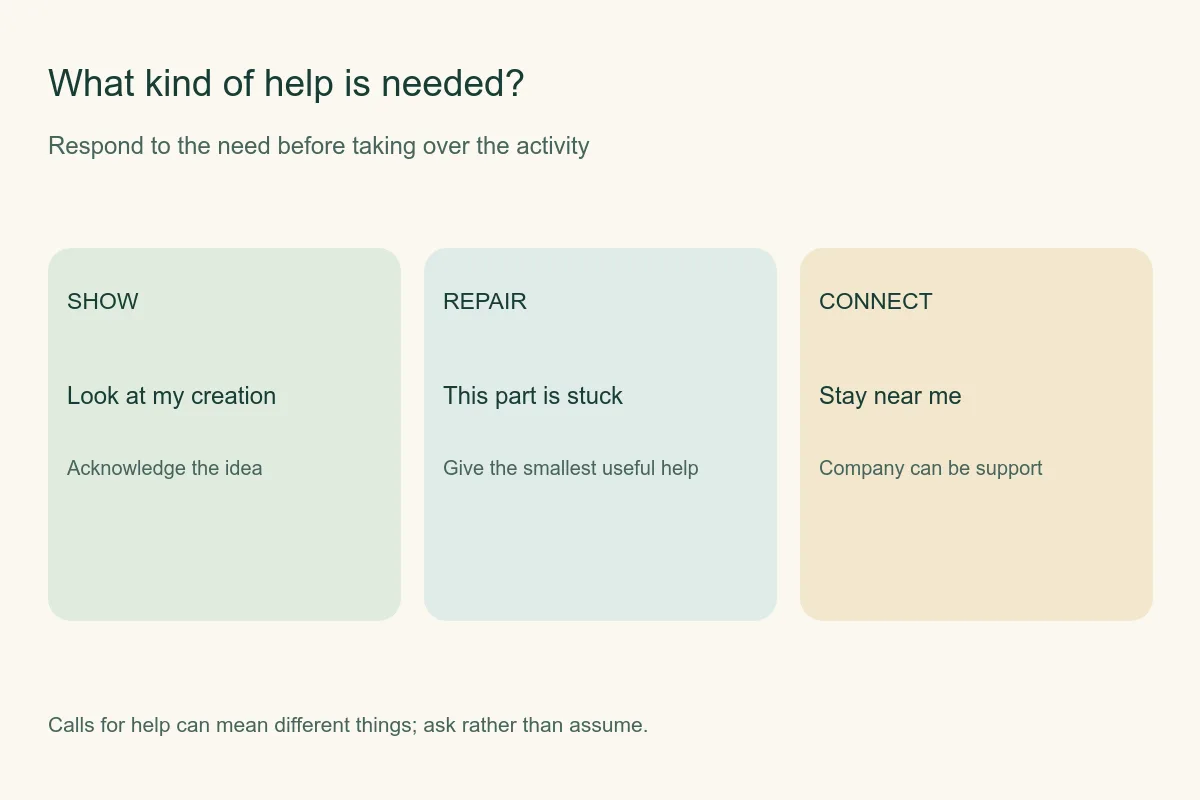
When the child calls, identify what they need. “Are you showing me something, asking for help, or wanting company?” A child may be seeking a brief moment of connection rather than a new activity. Look, respond, and say clearly when you are returning to your nearby task.
Use the smallest useful support. If a box will not stay open, hold it while the child works. If they cannot start a story, offer two possibilities. If they are lonely, sit nearby for a while. The next move should still belong to them whenever possible.
Independent play for kids becomes harder when interruptions repeatedly come from outside the play. Protect a sibling’s project, silence unnecessary notifications, and avoid constant praise or instructions. “That is a long road” can acknowledge a creation without turning it into a performance that requires your attention after every new piece.
If a child repeatedly abandons an activity, notice the pattern before deciding they lack persistence. Is it too difficult, too familiar, physically uncomfortable, or poorly timed? A movement break or a simpler version may help more than insisting they stay seated. Some children need ongoing support; independence can include adaptations rather than the removal of all help.
Build a Routine for Independent Play for Kids
Try a simple sequence: connect, choose, begin together, step back, and reconnect. Tell the child what you will be doing and where you will be. If you offer a timed check-in, make it a promise you can keep. Begin with a manageable interval instead of aiming immediately for a long uninterrupted work session.
The AAP’s low-cost play ideas emphasize familiar materials and parent-child interaction. The routine here is an original planning suggestion, not a prescribed teaching dose. Adjust it for the child’s experience, communication, energy, and need for supervision.
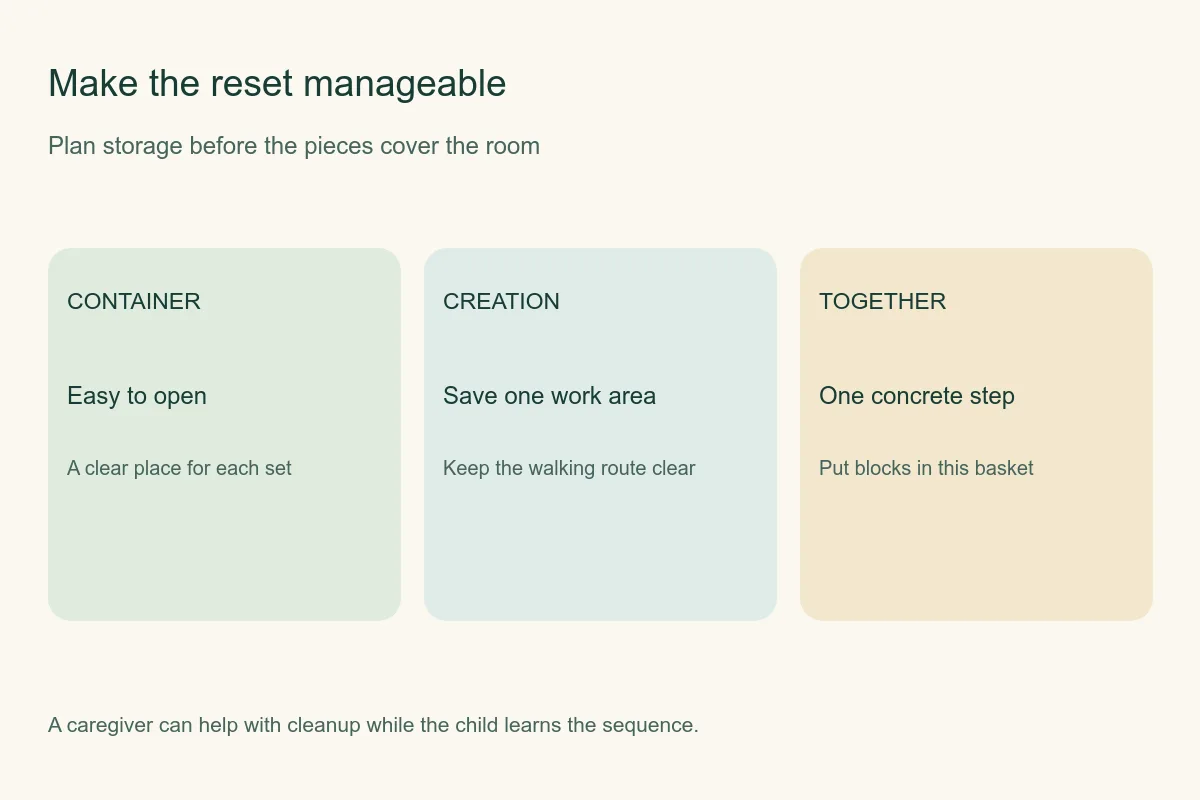
Make cleanup part of the setup. Use containers the child can open and picture labels they can understand. “Put the blocks in this basket” is clearer than “Fix this room.” Work alongside a child who is overwhelmed, and agree on one area that can hold an unfinished creation.
Do not stop a meaningful story every time a second material appears. Instead, agree on the space the play can use and help with the eventual reset. A manageable boundary might be keeping the walking route clear and returning unused materials to their tray. Independence includes learning to organize with support.
Track useful changes in independent play for kids over several attempts: started after one prompt, asked for a specific repair, returned to an unfinished idea, or helped sort pieces. Avoid comparing siblings or using a single difficult day as a verdict. For an occasional new choice, try the screen-free activity finder, then check whether its demands match the support available.
Frequently Asked Questions
How long should a child play independently?
There is no single duration for independent play for kids of the same age. Consider the activity, the child’s interests, recent practice, energy, and the help available. Notice whether they can make some choices and stay involved comfortably. Build from what you observe rather than using another family’s longest play session as a target.
Should I ignore my child when they say they are bored?
Acknowledge the feeling and check for a practical barrier, tiredness, or a need for connection. Offer a small choice or a brief start together if useful. You do not need to invent constant entertainment, but boredom is not a reason to ignore distress, a safety need, or a request the child cannot solve alone.
Does independent play have to happen without screens?
This guide focuses on screen-free play so children have opportunities to create and direct activities using physical materials. Families can make other media choices separately. An audiobook may accompany familiar play, for example. Consider whether a screen supports a chosen activity or takes over every decision, and keep supervision appropriate to the child.
What if a younger sibling keeps interrupting?
Arrange a separate supervised space or a work surface suited to the older child’s materials. Explain which creations may stay untouched, and help the younger child follow that boundary. Choose a time when a caregiver can support both children. The older child’s independent play should not depend on managing the younger sibling.
Make the First Step Easy to Repeat
Independent play for kids grows more useful when the start is clear, the materials are manageable, and a caregiver remains available. Choose one familiar option, give enough help to begin, and let the child decide what happens next. Protect the play from avoidable interruptions, then share cleanup in concrete steps. Keep one note about the support that helped. Tomorrow, offer the same material again before assuming you need something new. A child returning to their own idea is a useful outcome, even when the room is lively and the play period is brief.