
Short vowel activities help children notice the small sound change that turns cap into cup or pet into pit. A child may know the consonants, look carefully at a word, and still choose the wrong middle sound. Instead of adding a longer word list, give that middle vowel a clear job: listen for it, connect it to a letter, and check how changing it changes the word.
This guide focuses on short vowel contrasts, not on teaching the whole decoding process again. You will find five practical activities, an original sorting set with answers, ways to handle accent differences, and a flexible plan for deciding what to practice next. Begin with familiar spoken words and only the spellings your child has already been taught.

Short Vowel Activities: Start With One Useful Contrast
In beginning phonics, the familiar short vowel examples are a in cat, e in bed, i in sit, o in hot, and u in sun. Use these as example words, not a claim that every occurrence of a vowel letter makes that sound. English spellings change across patterns and words.
The word “short” is a teaching label. Asking a child to pronounce a vowel more quickly does not turn a long vowel into a short one. Model the intended sound in a familiar word instead of giving an abstract instruction about how long the child should speak.
Choose one contrast that appears in your child’s actual reading. If they read cap as cup, start there. Do not automatically introduce all five vowels because there are five columns on a worksheet. Two well-chosen categories are enough to observe whether the child hears and recognizes the difference.
If joining sounds is the main difficulty rather than distinguishing the vowel, use our CVC blending practice guide first or alongside this work. The two goals connect, but they are not identical: a child might hear the difference between two spoken words while still needing a model to decode either one.
The What Works Clearinghouse foundational reading guide supports connecting speech sounds with letters and teaching decoding and writing. The games here are original home-practice examples of those broad ideas, not a separately tested intervention or a guaranteed teaching schedule.
Listen to the Middle Sound Before Adding Printed Choices
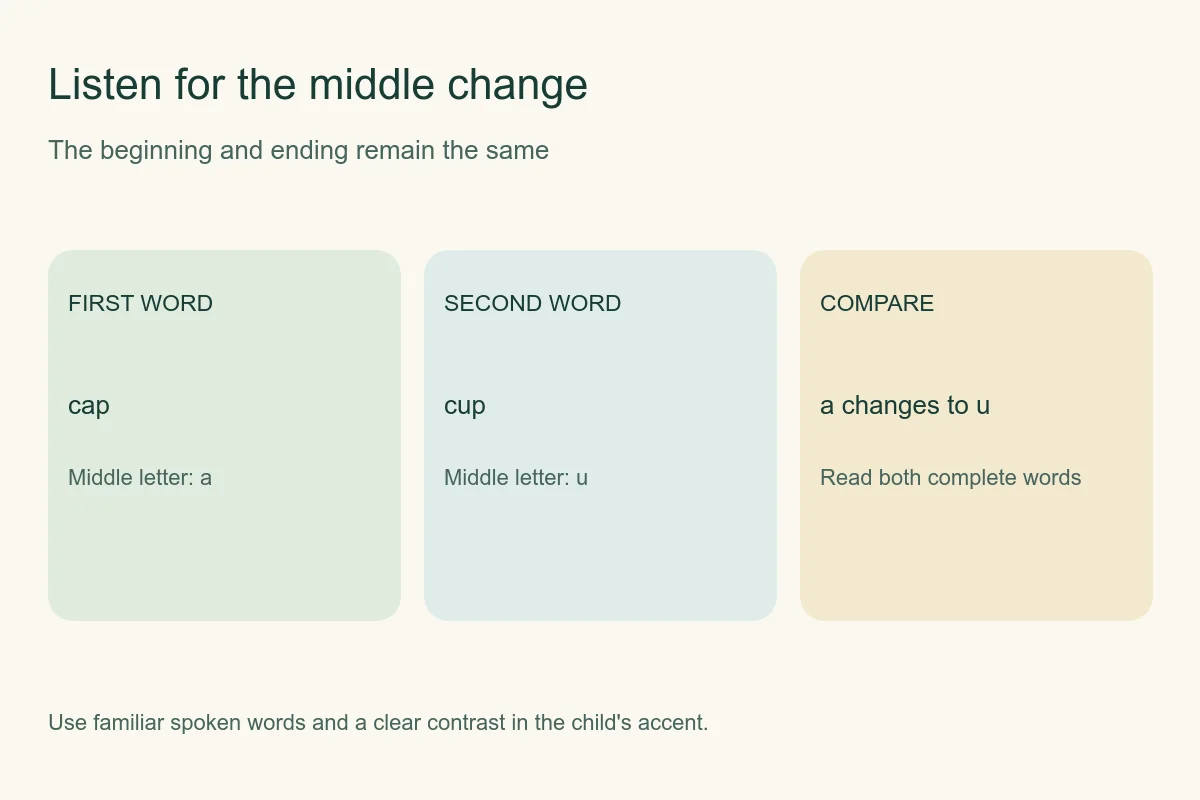
Say two familiar words naturally: “cap, cup.” Explain both meanings and use a picture or real object if needed. Then say one word and invite the child to point to its picture. You are checking whether the spoken contrast is clear before asking them to identify a printed vowel.
Next, say the words again while paying attention to the middle sound. Keep your pronunciation natural and avoid adding an extra “uh” after consonants. If you overexaggerate every sound, the child may hear a version of the word that is different from ordinary speech.
Use your family’s accent and coordinate with the sound model in your child’s teaching materials. Some accents merge particular vowel contrasts, including pin and pen in some contexts. If two words sound the same in your speech, choose a different pair instead of treating a dialect feature as a child’s mistake.
For an initial listening activity, the child can point, gesture, or move a paper card. A written answer is not necessary. Keeping handwriting out of this first step helps you notice whether the task is about hearing the contrast, recognizing the letter, or managing both at once.
Five Short Vowel Activities to Try at Home
1. Two-picture listening choice
Draw a cap and a cup on separate cards. Name both pictures so there is no uncertainty about your drawings. Say one word without showing its spelling and ask the child to choose the picture. Take turns being the speaker. After a few supported examples, mix the order so the answer is not always on the same side.
Keep the contrast consistent for this short game. Adding cape immediately introduces a different spelling pattern and changes the lesson. You can explore silent-e later, but it does not need to become part of the first short-a versus short-u activity.
2. Middle-letter switch
Write cap with the middle letter on its own paper tile. Read it together, replace a with u, and read cup. Ask, “Which letter changed? What changed in the spoken word?” Leave the beginning and ending in place so the vowel receives the attention.
Then let the child give you an instruction: “Make cup into cap.” Read the result rather than assuming that moving a card proves the word was understood. If the child is not yet reading the whole word independently, provide a shared model without making the tile activity a test.
3. Anchor-word sort
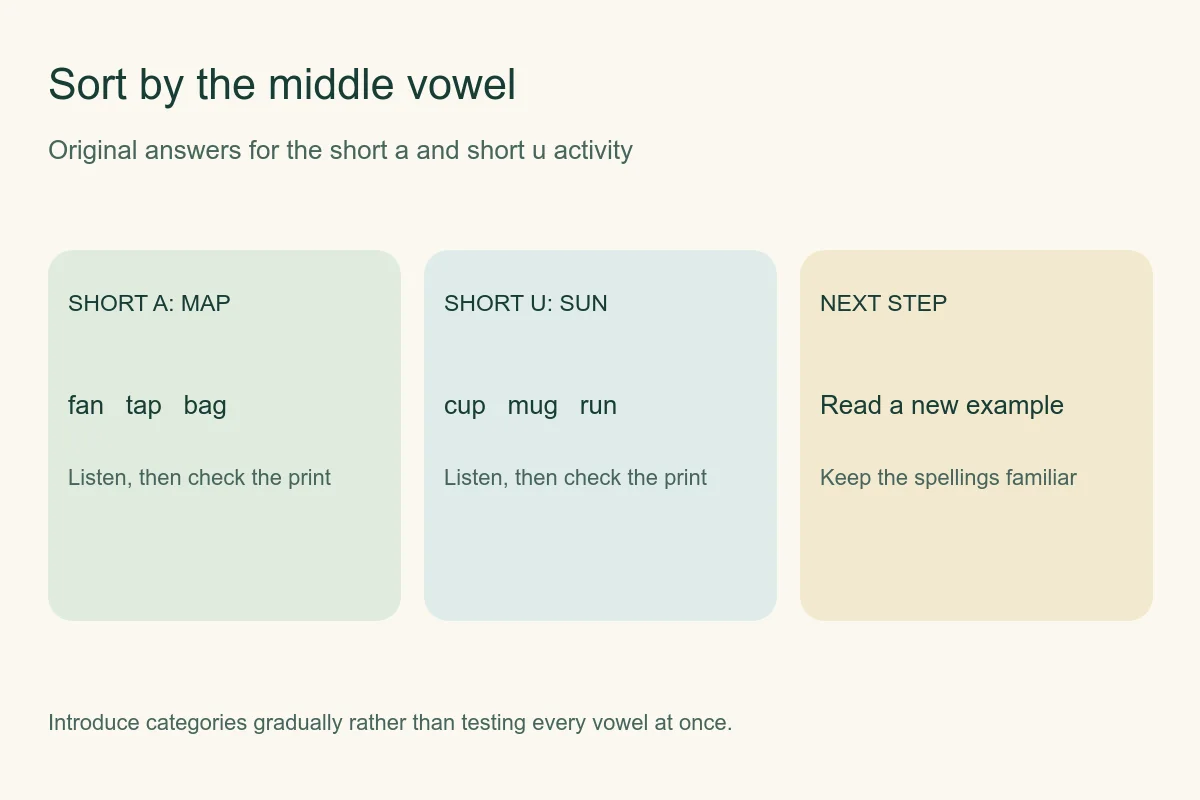
Make two heading cards using familiar anchor words, such as map and sun. Read a small mixed set and sort each word by its middle vowel sound. Include words with different beginnings and endings so that sorting cannot depend only on matching the first consonant.
After the listening sort, reveal or write the words and connect the middle sound to the letter. The University of Florida Literacy Institute word-work resources offer additional decoding and spelling activities, including short-vowel practice formats. Select materials that match your child’s taught patterns.
4. Fill the missing middle
Write m_p and say “map.” Offer the letters a and u. The child chooses a letter, builds the word, and reads it back. Explain the intended word before asking for an answer: a blank frame by itself can have more than one possible completion.
Move from a choice of two to writing the vowel only when the first task is manageable. If you want more writing later, use our short handwriting practice routine as a separate session. A large amount of copying is not required to make a useful vowel comparison.
5. Spoken-word detective
Choose one target vowel and listen for it in a small set of words you say aloud. For short i, try sit, map, pig, and sun. The child signals when they hear the target sound. Then look at the spellings of the matching words together.
Around the house, name an object before using it in the game. A picture of a cup might be called a mug, and that changes the sounds under discussion. The goal is to examine a known spoken word, not to guess which label the adult had in mind.
An Original Short Vowel Practice Set With Answers
Use this on-page set orally or copy the words onto scrap paper. It is not a separate downloadable worksheet. Begin with the first two categories, then add the others only when their vowel spellings have been taught. Read directions aloud so that understanding the task does not depend on independent reading.
Task A: sort short a and short u
Sort these words under the anchors map and sun: cup, fan, mug, tap, run, bag. Ask the child to explain one choice by pointing to the middle letter and saying the word, rather than requiring an explanation after every card.
Answers: Short a: fan, tap, bag. Short u: cup, mug, run. If the child sorts accurately by sound but cannot name the vowel letter, make that sound–letter connection the next teaching step.
Task B: complete a spoken word
- You say “pet.” The child chooses the middle letter in p_t from e or i.
- You say “sit.” The child chooses the middle letter in s_t from a or i.
- You say “hot.” The child chooses the middle letter in h_t from o or u.
- You say “bug.” The child chooses the middle letter in b_g from a or u.
Answers: 1: e, making pet. 2: i, making sit. 3: o, making hot. 4: u, making bug. In each case, the adult’s spoken word supplies the intended meaning; the incomplete spelling alone is not the question.
Task C: find what changed
Read cap → cup, pet → pit, and hot → hut. For each pair, identify the changed letter and explain that the beginning and ending remain the same. Use only pairs that are clearly distinct in the child’s accent. These are reading comparisons, not instructions to teach all vowel contrasts in one sitting.
Move From Vowel Choices to Meaningful Reading
After a successful sort, use one selected word in a short message. For example, “A cup is on a mat” includes short-u and short-a examples, but also includes other spellings. Check each word against your child’s current instruction and supply unfamiliar words rather than asking them to guess.
Read the message, then discuss its meaning or sketch it together. Ask a focused question such as “Where is the cup?” A correct vowel choice is useful, but the wider purpose is reading a message that makes sense. Do not let an entire session become a search for colored vowel letters.
Our phonics workbook can provide further pages to inspect for an appropriate match. Look at the actual spelling demands before choosing a page. A “kindergarten” label does not guarantee that every word uses only the patterns your child already knows.
When short-vowel words become more secure, the blends and digraphs guide explains a different next step: reading consonant groups without dropping sounds. Later, use our reading fluency activities to work on connected text, phrasing, and meaning. You do not need to rush through these stages on a fixed timetable.
A Flexible Week of Short Vowel Practice
Think in repeated opportunities rather than a new vowel every day. Here is an example sequence for one selected contrast. Each session can be brief, and the same step can be repeated if it still needs support.
- First session: Name the pictures and model the spoken contrast. Let the child make a few listening choices.
- Next session: Revisit the same spoken words and add the matching printed vowels.
- Another session: Change the middle letter in one familiar word and read both versions.
- Later: Mix a small set, include a new example using known spellings, and use a word in a message.
- Review: Note the support needed and decide whether to repeat, reduce, or extend the contrast.
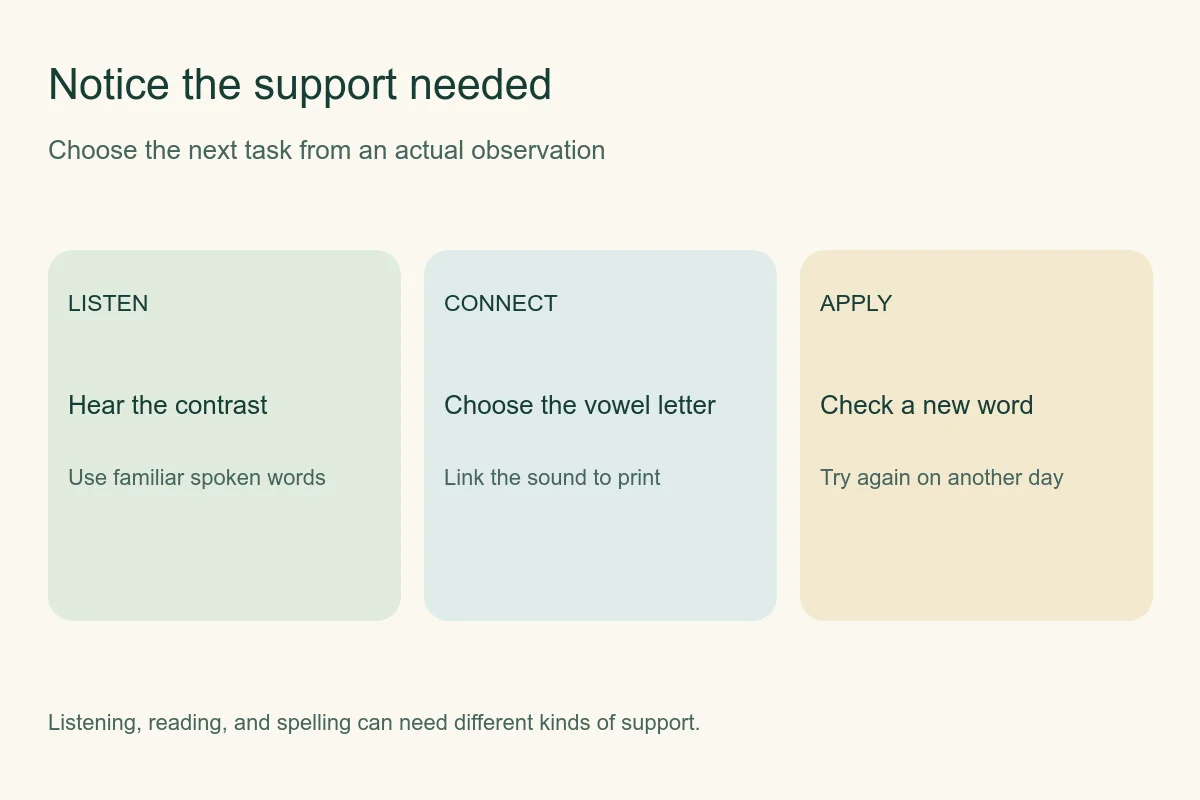
Record one concrete observation: “Sorted cap and cup after a model; chose a independently in map.” Avoid writing only a percentage or “vowels done.” The distinction between copied, prompted, and independent responses helps you choose the next activity more accurately.
Do not interpret a familiar sort as proof that the child can apply the vowel in any word. Try a new, accessible example on another day. Keep the spelling pattern controlled while changing the context, so that the review checks the intended skill rather than several new challenges at once.
What to Change When Vowel Practice Stalls
If the child sorts by the first letter, choose examples with the same outside consonants, such as cap and cup, and model attention to the middle. If they remember where a card belongs without reading it, change the positions and introduce one new example.
If listening is accurate but selecting a letter is hard, reduce the printed choices and explicitly connect the spoken vowel with its letter. If reading is accurate but spelling is difficult, provide the outside letters and practice only the middle choice before asking for a whole written word.
If frustration rises, shorten the activity or return to shared examples. Avoid correcting an accent difference or demanding a particular mouth position from a generic online instruction. This guide teaches literacy practice, not speech therapy, and it cannot identify the cause of a persistent difficulty.
When the same difficulty continues across well-supported sessions, share your notes with the child’s teacher or a qualified reading specialist. Describe the task and the help that worked. You can seek advice without assigning a diagnosis or waiting for the child to struggle through increasingly long pages.
Frequently Asked Questions
Should we teach all five short vowels together?
Not necessarily. Begin with a manageable set that fits the child’s instruction. One clear contrast can reveal more than a large mixed page. Add other taught vowels gradually and return to mixed review when the individual examples are familiar.
Are short vowels simply vowels said quickly?
No. In beginning phonics, “short vowel” names a familiar sound category, such as the vowel in cat or sit. Speaking a different vowel faster does not make it the intended short sound. Use a clear example word.
What if two example words sound the same in our accent?
Choose a different word pair and use the family’s natural pronunciation. Coordinate with the child’s teaching materials. A dialect difference should not be treated as an incorrect response to a listening task.
Does every vowel activity need a worksheet?
No. Picture choices, paper-letter changes, and spoken-word games can all provide useful practice. Add print to connect sounds with spellings, and use writing when it serves the learning goal rather than simply increasing the amount of work.
Start small: Choose a contrast your child actually needs, name the words clearly, and connect the middle sound to its letter. Then read the word in a meaningful message. A few careful observations will help you plan the next step better than a page full of guesses.
One Response